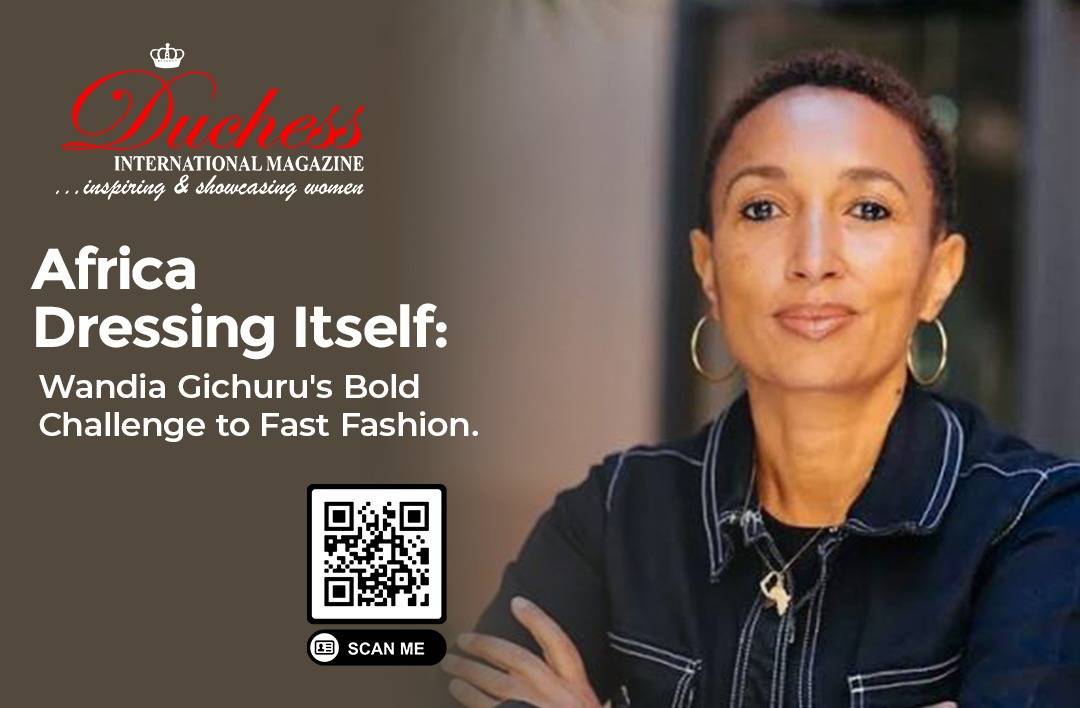
There is a question hiding in plain sight across much of Africa. Walk through shopping malls, browse online stores, or step into bustling markets and you will find clothing designed in London, Paris, Milan, New York, or Shanghai. For decades, Africans have worn garments imagined elsewhere, produced elsewhere, and often marketed through someone else’s idea of style and aspiration. Yet Africa is home to some of the world’s richest textile traditions, most dynamic creative industries, and fastest-growing consumer markets. The contradiction is difficult to ignore. Why does a continent filled with designers, artisans, manufacturers, and entrepreneurs still rely so heavily on fashion created beyond its borders? Few people have challenged that question more boldly than Kenyan entrepreneur Wandia Gichuru, whose career has become a powerful argument for an Africa that not only consumes fashion but creates it on its own terms.
Today, Gichuru is widely recognized as the co-founder and CEO of Vivo Fashion Group, one of East Africa’s most successful fashion brands. But the story of Vivo is not simply a business success story. It is the story of a woman who chose reinvention over certainty. Before becoming a fashion entrepreneur, Gichuru spent years building a career in corporate and development sectors, including working in the United Kingdom. Like many professionals, she had followed a path that appeared stable, respectable, and predictable. Fashion was not the obvious next step. In fact, there was little to suggest that she would eventually become one of the most influential voices in African fashion entrepreneurship. Yet the most significant careers are often built not by following expectations but by questioning them.
When Gichuru eventually returned to Kenya, she encountered a reality that many African consumers knew well. Finding clothing that genuinely reflected modern African lifestyles was surprisingly difficult. International brands often treated African consumers as an afterthought, while local fashion businesses frequently struggled with scale, consistency, and visibility. Women were left choosing between imported styles that did not always reflect their needs and local options that were often underserved by investment and infrastructure. To many people, this was simply the way things were. Gichuru saw something different. She saw an opportunity hidden inside a problem.
That insight led to the creation of Vivo in 2011. From the beginning, the company was built around a deceptively simple idea: African women deserved clothing designed with them at the center of the conversation. Not as an extension of another market. Not as consumers expected to adapt to global trends. But as customers whose tastes, body types, lifestyles, and aspirations were worthy of direct attention. It sounds obvious today, but it was a significant departure from an industry where many fashion trends flowed in a single direction—from global fashion capitals outward. Vivo represented a quiet challenge to that model. Instead of asking African consumers to fit into someone else’s vision, it asked what fashion would look like if African women became the starting point.
What makes Gichuru’s journey especially compelling is that she entered an industry dominated by enormous global forces. Fast-fashion giants operate on a scale that allows them to produce clothing quickly, distribute it internationally, and compete aggressively on price. At the same time, African markets have long been shaped by large volumes of imported clothing and second-hand garments arriving from abroad. Competing against those realities required more than creativity; it required conviction. Gichuru understood that fashion is not merely a transaction. People do not buy clothes solely because they are affordable. They buy them because clothing communicates identity, confidence, belonging, and self-expression. If African consumers could see themselves reflected in the products being offered, local brands could compete on something deeper than price alone.
Beneath the business strategy was an even larger idea. For decades, conversations about Africa’s economic future have often focused on exports, resources, and foreign investment. Gichuru’s work highlights another possibility: the power of creating value within African markets themselves. Every garment designed, produced, marketed, and sold locally represents more than a fashion choice. It represents jobs, skills, entrepreneurship, manufacturing, and creative ownership. In this sense, her work is not simply about clothing. It is about building ecosystems. It is about proving that African businesses can create products that meet global standards while remaining deeply connected to local realities.
There is also a cultural dimension to her story that makes it particularly relevant today. Fashion has always been about more than appearance. It reflects how societies see themselves and how they wish to be seen. For generations, many definitions of style, beauty, and sophistication were shaped by external influences. African designers frequently found themselves navigating an industry where validation often came from abroad. Gichuru’s success challenges that dynamic. Through Vivo, she has demonstrated that African consumers do not need permission from international fashion capitals to define what elegance, professionalism, or contemporary style should look like. Those definitions can emerge from Nairobi, Lagos, Accra, Kigali, or Johannesburg just as easily as they can from Paris or Milan.
What separates Gichuru from many entrepreneurs is the nature of the question she chose to ask. Many business leaders begin by studying what is already successful and trying to replicate it. Gichuru focused on what was missing. She paid attention to a gap that others had learned to accept. That mindset is often what distinguishes transformative leaders from successful operators. Transformative leaders do not simply improve existing systems; they challenge assumptions that people no longer notice. In her case, the assumption was that African consumers would always depend on fashion designed elsewhere. By building a brand around a different possibility, she helped prove that assumption was not inevitable.
Ultimately, Wandia Gichuru’s story is about much more than fashion. It is about confidence—personal, commercial, and continental. It is about rejecting the idea that value must come from elsewhere before it can be recognized at home. It is about understanding that industries are shaped by the people willing to imagine alternatives. For decades, Africa has largely been positioned as a consumer within the global fashion conversation. Gichuru’s career points toward a different future—one where African brands are not merely participating in the industry but helping define it. Through Vivo, she has built more than a company. She has helped advance a larger belief: that Africa’s future will increasingly be shaped by what it creates for itself. The question is no longer whether Africa can dress itself. The question is how far African fashion can go when it fully believes in its own vision.