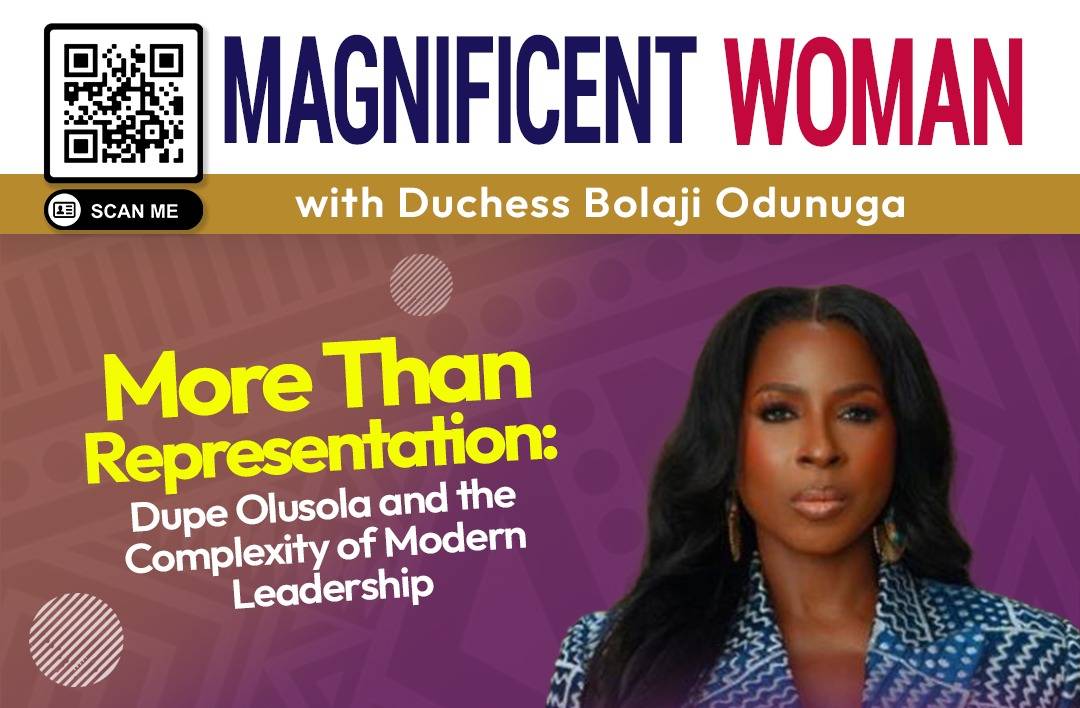
Some careers are built by going deeper into one field. Others become remarkable because of how far they are willing to travel. Dupe Olusola’s professional journey belongs to the second category. Over more than two decades, she has worked across financial markets, investment, agribusiness, banking, marketing and hospitality, moving from one demanding business environment to another and taking on responsibilities that required more than simply carrying forward an impressive title. Her career has included roles with Bloomberg Financial Markets UK, Northern Trust, SecTrust, African Capital Alliance, United Bank for Africa and Transcorp, as well as leadership of Teragro Commodities and Transcorp Hotels. That range is important because every transition required her to understand a different business, a different set of stakeholders and a different route to creating value. Her story is therefore less about climbing one corporate ladder and more about building the capacity to navigate several.
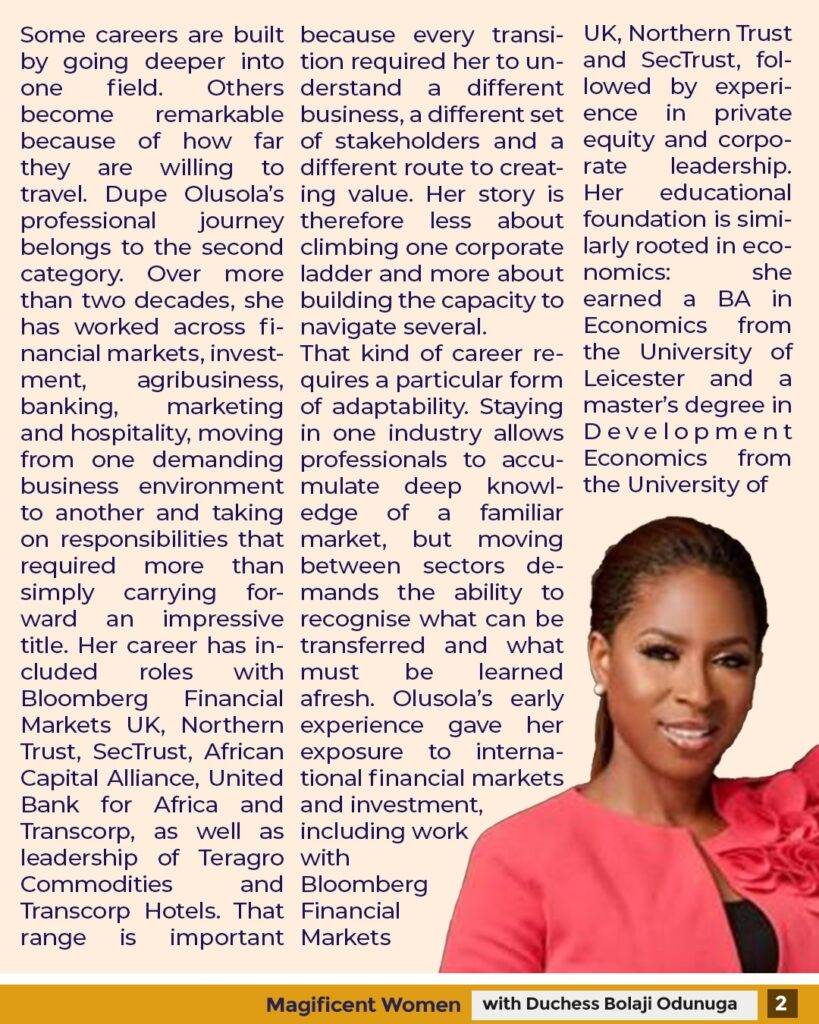
That kind of career requires a particular form of adaptability. Staying in one industry allows professionals to accumulate deep knowledge of a familiar market, but moving between sectors demands the ability to recognise what can be transferred and what must be learned afresh. Olusola’s early experience gave her exposure to international financial markets and investment, including work with Bloomberg Financial Markets UK, Northern Trust and SecTrust, followed by experience in private equity and corporate leadership. Her educational foundation is similarly rooted in economics: she earned a BA in Economics from the University of Leicester and a master’s degree in Development Economics from the University of Kent. United Bank for Africa’s records also describe her as having worked across international markets and diverse industries, with experience spanning finance, agribusiness and business development. Her career illustrates how professional range can become an asset when each chapter adds a new way of understanding how organisations operate.
One of the clearest examples came through her work in agribusiness. As CEO of Teragro Commodities, a Transcorp subsidiary, Olusola was involved in repositioning the business and developing its relationship with major corporate partners. UBA’s corporate profile records her leadership of an agribusiness subsidiary that spearheaded a partnership with Coca-Cola to produce Five Alive Pulpy Orange Juice, making it the sole local concentrate producer. The significance of that experience goes beyond the partnership itself. Agribusiness demands an understanding of production, supply, partnerships, markets and commercial sustainability—concerns that are quite different from those of financial markets. It meant operating beyond the professional language of finance and dealing with the realities of building a business around a physical product and a supply chain. For a career that would later move into hospitality, the experience added another dimension to her understanding of how businesses create and deliver value.
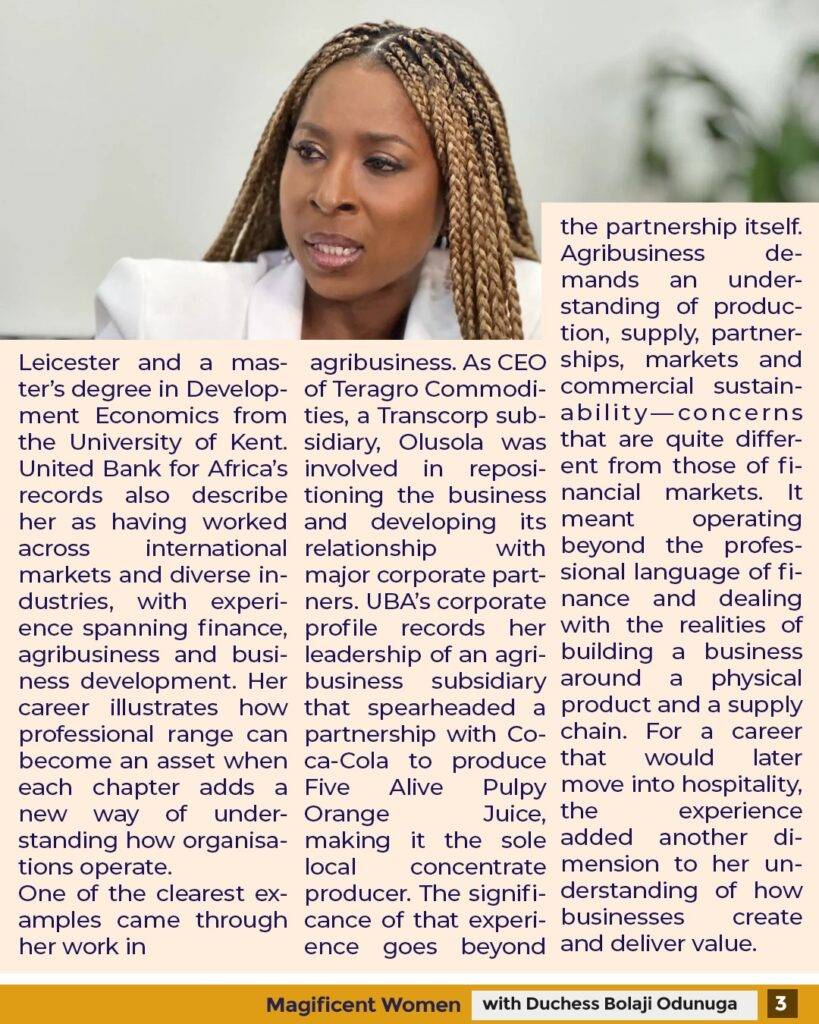
Her years at UBA expanded that range again. Before becoming Group Head of Marketing, Olusola served as Group Head of Embassies, Multilaterals and Development Organisations and Global Investors Services. UBA records credit her leadership in those areas with expansion of the bank’s engagement in the sector across Africa and beyond. She later became Group Head of Marketing, responsible for developing and delivering integrated marketing strategy across UBA’s banking and non-banking subsidiaries. The move is significant because marketing at that level is not simply about publicity or campaigns; it sits at the intersection of brand, customer understanding, business strategy and market positioning. Her experience therefore continued to widen. Finance gave her one lens, investment another, agribusiness another, and institutional banking and marketing added further perspectives. By the time she moved into hospitality leadership, she was carrying an unusually broad understanding of how businesses engage customers, partners, markets and institutions.
In March 2020, Olusola became Managing Director/Chief Executive Officer of Transcorp Hotels. The timing placed her in one of the most difficult periods the hospitality industry had faced in generations, as the COVID-19 pandemic disrupted travel, tourism and hotel operations around the world. Yet her tenure cannot be reduced to crisis management. Transcorp Hotels’ own reporting during her leadership points to an ambition to expand the business and establish new benchmarks in the hospitality sector, while her tenure also included the development and growth of Aura, the company’s digital hospitality platform. By the end of 2024, the company’s annual report still listed Olusola as Managing Director/CEO, marking the close of a significant chapter in her corporate career. What stands out is not simply that she led a major hospitality company, but that she arrived there after building experience in sectors that at first glance appear far removed from hotels and tourism.
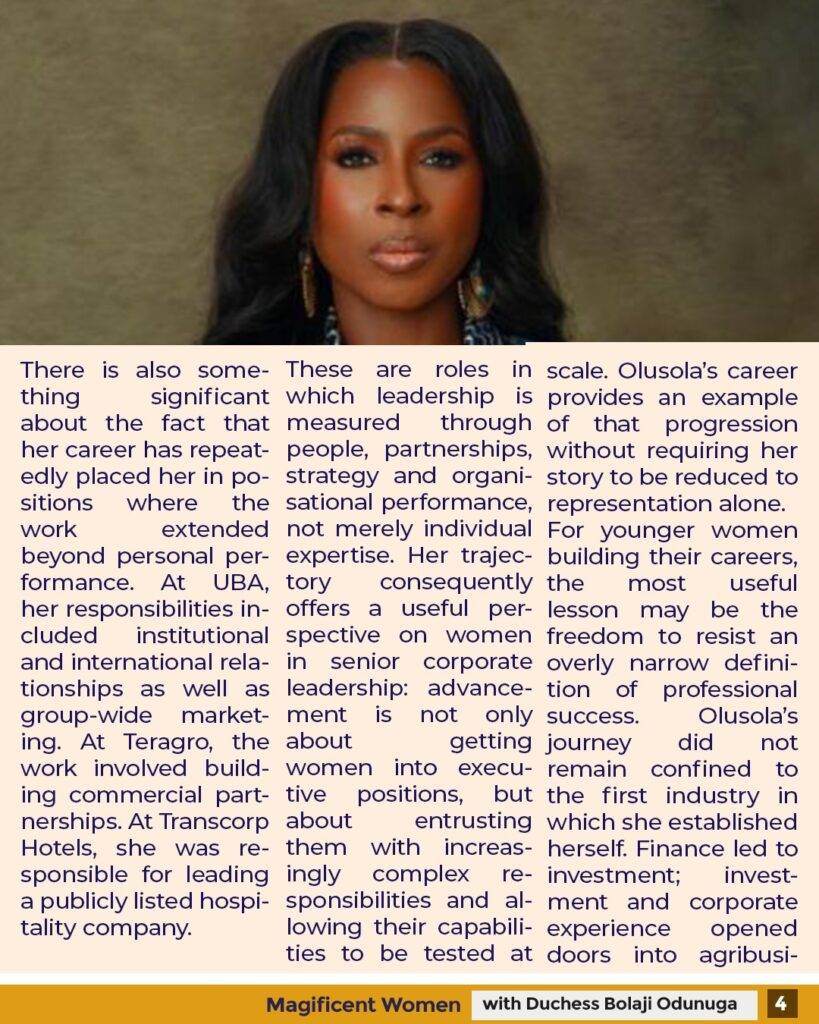
That journey makes her career particularly useful to examine through the lens of modern leadership. Financial services, agribusiness, banking, marketing and hospitality operate differently, but the senior executive questions underneath them are often connected: Where is the opportunity? What are the risks? What do customers or stakeholders need? How should resources be deployed? What has to change, and what must remain consistent? Olusola’s career suggests that leadership experience does not have to become obsolete when a person changes industries. Instead, previous experience can provide a framework for approaching new problems, while the new environment forces the leader to keep learning. Her professional breadth is therefore not simply a collection of unrelated roles. It represents an accumulation of perspectives, each one adding another dimension to how she approaches business and leadership.
There is also something significant about the fact that her career has repeatedly placed her in positions where the work extended beyond personal performance. At UBA, her responsibilities included institutional and international relationships as well as group-wide marketing. At Teragro, the work involved building commercial partnerships. At Transcorp Hotels, she was responsible for leading a publicly listed hospitality company. These are roles in which leadership is measured through people, partnerships, strategy and organisational performance, not merely individual expertise. Her trajectory consequently offers a useful perspective on women in senior corporate leadership: advancement is not only about getting women into executive positions, but about entrusting them with increasingly complex responsibilities and allowing their capabilities to be tested at scale. Olusola’s career provides an example of that progression without requiring her story to be reduced to representation alone.
For younger women building their careers, the most useful lesson may be the freedom to resist an overly narrow definition of professional success. Olusola’s journey did not remain confined to the first industry in which she established herself. Finance led to investment; investment and corporate experience opened doors into agribusiness and banking; marketing and institutional banking became part of a wider leadership portfolio; and those experiences eventually fed into hospitality. That does not mean every professional needs to change industries to succeed. It means that a career can be strengthened by deliberately collecting experiences that expand judgment, commercial understanding and the ability to work with different kinds of people and problems. A new role does not always have to look like a promotion on paper to be valuable. Sometimes its greatest value is what it teaches you to do next.
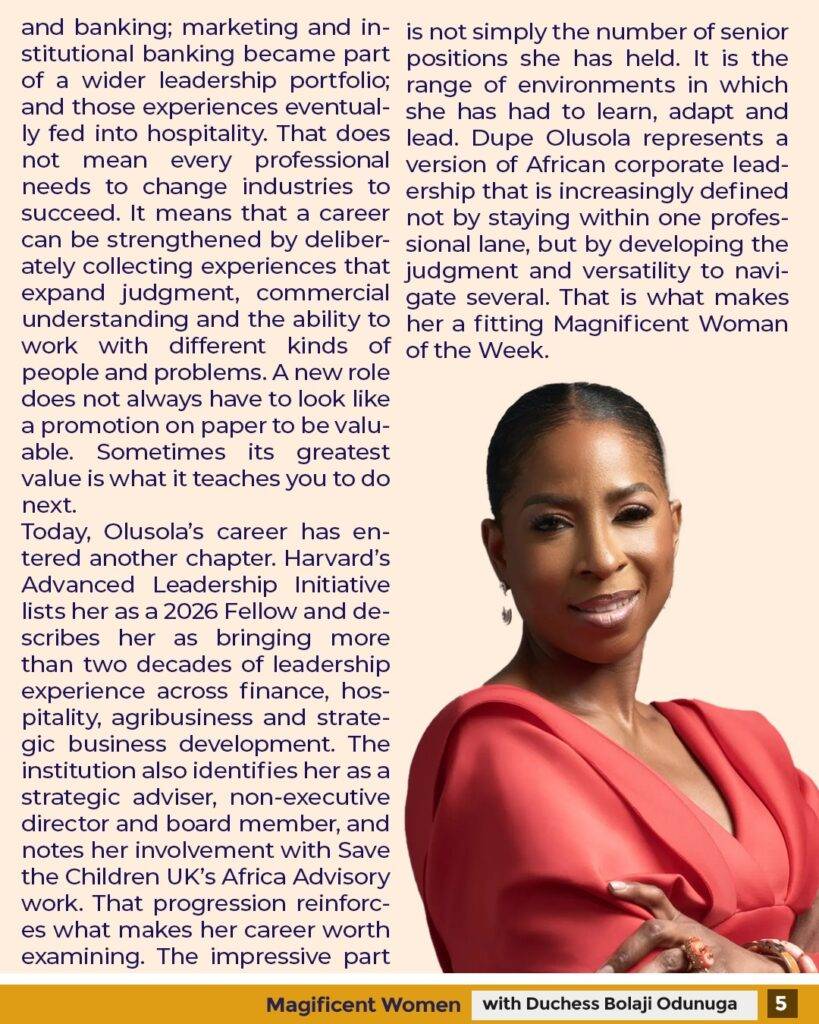
Today, Olusola’s career has entered another chapter. Harvard’s Advanced Leadership Initiative lists her as a 2026 Fellow and describes her as bringing more than two decades of leadership experience across finance, hospitality, agribusiness and strategic business development. The institution also identifies her as a strategic adviser, non-executive director and board member, and notes her involvement with Save the Children UK’s Africa Advisory work. That progression reinforces what makes her career worth examining. The impressive part is not simply the number of senior positions she has held. It is the range of environments in which she has had to learn, adapt and lead. Dupe Olusola represents a version of African corporate leadership that is increasingly defined not by staying within one professional lane, but by developing the judgment and versatility to navigate several. That is what makes her a fitting Magnificent Woman of the Week.