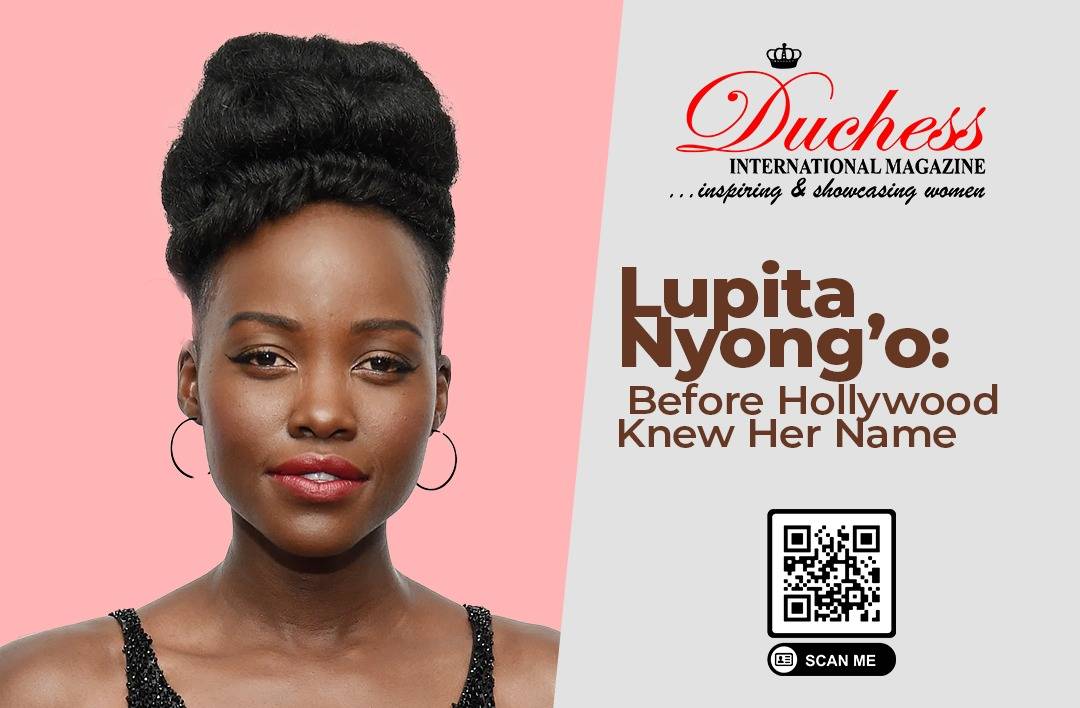
Before the Oscar, before the red carpets, before Black Panther and Star Wars turned her into one of the most recognizable faces in global cinema, Lupita Nyong’o was a girl trying to figure out whether the thing she loved most was even a viable life. Her story is not one of overnight discovery. It is the story of a woman who quietly built the foundation for her career for nearly two decades before most of the world ever learned her name.
She was born in Mexico City in 1983, an unlikely birthplace for a Kenyan actress, but one shaped entirely by politics rather than coincidence. Her father, Peter Anyang’ Nyong’o, was a Kenyan politician and academic who had fled the country with his family to escape government harassment, later becoming a visiting lecturer in political science in Mexico. The family returned to Kenya when Lupita was four, though the political tension that had sent them away in the first place did not fully disappear, her family continued to face scrutiny under Daniel arap Moi’s government even after coming home. She grew up mostly in Nairobi, holding, even then, an identity that stretched across two continents before she ever left home for good.
The first spark came early, and by her own account, almost by accident. At fourteen, she landed the role of Juliet in a Kenyan stage production of Romeo and Juliet, after years of being what she has described as simply a village girl performing in school shows. “I just came to life on stage,” she has said of that first taste of performing, “I just loved it so much.” It is a small detail, but a telling one: long before Hollywood offered her anything, a teenage production in Kenya had already shown her what she wanted to chase.
That chase, however, did not run in a straight line. Kenya’s entertainment industry in the 1990s offered little in the way of a stable career path, and Nyong’o has spoken candidly about how thin that path looked from where she stood: entertainers in Kenya were not financially secure, and most had to hold other work simply to get by. When she left for the United States to attend Hampshire College in Massachusetts, she pursued film and African studies rather than acting itself, a choice that reflected a very practical uncertainty rather than a lack of passion. She still gravitated toward the industry however she could, working as a production assistant on films shot partly in Kenya, including Fernando Meirelles’s The Constant Gardener in 2005.
It was on that set that one of the more pivotal, if brief, moments in her pre-fame story occurred. Working alongside Ralph Fiennes, she admitted, shyly, that she too wanted to act. His response was blunt rather than encouraging in the conventional sense: “Lupita, only act if you can’t breathe without it,” he told her. It was not a rejection, but it was not comfort either. It was the kind of warning that either sends a person running from a dream or convinces them the dream is worth the risk. For Nyong’o, it clearly did the latter, even if the realization took a few more years to fully take hold.
Back in Kenya, she found a different kind of visibility first, joining the cast of Shuga, an MTV-produced Kenyan and Nigerian television series aimed at spreading HIV awareness among young audiences across the continent. It gave her real, if regional, recognition and acting experience, but it also sat alongside a quieter, more private reckoning. She has described that period plainly as a kind of career crisis, a moment of genuinely asking herself what her life was actually about, and concluding that she would deeply regret never trying to become a professional actor.
That reckoning led her to apply to the best acting programs she knew, and she was accepted into the Yale School of Drama’s demanding MFA program, graduating in 2012. It was there, playing roles in productions of The Winter’s Tale, Uncle Vanya, and The Taming of the Shrew, that she quietly built the technical foundation that would carry her into her first film role. Notably, she has said she was not a particularly strong history student growing up, a small, human detail that makes what came next feel less like inevitability and more like disciplined, hard-won craft.
The break, when it finally came, arrived almost too fast to process. She was cast as Patsey in Steve McQueen’s 12 Years a Slave just three weeks before she graduated from Yale, stepping directly from a classroom into one of the most acclaimed films of the decade. She has said, candidly, that she never imagined being involved in a project of that scale immediately after drama school. What looked, to audiences meeting her for the first time in 2013, like a sudden arrival was in fact the final beat of a story that had already been unfolding for nearly two decades, through a teenage Juliet in Nairobi, a film studies degree chosen out of practicality, a blunt piece of advice from Ralph Fiennes, and a quiet crisis of purpose that sent her back to school one more time.
What makes Lupita Nyong’o’s pre-fame years worth telling is precisely how ordinary the uncertainty in them was. There was no guaranteed path, no early sign from the industry that she would become a global name, only a series of small, deliberate choices made by a woman who kept returning to the one thing she loved even when the odds and the economics around her offered little encouragement to do so. Hollywood did not discover Lupita Nyong’o. It simply caught up to a career she had already been quietly building the entire time.