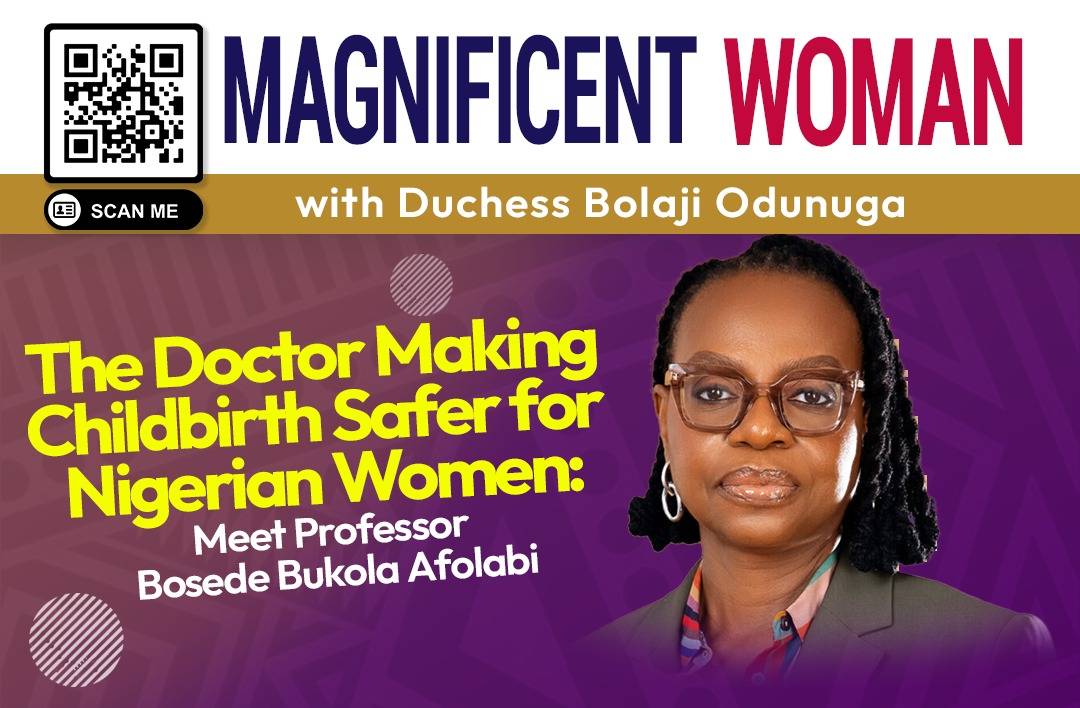
This week, Duchess International Magazine recognizes Professor Bosede Bukola Afolabi as our Magnificent Woman of the Week, for her decades-long dedication to making childbirth safer for Nigerian women and advancing maternal health research across the country.
Every year, thousands of Nigerian women lose their lives to complications that, in a better-resourced healthcare system, would never have become fatal in the first place. Nigeria carries one of the highest maternal mortality burdens in the world, a statistic so large it can start to feel abstract, a number rather than a series of individual women who did not survive childbirth. Professor Bosede Bukola Afolabi has spent more than two decades refusing to let that statistic stay abstract, building a career squarely around the question of how to make pregnancy and delivery safer for the women who need it most.
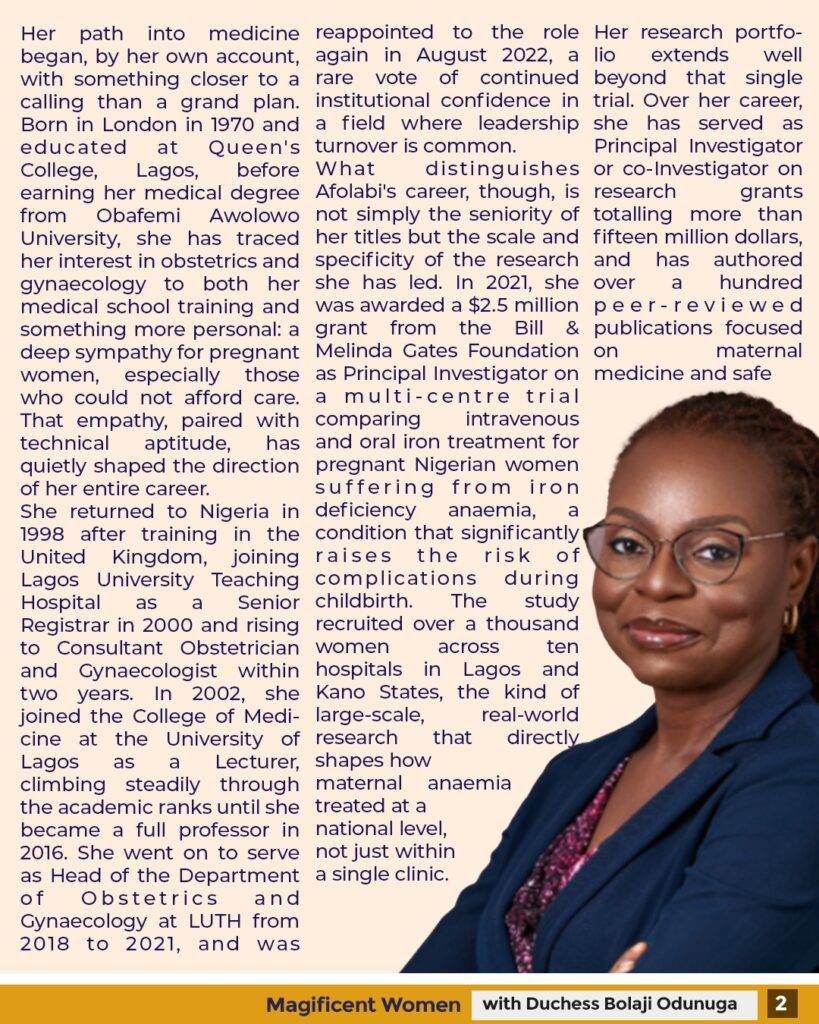
Her path into medicine began, by her own account, with something closer to a calling than a grand plan. Born in London in 1970 and educated at Queen’s College, Lagos, before earning her medical degree from Obafemi Awolowo University, she has traced her interest in obstetrics and gynaecology to both her medical school training and something more personal: a deep sympathy for pregnant women, especially those who could not afford care. That empathy, paired with technical aptitude, has quietly shaped the direction of her entire career.
She returned to Nigeria in 1998 after training in the United Kingdom, joining Lagos University Teaching Hospital as a Senior Registrar in 2000 and rising to Consultant Obstetrician and Gynaecologist within two years. In 2002, she joined the College of Medicine at the University of Lagos as a Lecturer, climbing steadily through the academic ranks until she became a full professor in 2016. She went on to serve as Head of the Department of Obstetrics and Gynaecology at LUTH from 2018 to 2021, and was reappointed to the role again in August 2022, a rare vote of continued institutional confidence in a field where leadership turnover is common.
What distinguishes Afolabi’s career, though, is not simply the seniority of her titles but the scale and specificity of the research she has led. In 2021, she was awarded a $2.5 million grant from the Bill & Melinda Gates Foundation as Principal Investigator on a multi-centre trial comparing intravenous and oral iron treatment for pregnant Nigerian women suffering from iron deficiency anaemia, a condition that significantly raises the risk of complications during childbirth. The study recruited over a thousand women across ten hospitals in Lagos and Kano States, the kind of large-scale, real-world research that directly shapes how maternal anaemia gets treated at a national level, not just within a single clinic.
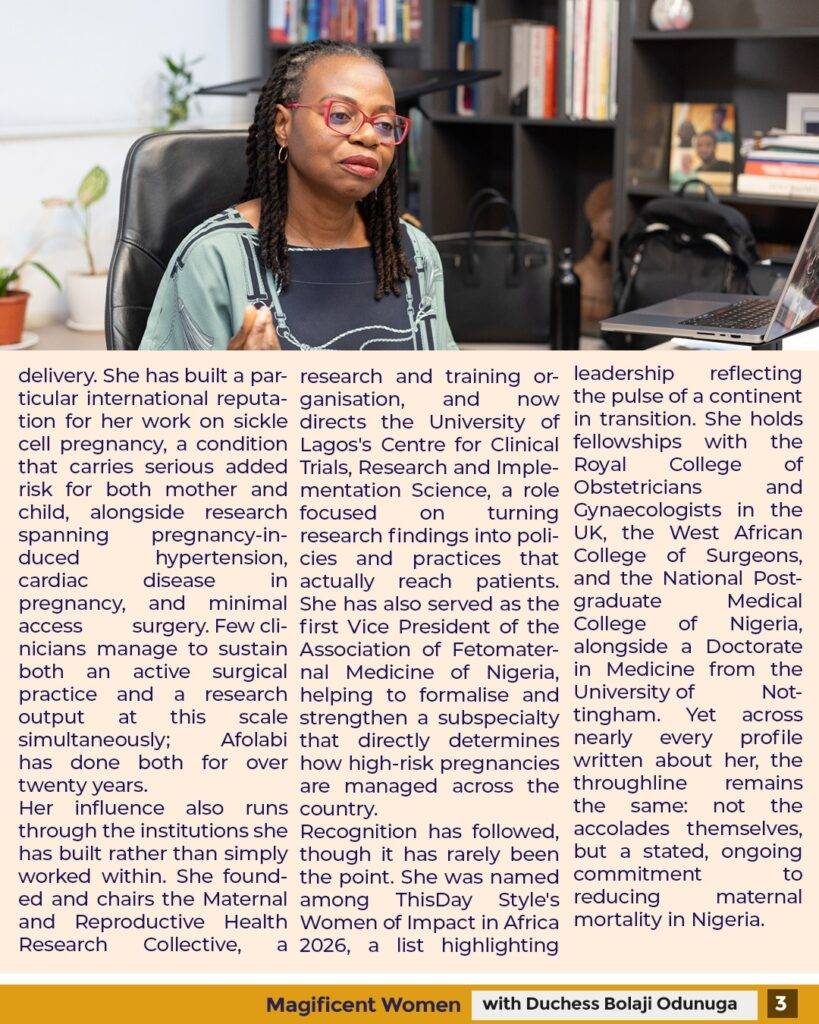
Her research portfolio extends well beyond that single trial. Over her career, she has served as Principal Investigator or co-Investigator on research grants totalling more than fifteen million dollars, and has authored over a hundred peer-reviewed publications focused on maternal medicine and safe delivery. She has built a particular international reputation for her work on sickle cell pregnancy, a condition that carries serious added risk for both mother and child, alongside research spanning pregnancy-induced hypertension, cardiac disease in pregnancy, and minimal access surgery. Few clinicians manage to sustain both an active surgical practice and a research output at this scale simultaneously; Afolabi has done both for over twenty years.
Her influence also runs through the institutions she has built rather than simply worked within. She founded and chairs the Maternal and Reproductive Health Research Collective, a research and training organisation, and now directs the University of Lagos’s Centre for Clinical Trials, Research and Implementation Science, a role focused on turning research findings into policies and practices that actually reach patients. She has also served as the first Vice President of the Association of Fetomaternal Medicine of Nigeria, helping to formalise and strengthen a subspecialty that directly determines how high-risk pregnancies are managed across the country.
Recognition has followed, though it has rarely been the point. She was named among ThisDay Style’s Women of Impact in Africa 2026, a list highlighting leadership reflecting the pulse of a continent in transition. She holds fellowships with the Royal College of Obstetricians and Gynaecologists in the UK, the West African College of Surgeons, and the National Postgraduate Medical College of Nigeria, alongside a Doctorate in Medicine from the University of Nottingham. Yet across nearly every profile written about her, the throughline remains the same: not the accolades themselves, but a stated, ongoing commitment to reducing maternal mortality in Nigeria.
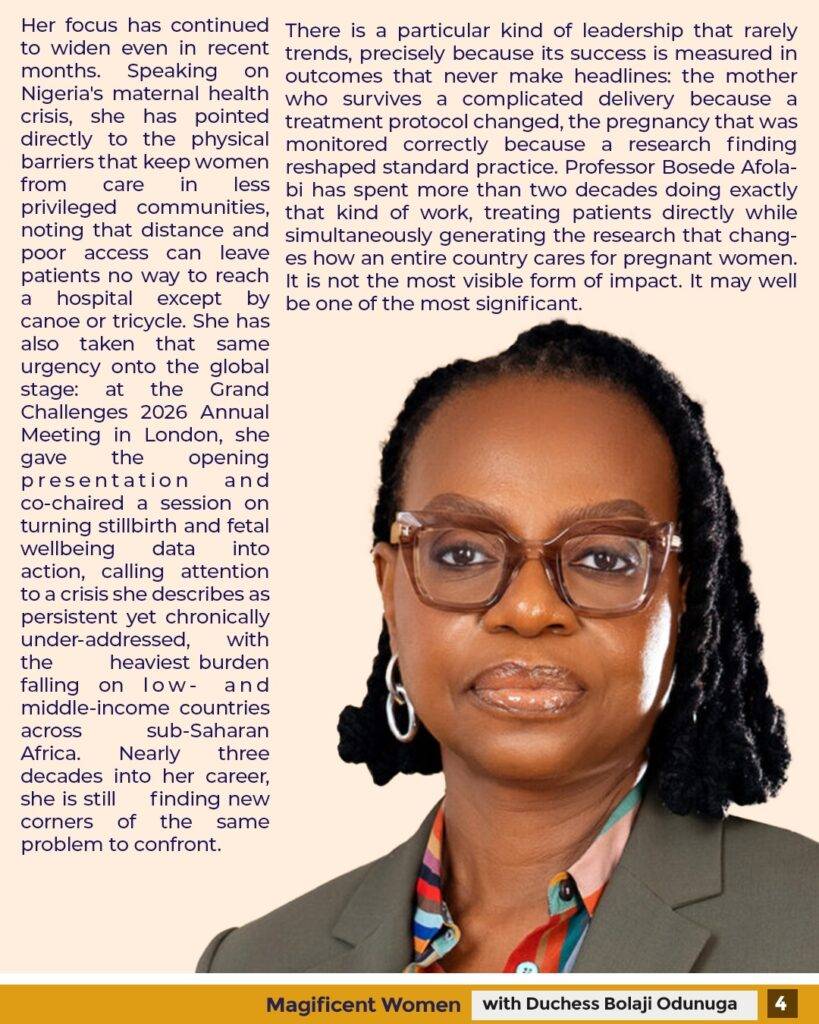
Her focus has continued to widen even in recent months. Speaking on Nigeria’s maternal health crisis, she has pointed directly to the physical barriers that keep women from care in less privileged communities, noting that distance and poor access can leave patients no way to reach a hospital except by canoe or tricycle. She has also taken that same urgency onto the global stage: at the Grand Challenges 2026 Annual Meeting in London, she gave the opening presentation and co-chaired a session on turning stillbirth and fetal wellbeing data into action, calling attention to a crisis she describes as persistent yet chronically under-addressed, with the heaviest burden falling on low- and middle-income countries across sub-Saharan Africa. Nearly three decades into her career, she is still finding new corners of the same problem to confront.
There is a particular kind of leadership that rarely trends, precisely because its success is measured in outcomes that never make headlines: the mother who survives a complicated delivery because a treatment protocol changed, the pregnancy that was monitored correctly because a research finding reshaped standard practice. Professor Bosede Afolabi has spent more than two decades doing exactly that kind of work, treating patients directly while simultaneously generating the research that changes how an entire country cares for pregnant women. It is not the most visible form of impact. It may well be one of the most significant.