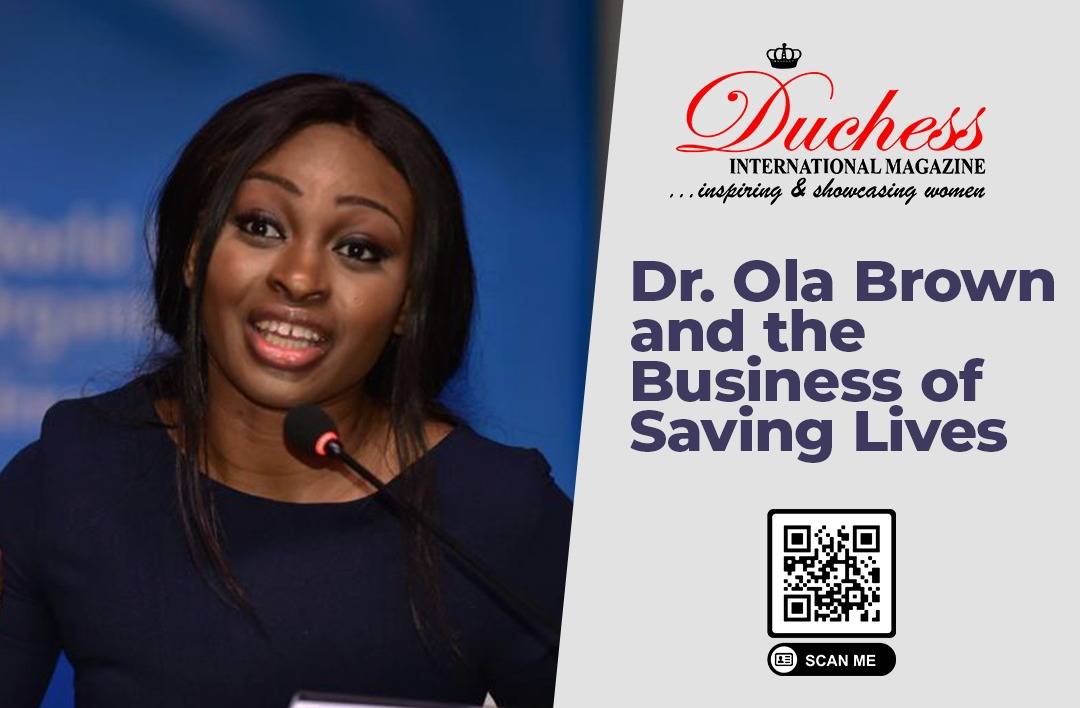
When a medical emergency occurs, minutes can mean the difference between life and death. Yet across much of Africa, access to emergency medical transportation remains one of the weakest links in the healthcare system. Patients in critical condition are often separated from life-saving care by distance, traffic congestion, inadequate infrastructure, or the absence of specialized emergency services. It is a challenge that has cost lives and exposed longstanding gaps within healthcare delivery. While many saw these limitations as unfortunate realities, Dr. Ola Brown saw something different. She saw a problem that demanded a solution. More importantly, she saw an opportunity to use entrepreneurship as a tool for saving lives.
For many people, medicine and business occupy opposite ends of the spectrum. One is associated with care and compassion; the other with profit and commercial success. Yet Dr. Brown’s career challenges that assumption. Trained as a medical doctor, she understood the realities of healthcare from the frontlines. She saw patients whose outcomes were often influenced not only by medical expertise but also by the systems surrounding healthcare delivery. Access, logistics, financing, transportation, and infrastructure all played critical roles. These experiences shaped a realization that would eventually define her career: treating individual patients was important, but transforming the systems that served them could create an even greater impact.
That realization became the foundation for one of Nigeria’s most innovative healthcare ventures. Through Flying Doctors Nigeria, Dr. Brown sought to address a challenge that had long been overlooked—the ability to move critically ill patients quickly and safely to the care they needed. The concept was simple in theory but extraordinarily difficult in practice. Combining healthcare with aviation required navigating regulatory requirements, operational complexities, specialized personnel, expensive equipment, and significant capital investment. It was a bold undertaking in an environment where many entrepreneurs would have chosen less demanding paths. Yet the very difficulty of the problem was what made it worth solving.
Behind every successful venture lies a story of uncertainty, and Dr. Brown’s journey was no exception. Building a company in the healthcare sector is challenging enough. Building one that depends on aviation infrastructure, emergency response systems, regulatory compliance, and highly skilled medical professionals introduces another level of complexity. There were questions about feasibility, sustainability, and scale. Like many entrepreneurs pioneering new ideas, she faced the challenge of convincing people to believe in a vision they had never seen before. Success was far from guaranteed. The path required persistence, resilience, and a willingness to take risks in pursuit of a larger purpose.
What makes Dr. Brown’s story particularly compelling is that she refused to be confined by traditional definitions of impact. Many doctors spend their careers treating patients, one life at a time. Dr. Brown recognized that entrepreneurship offered a way to influence healthcare on a broader scale. By building systems rather than simply working within them, she could help create solutions that reached far beyond a single hospital room. Her journey reflects a growing movement across Africa where innovators are no longer waiting for institutions to solve longstanding problems. Instead, they are building businesses designed to address those challenges directly.
Over time, Dr. Brown expanded her influence beyond healthcare delivery and into the world of investment and venture capital. This transition reflected an even broader understanding of how change happens. Access to capital remains one of the greatest barriers facing entrepreneurs across Africa, particularly those working on solutions to complex social challenges. Through investing in promising ventures, she moved from building one solution herself to helping others build theirs. In doing so, she demonstrated that capital can be more than a financial instrument; it can be a catalyst for innovation, job creation, and societal progress.
Her journey also highlights an important shift in how leadership is understood. For decades, discussions about leadership often focused on authority, titles, and institutional power. Dr. Brown represents a different model. Her influence stems not simply from the positions she holds but from her ability to identify problems and create solutions. She belongs to a generation of African women who are redefining leadership through innovation, entrepreneurship, and impact. In sectors traditionally dominated by men, she has built credibility through competence, vision, and execution, opening doors for others who aspire to follow similar paths.
Beyond her personal achievements, Dr. Brown’s story raises important questions about the future of healthcare in Africa. The continent faces significant healthcare challenges, from inadequate infrastructure and workforce shortages to unequal access to quality medical services. Governments and public institutions play critical roles in addressing these issues, but entrepreneurship is increasingly becoming part of the solution. Innovative businesses are helping bridge gaps in access, efficiency, and service delivery. Dr. Brown’s work demonstrates that some of the most effective responses to systemic challenges may come from individuals willing to combine purpose with enterprise and innovation with execution.
Ultimately, the story of Dr. Ola Brown is not simply about a doctor who became an entrepreneur. It is about what happens when someone decides that treating patients one at a time is not enough. It is about the courage to challenge assumptions, the willingness to build where others see barriers, and the vision to recognize that business can be a vehicle for social impact. In a world where healthcare challenges continue to evolve, her journey offers an important lesson: saving lives is not limited to the walls of a hospital. Sometimes it begins with building the systems, institutions, and innovations that make better outcomes possible for countless people. That is the true business of saving lives.