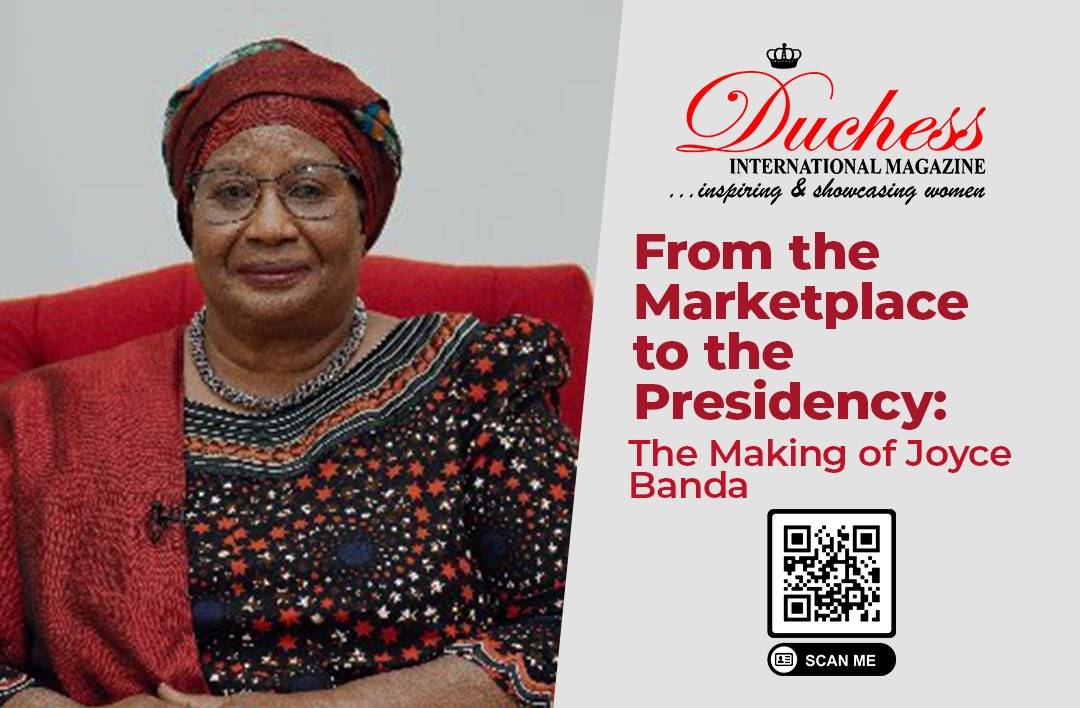
Before Joyce Banda entered the highest office in Malawi, she had already spent years working in spaces where leadership was less about titles and more about survival, enterprise and opportunity. She built businesses, worked with women traders, established organisations and travelled through communities where economic independence could determine whether a woman had any real control over her future. Her political career therefore did not begin with Parliament, a ministerial appointment or the presidency. It grew out of years of working directly with women and communities and seeing the connection between economic power and social change. By the time Banda became Malawi’s first female president in 2012, she had already built a public identity around women’s economic empowerment, education and leadership. Her rise to the presidency was therefore not the beginning of her leadership story. It was the point at which a much longer story became national.
Banda’s entry into public life was preceded by entrepreneurship. In 1989, she founded the National Association of Business Women, an organisation that provided women with access to small-scale financing and business opportunities. She also established businesses including Ndekani Garments and Kalingidza Bakery, experiences that gave her first-hand knowledge of the challenges faced by women trying to earn an income and build sustainable livelihoods. Her work eventually expanded beyond individual businesses into organised advocacy for women’s economic participation. She became involved in the Young Women Leaders Network and other initiatives designed to create opportunities for women and girls. The pattern was already visible: Banda was not simply interested in helping women cope with difficult circumstances; she was interested in giving them tools that could change those circumstances. That distinction would remain central to her public life long after she moved into politics.
Her work also demonstrated that entrepreneurship could be a vehicle for social change. The National Association of Business Women became particularly significant because it connected women with financial support for small businesses, including women operating in rural communities. Banda later became associated with the African Federation of Women Entrepreneurs and other initiatives promoting women’s participation in business. In 1997, she shared the Hunger Project Africa Prize for Leadership for the Sustainable End of Hunger with former Mozambican President Joaquim Chissano. She used the prize money to establish the Joyce Banda Foundation, which focused on areas including women’s economic empowerment, education, maternal health, leadership and support for vulnerable communities. The significance of these efforts lies in their timing: Banda was building institutions around women and children years before she held national political office. Her political leadership would later make more sense because it emerged from a body of work that had already been rooted in communities.
Politics came later. Banda entered Parliament in 1999 and subsequently served as Minister of Gender, Child Welfare and Community Services from 2004 to 2006. She then became Minister of Foreign Affairs, serving from 2006 until 2009, before becoming Malawi’s first female Vice President in 2009. Her movement through those positions represented a significant expansion of responsibility—from community-focused advocacy to national policy and international diplomacy. As Minister of Gender and Child Welfare, she was associated with the enactment of Malawi’s Prevention of Domestic Violence Bill in 2006. Her foreign affairs portfolio placed her in a very different political arena, requiring engagement beyond domestic social policy. By the time she reached the vice presidency, she had accumulated experience across grassroots development, legislation, government administration and international relations. Her career was becoming a study in how leadership developed through successive responsibilities rather than arriving fully formed with a political title.
The road to the presidency, however, was far from straightforward. While serving as vice president under Bingu wa Mutharika, Banda became caught in a succession dispute after she refused to support the president’s brother, Peter Mutharika, as his preferred successor. She was expelled from the ruling Democratic Progressive Party but remained vice president under Malawi’s constitutional framework. In 2011, she founded the People’s Party, creating a political vehicle of her own while remaining in the country’s political mainstream. Then, on 5 April 2012, President Bingu wa Mutharika died suddenly. Two days later, Banda assumed the presidency in accordance with the constitutional order, despite resistance from some political figures who wanted a different succession. The moment made her Malawi’s first woman president and Africa’s second female head of state after Ellen Johnson Sirleaf of Liberia. Her ascent was therefore not a conventional electoral victory; it was the culmination of political experience, institutional struggle and a constitutional succession that placed her at the centre of Malawi’s future.
Her presidency began under difficult economic circumstances. Malawi was facing foreign-exchange and fuel shortages, among other economic pressures, and Banda’s administration moved quickly to implement reforms intended to restore economic stability. The Global Leadership Foundation credits her government with improvements in economic growth and foreign-exchange import cover during her tenure, while Malawi’s National Planning Commission later highlighted her administration’s efforts to address fuel and foreign-exchange shortages soon after she took office. Her presidency also included efforts to strengthen democratic institutions and repeal laws that restricted civil liberties and press freedom. These achievements, however, existed alongside serious controversy, particularly the Cashgate corruption scandal that emerged during her administration. Banda has denied involvement in the scandal. A serious examination of her presidency therefore cannot reduce it to either triumph or failure. It was a complicated period of economic reform, political transition, institutional pressure and controversy.
Perhaps the most revealing part of Banda’s story is that the qualities associated with her political leadership were visible long before she entered State House. Her understanding of women’s economic independence had been shaped by years of working with women entrepreneurs. Her interest in education had informed the work of the Joyce Banda Foundation. Her experience in business had given her exposure to the practical realities of earning, investing and sustaining livelihoods. Politics expanded the scale at which she could operate, but it did not create the issues she cared about. This is important because political leadership is often presented as though it begins when someone wins an election or receives a government appointment. Banda’s trajectory offers another interpretation: sometimes the presidency is simply the largest platform available to someone whose leadership has already been developing elsewhere.
Her defeat in the 2014 presidential election added another chapter to that story. Banda contested the election as the incumbent, but Peter Mutharika won with 36.4 percent of the vote, while Banda received 20.2 percent. The election was surrounded by disputes over counting procedures and alleged irregularities, and Banda initially challenged the process before the official result was announced. The European Union Election Observation Mission subsequently recorded Mutharika as the winner and Banda as the third-place candidate. Losing the presidency did not erase the work that had preceded it. Banda continued to focus on women’s rights, education and economic empowerment through her foundation and international engagements. Her post-presidential life reinforces an important point about leadership: political office can end, but a leader’s work does not necessarily have to end with it.
What makes Joyce Banda’s story worthy of examination is therefore not simply that she became the first woman to occupy Malawi’s presidency. It is the long road that came before that moment—the businesses she built, the women she organised, the institutions she established, the government responsibilities she assumed and the political battles she navigated before the presidency became hers. Her journey from entrepreneurship and grassroots advocacy to the vice presidency and ultimately State House challenges the assumption that leadership begins at the top. For Banda, the presidency was one chapter in a much larger career devoted to economic participation, women’s empowerment and public service. From the marketplace to Malawi’s highest office, her story demonstrates that political leadership can be built long before the ballot box ever offers a person a place at the centre of national power.