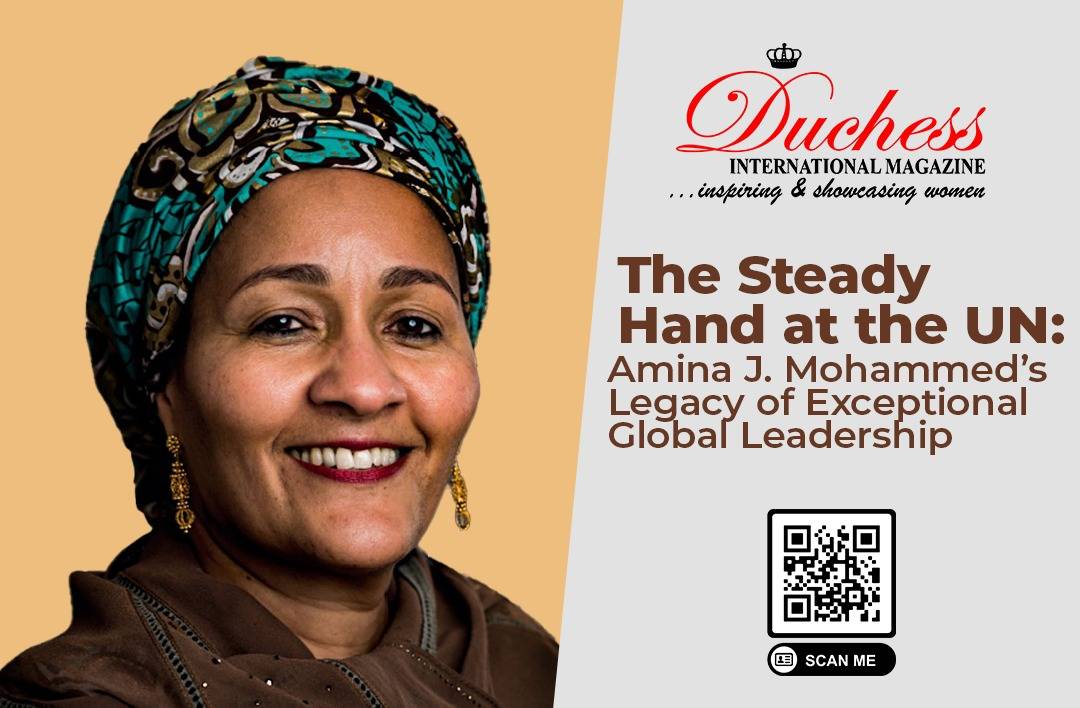
There are few titles in international diplomacy that carry more quiet weight than Deputy Secretary-General of the United Nations, the second-highest office in an organisation representing 193 member states. Since January 2017, that office has belonged to a Nigerian woman who began her career not in diplomacy at all, but designing schools and clinics. Amina J. Mohammed’s rise to the top of global governance was not a straight line drawn early in life. It was built, deliberately and steadily, across three decades of work that moved from architecture to public policy to the largest development framework the world has ever agreed upon.
She was born in Liverpool, England, in 1961, to a Nigerian Fulani veterinarian father and a British nurse mother, the eldest of five daughters. She was educated between Nigeria and the United Kingdom, attending schools in Kaduna and Maiduguri as well as Buchan School on the Isle of Man, before her father insisted she return to Nigeria once her schooling was complete. Her early career reflected her original academic path rather than her later diplomatic one: she worked in architectural design in Nigeria through the 1980s, spending a decade at a firm affiliated with a UK architecture practice before founding her own consultancy, Afri-Projects Consortium, in 1991, work centred on designing schools and clinics for communities that needed them.
That grounding in practical, on-the-ground development work shaped everything that followed, and it was never purely professional. Asked years later how much the Sustainable Development Goals meant to her personally, given her own childhood in Nigeria’s Lake Chad region, she answered without hesitation: if she stretches her hand into her extended family, she still touches poverty. It is a rare, unguarded moment from someone whose public voice is more often institutional than personal, and it reframes everything that follows, not as a career built on ambition alone, but one built on a debt she felt toward the family and community she came from.
She moved into Nigerian public service as Senior Special Assistant to the President on the Millennium Development Goals, coordinating the country’s debt-relief funding for poverty reduction and education, work that placed her at the intersection of international finance and domestic need years before most people in global development were thinking in those terms. It was this hybrid fluency, comfortable in both technical detail and political negotiation, that eventually carried her onto the international stage.
In 2012, she joined the United Nations as Special Adviser to Secretary-General Ban Ki-moon on Post-2015 Development Planning, and it is here that her most consequential legacy was forged. She became one of the principal architects of the 2030 Agenda for Sustainable Development, leading the consultations and negotiations that produced the 17 Sustainable Development Goals and 169 targets ultimately adopted by all 193 UN member states in 2015. It is difficult to overstate what that achievement represents: a single, unified global framework, agreed upon by nearly every country on earth, that continues to guide development funding and policy today. Few individuals in modern international relations can point to a comparable fingerprint on how the entire world organises its approach to poverty, climate, and human development.
In January 2017, newly appointed Secretary-General António Guterres named her Deputy Secretary-General, making her the highest-ranking Nigerian in United Nations history. She was reappointed to the post in 2022 for Guterres’s second term, a continuation that reflected confidence in her stewardship of what has been described as the most ambitious reform in the history of the UN’s development system, restructuring how the organisation coordinates its work across 130 countries. As Chair of the UN Sustainable Development Group, she has overseen the practical machinery translating the SDGs from an agreed framework into implemented programs on the ground.
That record includes a chapter worth holding honestly alongside the achievements. Before returning fully to the UN, she briefly served as Nigeria’s Minister of Environment in 2015 and 2016, steering the country’s efforts on climate action and its early commitments under the Paris Agreement. An advocacy group later alleged she had granted Chinese companies unauthorised permission to import critically endangered Nigerian timber during that tenure, an allegation the Nigerian government has refuted. It is a single, disputed chapter within a career now spanning well over a decade at the UN’s highest levels, but a full accounting of her legacy should include it rather than edit it out.
Her voice has remained consistent across nearly a decade in the role since: a persistent argument against fragmented, siloed thinking in a world facing genuinely interconnected crises. Speaking at the World Summit for Social Development in late 2025, she stated plainly that siloed policies will not solve today’s deeply interconnected challenges, calling for transformative change rather than the reaffirmation of old commitments. Months later, presenting the Sustainable Development Goals Report 2026, she pointed to real, measurable progress, crediting political will, sustained investment, and international cooperation around a framework that is, in her words, actually working.
What makes Amina Mohammed’s leadership genuinely exceptional is not any single achievement, but the unusual consistency running underneath all of them: an architect’s instinct for structure, applied first to buildings, then to national policy, and finally to the scaffolding of global cooperation itself, all of it traceable back to a woman who once said she still touches poverty the moment she reaches into her own family. She has spent a career building frameworks meant to outlast her own tenure in them, from the schools and clinics she designed in Nigeria decades ago to the Sustainable Development Goals now guiding the world’s development agenda through 2030. That is the quieter, harder kind of legacy, not a single defining moment, but structures still standing, still functioning, long after the person who built them has moved on to build the next one.