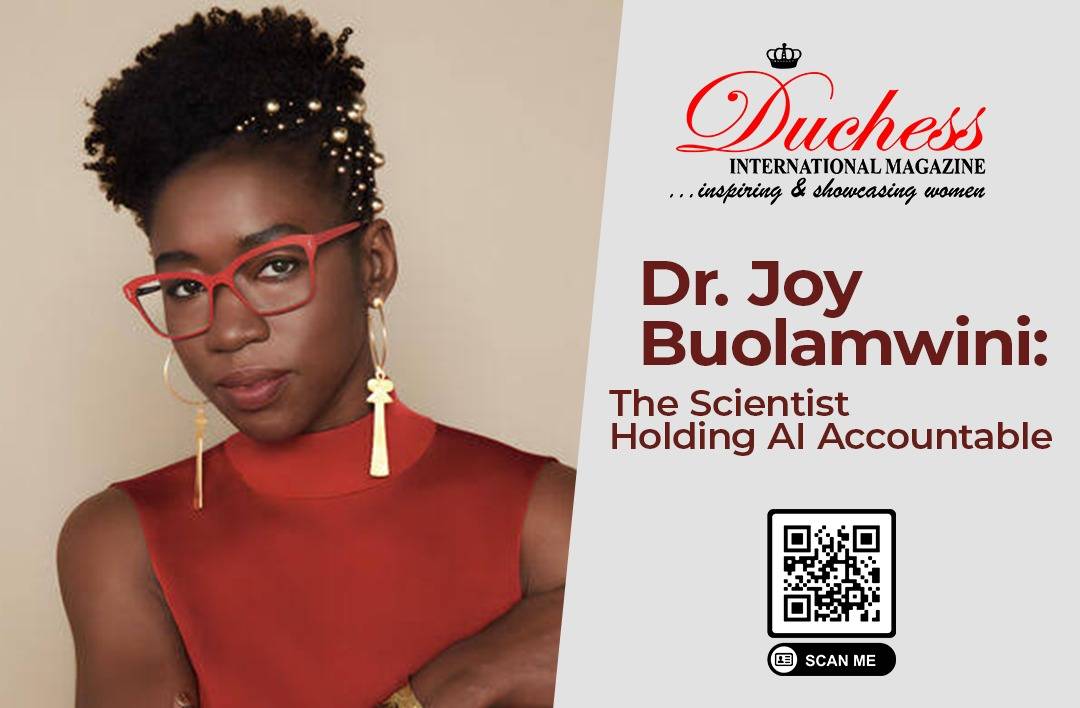
The discovery that would define Dr. Joy Buolamwini’s career began with a mask. As a graduate student at the MIT Media Lab, she was working on an art project called the Aspire Mirror, designed to detect a face and reflect something inspiring back at the viewer. The software kept failing to detect her own face. Out of curiosity, she put on a plain white mask. The system found it instantly. It was a strange, almost absurd moment, a piece of software that could locate a featureless white mask with ease but could not locate her, a Black woman, at all. She did not walk away from it. She started asking why.
That question became the foundation of her 2018 master’s thesis, “Gender Shades,” a study that evaluated commercial facial analysis systems from Microsoft, IBM, and Amazon for accuracy across gender and skin type. The results were stark: these systems performed reliably on lighter-skinned male faces and failed disproportionately on darker-skinned female faces, the exact intersection Buolamwini herself sat at. It was not an isolated finding buried in an academic journal. It became one of the most widely cited pieces of evidence that artificial intelligence, marketed as neutral and objective, was in fact replicating and amplifying the biases of the people who built it and the data used to train it.
She gave a name to the phenomenon underneath that finding: the coded gaze, her term for the way the priorities, preferences, and prejudices of technologists get quietly built into the algorithms, software, and products the rest of the world is asked to trust. It is a deceptively simple phrase for a complicated problem, one she has spent nearly a decade translating for audiences far beyond computer science, world leaders, policymakers, corporate executives, and ordinary people who had never questioned why a soap dispenser, a hiring algorithm, or a facial recognition system might not work the same way for everyone.
In 2016, before her research had reached full public attention, she founded the Algorithmic Justice League, a nonprofit built to spread awareness of the coded gaze through both research and art. That combination, technical rigor paired with creative expression, has remained the organization’s signature. Buolamwini has described herself, memorably, as a poet of code, and her work bears that title out literally. Her spoken word visual piece, “AI, Ain’t I A Woman?”, set facial analysis software loose on the faces of Oprah Winfrey, Serena Williams, and Michelle Obama, and captured, in real time, the systems failing to correctly recognize some of the most photographed women in the world. It is one thing to read a research paper about algorithmic bias. It is another to watch a machine fail to see Serena Williams while a poem narrates the failure back to you.
Not every institution responded the way MIT’s own labs eventually did. When Buolamwini and fellow researcher Deborah Raji extended their audit to Amazon’s Rekognition software in 2018, the company did not quietly improve its systems the way Microsoft and IBM had. It published blog posts publicly disputing her methodology and calling her conclusions misleading. She has since described her own reaction plainly: she did not expect their response to be quite so hostile. Rather than back down, she and Raji countered Amazon’s claims point by point, and months later, twenty-six AI researchers, including a winner of the field’s highest honor, publicly defended her work and called on Amazon to stop selling the technology to police departments. Reflecting later on how she got through that period, she has said the important thing is not to let dismissal from powerful people make you doubt your own work, to keep pushing, and to find the audiences where the work actually resonates.
Her advocacy has never stayed confined to research papers or gallery installations. She has testified before U.S. Congress on facial recognition technology, established the inaugural IEEE working group to help create the first international standards for facial analysis technology, and, in the years following her research, watched Microsoft, IBM, and eventually Amazon each pull back their facial recognition offerings from law enforcement in different capacities. In 2020, her work became the subject of the Netflix documentary Coded Bias, introducing her findings to an audience far larger than academic or policy circles could reach on their own. She has said plainly that no one is immune to algorithmic abuse, but that those already marginalized in society shoulder an even larger burden, a line that has become something close to a thesis statement for her entire body of work.
Her 2023 book, “Unmasking AI: My Mission to Protect What Is Human in a World of Machines,” extended that argument into the systems governing everyday life far beyond facial recognition: hiring software that screens out qualified applicants, healthcare algorithms that misallocate resources, and housing and benefits systems where a biased model can quietly determine access to necessities most people assume are decided by a neutral, human process. The book became a national bestseller, translating years of dense technical research into a plain warning most readers could immediately recognize themselves inside.
Buolamwini’s own path to this work reflects the same layered identity running through her research. Born in Edmonton, Canada, to Ghanaian parents, she spent part of her early childhood in Ghana before her family settled in Mississippi when she was four. The distance between those two identities was not always comfortable. In her own book, she has written about being a nine-year-old who endured being shaded, teased, for the darkness of her complexion, and how unimaginable it would have seemed to her then that she would one day be celebrated, in beauty campaigns and public life, specifically for her dark skin and her Ashanti features. That detail reframes her research in a quieter, more personal light: a woman who spent her childhood being told her particular darkness was a liability later built a career proving, empirically, that machines built to see faces could not properly see people who looked like her at all. She carries a Rhodes Scholarship and a Fulbright Fellowship alongside her MIT doctorate, academic credentials that could easily have kept her inside a purely theoretical research track. She chose instead to build an organization, a documentary subject, a bestselling book, and a body of testimony aimed squarely at people with the power to actually change how these systems get built. She has said the fight for algorithmic justice is not simply a research interest to her. It is, in her own words, a calling.
What makes her work land as more than a technical critique is the specificity of the moment she keeps returning to: a woman having to put on a white mask just to be seen by the machine meant to see her. It is a small, almost cinematic detail, and it does more explanatory work than pages of statistical bias analysis, because it makes the abstract concrete. Bias in AI is not a hypothetical future risk. It was already sitting inside a research lab at one of the world’s most prestigious universities, undetected until someone who was personally erased by it decided to go looking for why.
Dr. Joy Buolamwini’s significance is not simply that she found a flaw in a set of algorithms. It is that she refused to let that discovery remain a private inconvenience, turning one Black woman’s difficulty being seen by a piece of software into an entire field’s reckoning with who gets built into, and left out of, the technology now shaping employment, healthcare, law enforcement, and daily life for billions of people who will never read a single line of the code deciding their outcomes.