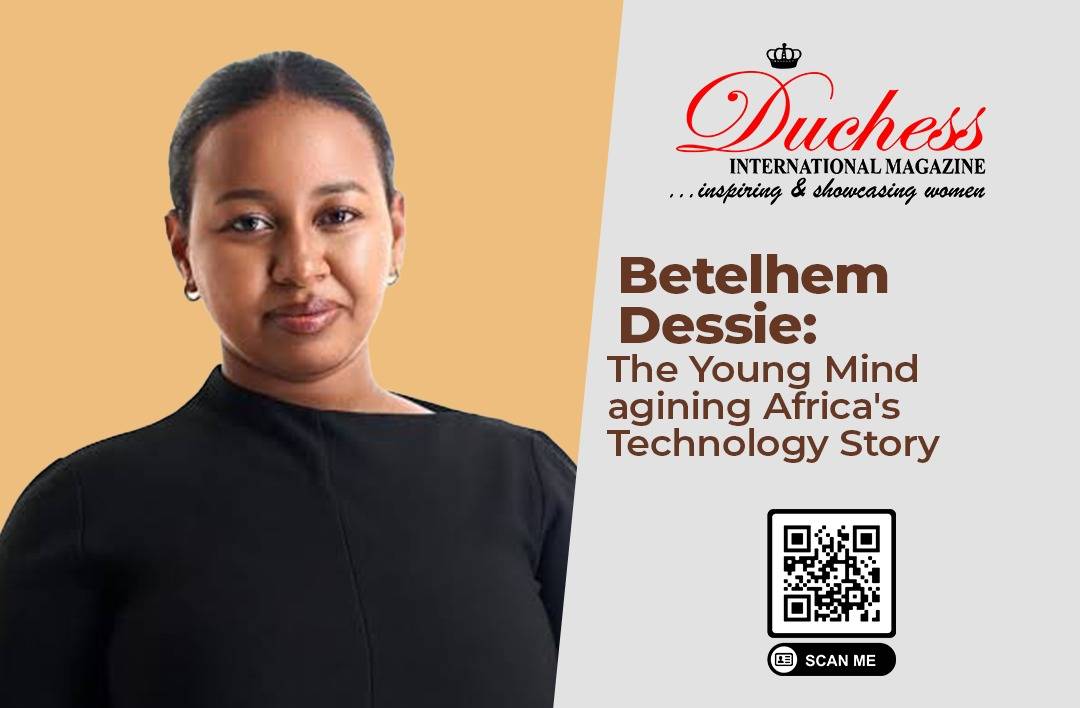
The story of one of Ethiopia’s most influential technologists begins, improbably, with a birthday she almost didn’t get to celebrate. At nine years old, growing up in Harar, Betelhem Dessie asked her father for money to mark the occasion. He told her, honestly, that he didn’t have it, work had kept him too busy to set anything aside. Rather than let the day pass quietly, she went to work in his small electronics shop herself, editing videos and sending audio and music files to customers’ phones until she had earned sixteen hundred Ethiopian birr, enough for the birthday she wanted. She has since described what that moment gave her beyond the money itself: being able to earn it made her feel confident and independent, and she wanted that feeling to last. It was a small, practical act of problem-solving from a nine-year-old, and it never really stopped after that.
That early curiosity hardened quickly into skill. By ten, she had taught herself to code in HTML, entirely self-directed, with no formal pathway or institution guiding her. Ethiopia in the early 2010s offered little in the way of structured tech education for a child like her, so she built her own path instead, teaching herself video editing, computer maintenance, and mobile software installation before most of her peers had access to a computer at all. What could easily have remained a private hobby became, by her teenage years, something far larger: a rare, self-taught fluency in exactly the skills her country was about to need most.
That fluency found an institutional home at iCog Labs, Ethiopia’s first artificial intelligence and robotics lab, where Dessie became one of the youngest people at the center of the country’s emerging tech scene. She was still a teenager when she began working there, eventually becoming closely involved with the lab’s most famous project: the development and Ethiopian debut of Sophia, the humanoid robot that would go on to capture global attention. In July 2018, when Sophia arrived in Addis Ababa for the Information and Communication Technology International Expo, it was Dessie carrying the robot’s prototype, and it was Dessie who met with Prime Minister Abiy Ahmed as part of the moment. She was nineteen years old, already regarded, in CNN’s words, as the youngest pioneer in Ethiopia’s fast-emerging tech scene, sometimes called Sheba Valley.
But Dessie’s real legacy was never going to be a single high-profile robot. It was what she chose to build once she had the platform that Sophia’s spotlight gave her. Partnering with iCog Labs, she founded iCog Anyone Can Code, later simply iCog, a social enterprise built entirely around a conviction that access to technology should not depend on privilege or geography. She has been direct about the gap she saw driving the need for it: Ethiopia’s youth were not short on ideas, energy, or ambition, but they lacked co-creation spaces where like-minded people could build and innovate together, which left many students unsure of where to even start. Her stated aim, in her own words, was simply to democratize technology.
The scale of that effort is now difficult to overstate. Under her leadership, iCog has introduced coding to more than thirty thousand students across Ethiopia, work that reaches far beyond a single classroom or city. She has been careful, too, to frame the mission as bigger than syntax and software. Coding, in her view, is inseparable from equipping kids to cope with the twenty-first century more broadly, problem solving, analytical thinking, self-directed learning, and understanding how to navigate the internet safely and critically.
That broader framing shows up most clearly in how deliberately her curriculum extends past coding itself. iCog’s programs integrate topics like sexual reproductive health and gender-based violence directly into its youth training, a choice she has explained as addressing the real issues affecting young people’s lives, not just their technical skills. For the girls in particular, she has said the coding education comes paired with other knowledge, the kind that helps them stay aware of risks around them, or at least equipped to recognize and report them if they arise. It is a rare instance of a technology program treating digital literacy and personal safety as inseparable parts of the same mission, rather than two unrelated agendas competing for the same classroom hour.
Recognition followed, though it was never really the point. She holds ownership of four individually patented projects and three more developed in collaboration, a striking figure for someone still in her twenties. She has been named among Quartz’s African innovators to watch, been featured by CNN and the BBC, and was selected for the Obama Foundation’s Africa Leaders Program. Yet across nearly every profile written about her, the throughline remains consistent, not the accolades, but the sheer number of young Ethiopians who can now say they wrote their first line of code because of a program she built.
There is something worth noticing in the arc of her story specifically: it did not begin with elite access. It began with a nine-year-old earning her own birthday money in her father’s shop, entirely outside any formal system built to nurture that kind of curiosity. Dessie has effectively spent the years since building the system that didn’t exist for her, so that the next child with the same curiosity would not have to invent their own path from scratch. She has put the logic behind that mission plainly: the one resource Africa has in genuine abundance is its young generation, and training that generation in technology is how something lasting finally gets built.
Betelhem Dessie’s significance to Africa’s technology story is not measured only in patents or robot demonstrations, however striking those moments have been. It is measured in the growing number of Ethiopian children who now have a real, structured way into a field she once had to teach herself entirely alone, and in a training model that treats their safety and wellbeing as seriously as their syntax. She did not simply enter Ethiopia’s tech scene at an early age. She spent the years since making sure it would be easier, and safer, for the next young mind to enter it too.