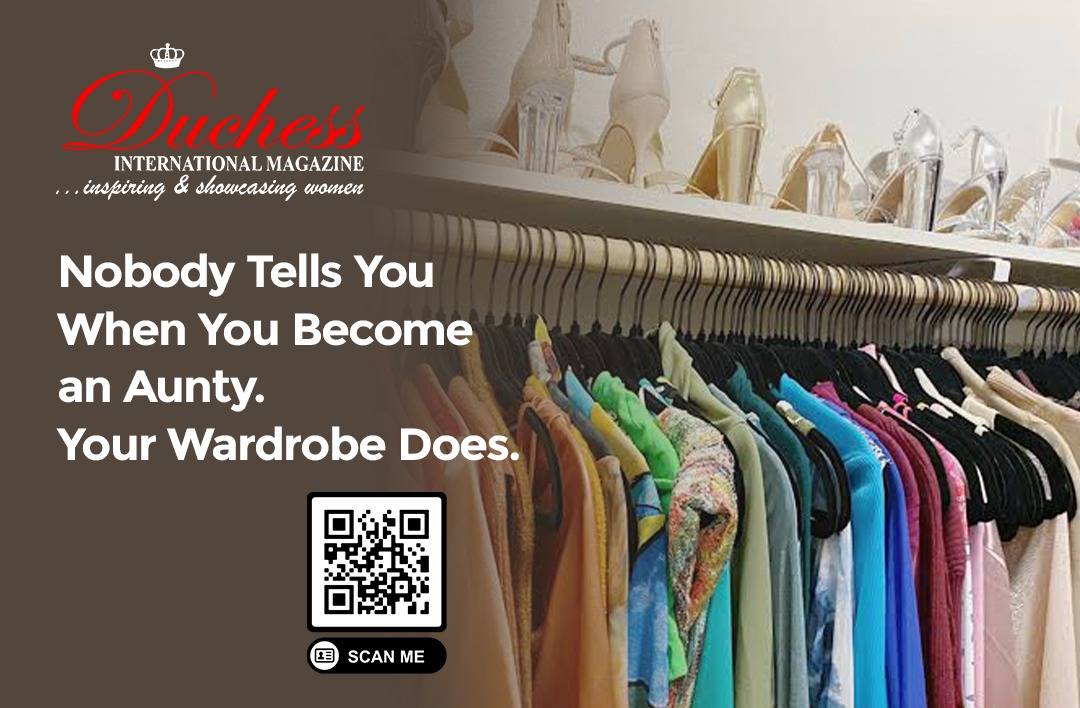
Every woman remembers the moment she was first called “Aunty” by a stranger. The shock. The confusion. The brief urge to turn around and look for the actual aunty being addressed. Then comes the uncomfortable realization that the title was meant for you. What nobody tells you is that by the time the world starts calling you an aunty, your wardrobe has usually known for months. Long before the title arrives, something subtle begins to shift. The shoes become more practical. The handbags become larger. The appreciation for quality tailoring appears almost out of nowhere. Somewhere between youthful experimentation and adult certainty, a quiet transformation begins.
The funny thing is that very few women notice it happening in real time. There is no official moment when a crop top is exchanged for a structured blazer or when a pair of painful heels is permanently replaced by shoes chosen with comfort in mind. The transition unfolds through dozens of small decisions. A dress is purchased because it will still look good five years from now. A handbag is chosen because it fits everything needed for a full day. Fabric suddenly matters. Pockets become exciting. Practicality, once dismissed as boring, starts to feel surprisingly luxurious. What once seemed like signs of aging gradually reveal themselves as signs of experience.
Yet the evolution of the aunty wardrobe is about far more than clothing. Across many African cultures, “aunty” has never been merely an age category. It is a social status. It is the title given to women who have accumulated something more valuable than years: perspective. The aunty is the woman younger people seek out for advice. She is trusted with family matters, career dilemmas, wedding plans, business ideas, and sometimes disputes nobody else can resolve. Her presence carries a certain authority, not because it was formally granted, but because it was earned. The wardrobe often changes because the role itself is changing.
Perhaps that is why so many women initially resist the title. For years, “aunty” has been portrayed as the opposite of youth: sensible instead of adventurous, practical instead of exciting, mature instead of trendy. The first time someone uses the word, it can feel like a reminder that a chapter has ended. Yet over time, many women discover that what they feared was never the title itself. It was what they believed the title represented. The realization eventually arrives that becoming an aunty is not necessarily about becoming older. It is about becoming more comfortable with who you are.
Fashion reflects this shift with remarkable honesty. In youth, style often functions as experimentation. Trends are tried on like different versions of identity. People dress to belong, to stand out, to impress, or simply to discover themselves. But by the time many women enter their aunty era, the relationship with clothing begins to change. The pressure to keep up with every trend weakens. The desire for approval loses some of its urgency. Style becomes less about performance and more about self-expression. The question is no longer, “Will people like this?” but rather, “Does this feel like me?”
This is where the stereotype of the aunty wardrobe becomes surprisingly misleading. Popular culture often reduces aunties to predictable images: the church aunty with perfectly coordinated outfits, the family-function aunty in elaborate lace, the corporate aunty whose blazer collection deserves its own storage unit. While these images persist for a reason, they fail to capture the diversity of modern womanhood. Today’s aunties wear sneakers with tailored trousers. They mix designer pieces with thrift finds. They move comfortably between boardrooms, creative industries, businesses, community leadership, and social media. The aunty aesthetic has evolved because women themselves have evolved.
There is also a financial story hidden inside the wardrobe. For many women, the aunty years coincide with greater economic independence. Careers become more established. Purchasing power increases. Experience shapes priorities. The result is often a dramatic shift in how fashion is approached. Quantity becomes less important than quality. Trends become less attractive than longevity. Instead of filling closets with impulse purchases, many women begin investing in pieces that will serve them for years. The wardrobe starts reflecting not only personal taste but also personal confidence. It becomes less crowded and more intentional.
What makes the aunty aesthetic fascinating is that it quietly mirrors a deeper transformation taking place beneath the surface. The woman who once worried about fitting in becomes more interested in standing comfortably in her own identity. The woman who once sought validation learns to trust her own judgment. The woman who once dressed for attention begins dressing for herself. This evolution is not always dramatic, but it is powerful. The wardrobe simply becomes the visible evidence of an internal shift that has been happening all along.
In many ways, the aunty aesthetic is really an aesthetic of power. Not power in the traditional sense of titles or status, but the quieter power of self-assurance. It is the confidence to choose comfort without apology. The confidence to ignore trends that no longer resonate. The confidence to define beauty on your own terms rather than accepting someone else’s definition. It is a style built not around insecurity but around certainty. And certainty, unlike trends, never goes out of fashion.
Perhaps that is why so many women eventually embrace the title they once resisted. They come to understand that becoming an aunty is not a loss of youth but a gain of perspective. The wardrobe changes because priorities change. The priorities change because confidence grows. And confidence grows because life has taught lessons that no trend ever could. The title may arrive unexpectedly, delivered by a stranger in a supermarket, at a family gathering, or on a crowded street. But by then, the transformation is already complete.
The truth is that the most memorable thing about the aunty aesthetic has very little to do with clothes. Behind every beautifully tailored kaftan, statement handbag, elegant dress, or sensible pair of shoes is a woman who has spent years becoming herself. The wardrobe is simply the evidence. The real story is the journey that got her there. And if becoming an aunty means arriving at a place where style is guided by confidence, choices are guided by experience, and identity is no longer negotiated with the world, then perhaps the title deserves more celebration than resistance. After all, nobody tells you when you become an aunty. But eventually, if you’re lucky, you realize it was never an insult. It was a promotion.