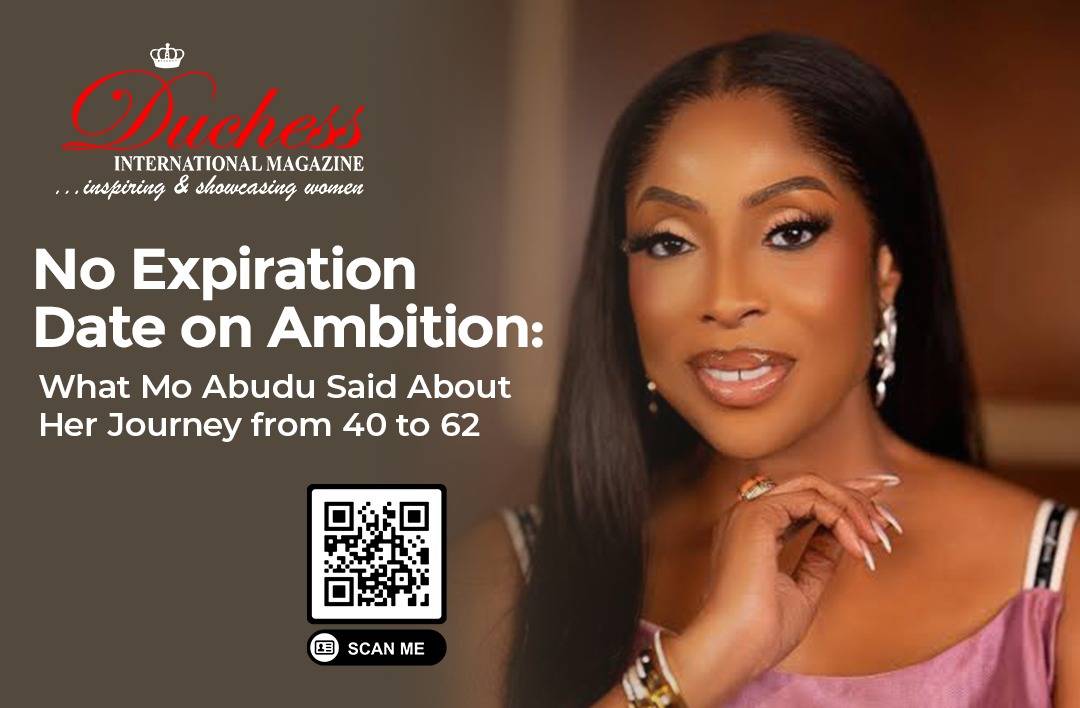
What if the biggest obstacle standing between people and their dreams is not talent, opportunity, or resources, but timing? More specifically, the belief that they have run out of it. For decades, success has been packaged as a race against the clock. The earlier the breakthrough, the more impressive the story. Society has quietly created an unofficial timetable for achievement: by a certain age, you should have figured out your career, defined your purpose, built your success and settled into a version of life that looks complete. Those who arrive early are celebrated; those who take longer are often made to feel as though they are behind. Mo Abudu’s career offers a compelling challenge to that thinking. Some of her most transformative achievements began at ages when many people are encouraged to play it safe. At 40, she entered television. At 50, she moved into filmmaking. At 55, she launched EbonyLife Place in Lagos. Now, at 62, she is still building, including taking the EbonyLife Place vision to London. Her story is not simply about success; it is about what becomes possible when ambition is allowed to outlive the timelines imposed on it.
Today, Abudu is one of the most recognisable figures in African media and entertainment, but describing her simply as a media entrepreneur misses the unusual shape of her career. Her professional life has moved through human resources, consulting, hospitality, television, film, creative education and cultural spaces, with each chapter feeding into the next. Through EbonyLife, she has been associated with films including Fifty, The Wedding Party, The Wedding Party 2: Destination Dubai, The Royal Hibiscus Hotel, Chief Daddy, Your Excellency, Òlòtūré, Chief Daddy 2: Going for Broke and Elesin Oba: The King’s Horseman, while projects such as Blood Sisters and Baby Farm expanded the company’s presence in television. She has also taken on filmmaking herself, writing and directing Her Perfect Life and Iyawo Mi. Yet the more interesting story is not the number of titles attached to her name. It is the fact that many of these chapters came after she had already established a successful professional life elsewhere.
Long before she became associated with red carpets, film premieres and African entertainment, Abudu had spent years building expertise in a completely different world. She began her career in human resources in the United Kingdom, moved to Nigeria and became head of Human Resources and Administration at ExxonMobil, where she spent nearly a decade. She later founded Vic Lawrence & Associates, an HR consulting firm, and became involved in developing Protea Hotel Oakwood Park. These experiences mattered because they gave her something that would later prove invaluable in media: an understanding of people, organisations, business structures, relationships and how to turn an idea into an operating enterprise. In other words, when Abudu eventually entered entertainment, she was not starting from nothing. She was starting from a different foundation.
That distinction became important when she made the leap into television at 40. It is easy to look back at Moments with Mo and see the beginning of a media empire, but Abudu has spoken about how uncertain the decision felt at the time. She had no conventional television background, and she has recalled being concerned about what people would think, with some even believing she was crazy to make the move. She resigned from the security of an established career and then had to learn an unfamiliar industry almost from scratch. She undertook training, practised interviewing, researched the business and pursued a platform for the show, eventually securing the support and partnerships needed to get it on air. Moments with Mo began airing in 2006 and became a syndicated talk show reaching audiences across Africa. What appears in hindsight to have been a perfectly calculated career move was, in reality, a considerable personal and professional risk.
But the significance of that decision was not simply that a 40-year-old woman became a television presenter. It was that Abudu did not treat her previous career as something she had to abandon in order to reinvent herself. She carried what she had learned into the new industry. Her corporate experience, relationships and understanding of business became part of the machinery behind the new venture. From Moments with Mo came a bigger ambition: a pan-African media platform capable of telling African stories on a larger scale. That vision eventually became EbonyLife TV, launched in 2013 as a global Black entertainment and lifestyle network, followed by EbonyLife Films and an expanding slate of television and film projects. The important shift was from being the face of a programme to becoming one of the people building the infrastructure through which African stories could reach audiences. Abudu was no longer simply participating in the industry; she was attempting to shape it.
Her move into film at 50 made the point even more clearly. By then, she had already achieved what many would consider a successful second career, yet another reinvention was beginning. EbonyLife Films launched with Fifty and went on to produce or executive-produce a growing slate that included The Wedding Party, The Wedding Party 2, The Royal Hibiscus Hotel, Chief Daddy, Your Excellency, Òlòtūré, Chief Daddy 2: Going for Broke and Elesin Oba: The King’s Horseman. The company’s work also extended into international partnerships and streaming, helping African stories travel beyond their original markets. Later, Abudu expanded her own creative work through Her Perfect Life and Iyawo Mi, writing and directing both films. The progression is revealing: the woman who once had to train herself to sit in front of a camera eventually became someone who could move between presenting, producing, writing, directing and building platforms for other storytellers.
That willingness to keep changing direction also complicates the way society talks about success. Careers are often presented as though they should follow a neat sequence: education, first job, promotion, leadership, retirement. Abudu’s trajectory is much less tidy. Her 2025 reflection on her journey mapped a series of milestones across two decades: Moments with Mo and hospitality at 40, EbonyLife TV at 49, EbonyLife Films at 50, EbonyLife Place Lagos at 53, EbonyLife Creative Academy at 56, her own filmmaking work at 58 and the expansion of EbonyLife Place to London at 60. Each stage required a different kind of thinking. Building a talk show required one set of skills; building a television network required another; filmmaking, creative education and hospitality demanded something different again. The lesson is not that everyone should keep changing careers. It is that previous success does not have to become a prison. Experience can become the raw material for the next chapter.
For women, that message carries an even greater weight because the pressure surrounding age rarely concerns career alone. Women are frequently measured against overlapping expectations about professional achievement, family, appearance, relevance and timing. There is often an invisible deadline attached to each stage, and stepping outside it can make an ordinary career transition feel like a failure to keep up. Abudu’s journey pushes against that thinking not through a speech about empowerment, but through the chronology of what she has actually done. At 53, she was building EbonyLife Place in Lagos; at 56, she was investing in the development of new storytellers through the EbonyLife Creative Academy; and at 60, she began developing EbonyLife Place London as a cultural hub centred on African and Black cinema, food, fashion and culture. Her career suggests that getting older does not necessarily mean becoming less ambitious. Sometimes it means having more experience, stronger relationships and a clearer understanding of what is worth building.
Now, at 62, Abudu is still operating from that position of possibility. In September 2026, while reflecting on her birthday, she pointed back to the milestones she had reached after 40 and urged people not to allow age to stop them from pursuing their dreams. Her next chapter is not theoretical: EbonyLife Place London is being developed as an African and Black cinema and cultural hub, with the opening planned for October 2026. At the same time, her wider ambitions for African storytelling continue through film and creative projects, including The Secret Lives of Baba Segi’s Wives, which is set for its world premiere at the Toronto International Film Festival and a subsequent cinema release in Nigeria. There is something significant about that stage of her career. After decades of achievement, she is still willing to enter unfamiliar territory, take financial and creative risks, and build something that did not previously exist.
That may ultimately be the most interesting part of Mo Abudu’s story. Her career does not suggest that age is irrelevant or that every dream will work if someone simply refuses to give up. The risks, failures, uncertainty and years of preparation are still part of the picture. What it challenges is the idea that there is a universally correct age at which ambition should become quieter. Abudu started in media at 40, expanded into filmmaking at 50, built new physical and creative spaces in her 50s and is still expanding her vision in her 60s. The significance is not that she kept herself busy for decades; it is that she repeatedly allowed herself to become a beginner again. At 62, she is still building, not because she has something left to prove, but because she has not finished imagining what is possible. Perhaps that is the more useful way to think about time: not as a deadline that closes doors, but as a record of how much can still be built when a person refuses to stop turning the page.