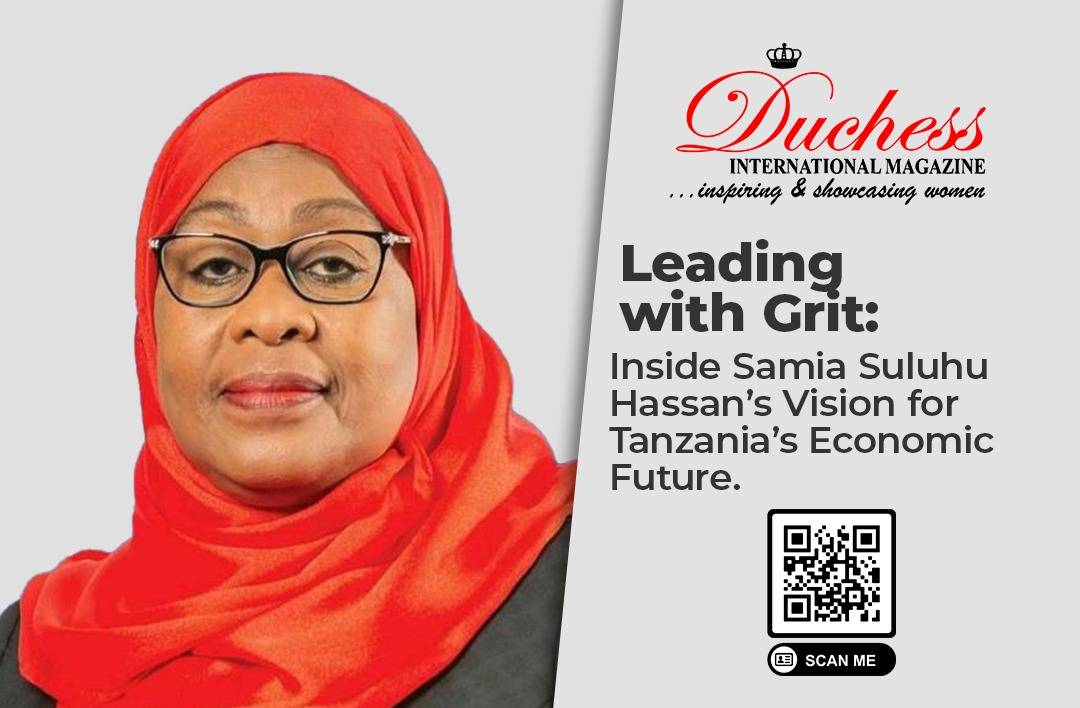
She inherited power in a moment of national loss, reformed cautiously, and is now betting on a $1 trillion future. Her grit is real, and so is the test it now faces.
Grit fits Samia Suluhu Hassan in two ways, and this feature looks at both. The first is the resolve of a woman who took power in a national crisis, pursued a careful reform agenda and now presides over the most ambitious economic plan in Tanzania’s history. The second is the harder and still unfolding test of whether that resolve can rebuild trust after the deadly unrest that followed the October 2025 election. Her vision for the country’s economic future cannot be understood without both.
She took office as Tanzania’s sixth president on 19 March 2021, two days after the death of John Magufuli, and became the first woman to lead the country. She was also the first Zanzibari to lead the United Republic, having been born in Makunduchi, Zanzibar, on 27 January 1960. Her path to the top began when she was elected in 2015 as Tanzania’s first female vice-president on the ruling CCM ticket. Few leaders inherit power in more difficult circumstances, and how she used that moment says a great deal about the character her supporters admire.
She promised continuity but chose a different path. Although she assured the nation she would follow her predecessor’s policies, she took a different approach and introduced reforms aimed at bringing back competitive politics, and she faced considerable resistance from Magufuli supporters inside her own party. Her guiding philosophy became known as the “4Rs” of reconciliation, resilience, reforms and rebuilding. On Covid-19 she recommended social distancing, mask-wearing and vaccination, a sharp change from her predecessor’s stance. In January 2023 she lifted a ban on political rallies that had lasted six years, and she overturned the school ban on pregnant girls. Even opposition voices acknowledged the shift, with the CUF deputy secretary general, Magdalena Sakaya, crediting her for lifting the ban on political activities and for promising free and fair elections, though she also warned that past malpractices had resurfaced in by-elections.
That reform agenda rests on a solid economic base. The IMF put Tanzania’s growth at 5.9 per cent in 2025, with inflation staying inside the Bank of Tanzania’s target range, and in July 2026 its Executive Board approved a $443.9 million disbursement after completing its final reviews of the country’s programmes. Gold exports and tourism both reached record or near-record levels, and the World Bank projects growth of about 6.2 per cent for 2026. Tanzania National Business Council executive secretary Godwill Wanga told The Citizen that rising national income and stable monthly indicators leave the country well placed to keep growing. The World Bank’s February 2026 economic update adds an important caution: fundamentals remain solid, but structural challenges continue to limit inclusive growth.
Behind those national figures are young Tanzanians whose lives the programmes are meant to change. One example is Building a Better Tomorrow (BBT), an agribusiness initiative launched by Agriculture Minister Hussein Bashe and implemented under her government. The minister told parliament in 2025 that more than 120,000 young people had directly benefited, and the programme aims for 12,000 profitable youth-led enterprises across 12,000 villages over eight years. Participants describe a demanding path, with beneficiary Mtengwa Wema Mtengwa explaining that trainees spend five months at agricultural training institutes and two months in national service training. Another beneficiary, Asia Msuya, said the programme gave her the agricultural knowledge to farm professionally and earn an income. Stories like theirs are the test of whether growth reaches ordinary households, which is exactly the challenge she has set for the economy.
Her most visible investment in the country’s future is energy. The Julius Nyerere Hydropower Project in Rufiji District has an installed capacity of 2,115 megawatts, cost about TSh7.452 trillion and was financed entirely from domestic government funds. Construction began in June 2019, under her predecessor, and was completed in March 2025 on her watch, and she formally inaugurated it on 22 August 2026. By the end of May 2026 it was already supplying about half of the electricity fed into the national grid. Alongside the Standard Gauge Railway, it is one of the large strategic projects that have reshaped the country’s infrastructure, and both now serve as the foundation for the plan that follows.
That plan is Development Vision 2050, known as Dira 2050. It aims to turn Tanzania into an upper-middle-income industrial economy with a $1 trillion economy and a per capita income of $7,000, and it took effect on 1 July 2026. She has called it a “national covenant for transformation,” and its aims also include a top-three ranking in Africa for investment and ease of doing business, 90 per cent electricity access and universal clean water. On 3 August 2026 she launched the two instruments to put it into practice: a Long-Term Perspective Plan running to 2050/51 and a Fourth Five-Year Development Plan covering 2026/27 to 2030/31. The private sector is expected to lead about 70 per cent of implementation, which marks a shift from the state-led borrowing that funded the first wave of mega-projects.
The strength of the plan lies partly in how frankly its gaps are described. Analysts point to a “structural transformation deficit,” noting that manufacturing has stayed at roughly eight per cent of GDP for nearly three decades despite strong headline growth. She has pressed the financial sector directly, telling banks at the Bank of Tanzania’s 60th anniversary to turn national growth into affordable credit for ordinary citizens. Academics such as Dr George Kahangwa say the vision is ambitious but that terms like “shared prosperity” need clearer, measurable definitions, and Dr Ngasamiaku, quoted by The Citizen, argues that Tanzania needs a shift in economic focus. As he put it, “That’s what will shield Tanzania from external shocks and ensure steady, homegrown growth.” [EDITOR: insert one short, approved quote from a Tanzanian entrepreneur or woman leader here, or delete this line before publishing.]
The most serious test came on 29 October 2025. She won re-election with 97.66 per cent of the vote, but the election took place after key opposition candidates were barred, and the African Union said it violated democratic values. Protests followed and the security response was deadly. A government-appointed commission of inquiry documented 518 deaths across 11 regions, while cautioning that the figure may not be conclusive. The UN believes hundreds were killed, and the opposition party CHADEMA says the toll exceeds 1,000. Amnesty International says security forces used unnecessary or disproportionate force, including lethal force. The commission itself concluded that the riots were organised, coordinated and financed, but Human Rights Watch notes that its full report has not been made public and that some of those killed or injured were not involved in the protests. Britannica notes that she has faced criticism for increasingly authoritarian tendencies, especially around this election.
Her response has combined acknowledgement with a promise of accountability. On 14 November 2025 she announced the commission of inquiry, and when its findings arrived she said the violence “did not remove our challenges; it added more.” She pledged that its recommendations would guide reconciliation, accountability and constitutional reform, and said the government would set up a body to investigate the alleged planning and financing of the protests. The economic stakes are direct, since she acknowledged in November 2025 that the unrest could hinder access to external funding. Analysts say the $1 trillion target is achievable only if Tanzania navigates its political challenges, mobilises more revenue and delivers genuinely inclusive growth, and investors will be watching how far the promised inquiries and reforms go.
Her leadership now continues through a personal loss as well. Her husband of more than four decades, Hafidh Ameir Hassan, who became Tanzania’s first First Gentleman when she took office, died on 7 September 2026 while being treated for a heart condition in Zanzibar. It is a reminder that behind the title of president is a woman carrying both national and private burdens. For African women watching her career, the lesson is not that leadership is simple or that history has already delivered its verdict. The turbines at Rufiji are already turning and supplying much of the country’s power. Whether the trust that any long-term vision depends on follows will be decided by what she does next.