

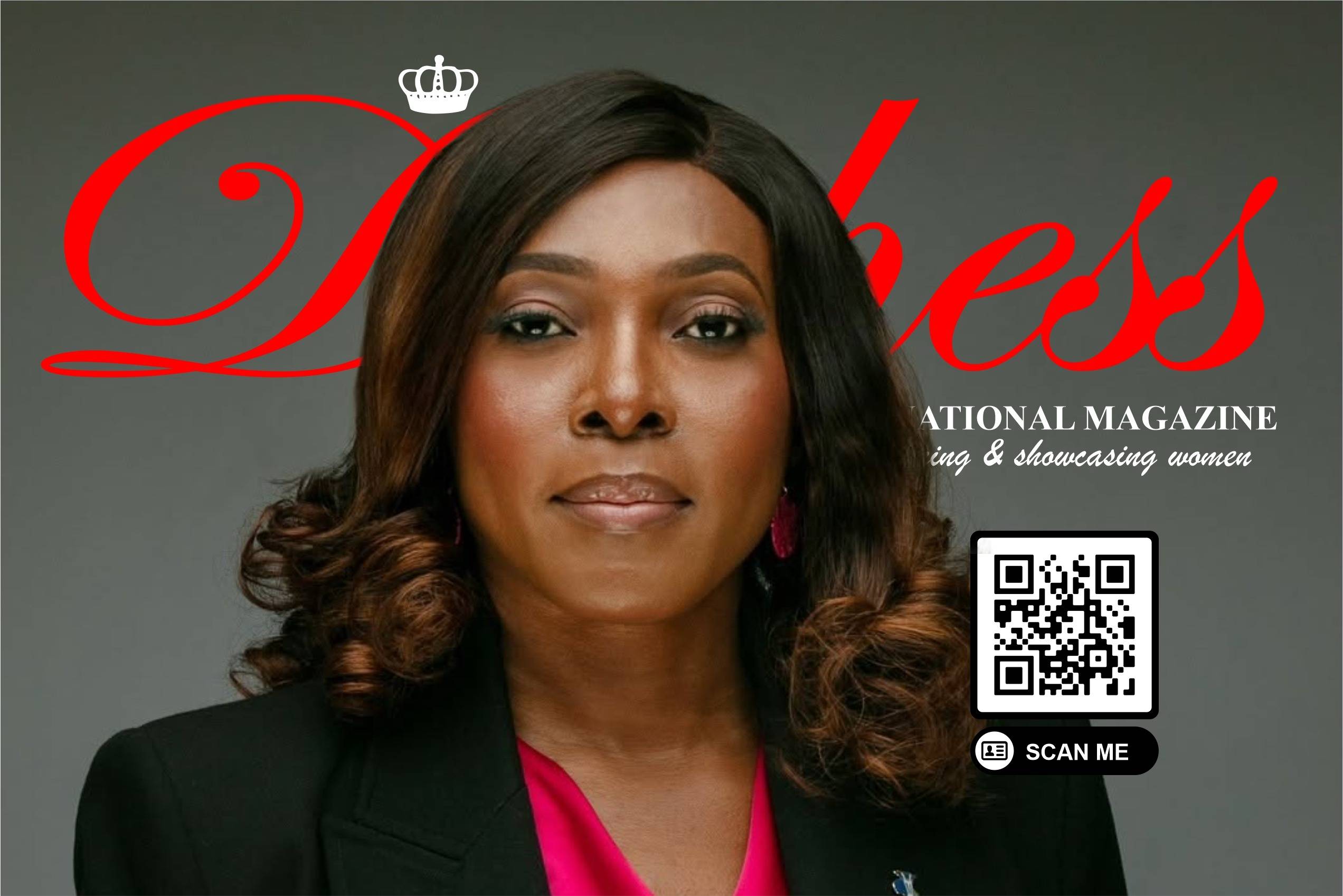
The future of Africa will not be shaped by technology alone, but by the people who understand how to make it useful, accessible and relevant to the continent’s needs. From telecommunications networks and satellite communications to broadband connectivity and digital infrastructure, the systems connecting people, businesses and institutions are becoming increasingly important to economic participation. At the centre of this evolving landscape is Nigerian engineer and technology executive Jane Egerton-Idehen. Her career has taken her from technical engineering roles to leadership positions at some of the world’s most recognised technology and telecommunications companies, and ultimately to the leadership of Nigerian Communications Satellite Limited (NIGCOMSAT). Her journey reflects the possibilities that emerge when technical knowledge, business experience and a commitment to wider access come together.
Born and raised in Lagos, Egerton-Idehen has spoken openly about growing up in difficult circumstances and how those experiences shaped her determination to pursue her ambitions. Her professional path began with an interest in engineering, which led her to study Electronics Engineering at the University of Nigeria, Nsukka. She graduated in 2001 with a second-class upper degree and began her career as an earth station engineer at Spar Aerospace. The role placed her close to the technical foundations of satellite communications, giving her early exposure to the infrastructure that enables information to travel across vast distances. She later pursued postgraduate business education at Warwick Business School, strengthening her understanding of management, strategy and commercial decision-making. She also undertook executive education at Harvard Business School and Yale School of Management, reflecting her continued investment in learning as her responsibilities grew.
Her years in the telecommunications industry were marked by a progression through technical, commercial and leadership roles. She joined Ericsson, where she spent more than a decade working across engineering-related, product, sales and management functions. She also worked with Nokia Siemens Networks, gaining experience in managing customer relationships and telecommunications operations across West Africa. These positions gave her a close understanding of the systems and partnerships required to build and maintain communication networks. They also helped her develop the commercial perspective needed to connect technical solutions with the needs of businesses, governments and consumers. Her career illustrates an important reality about the technology sector: innovation depends not only on the people who design systems, but also on those who can build partnerships, manage complex operations and make technology commercially and practically viable.
In 2017, Egerton-Idehen joined Avanti Communications, a British satellite operator, as Country Manager for Nigeria and later served as Regional Sales Director for West Africa. The move brought her experience in telecommunications infrastructure closer to the satellite services that help extend connectivity beyond traditional terrestrial networks. Satellite communications can play an important role in reaching remote locations, supporting enterprise operations and providing connectivity where fibre and mobile infrastructure may be limited. Her work involved developing relationships across markets and helping connect organisations with satellite-based communication solutions. In 2021, she took another significant step when she became Head of Sales for the Middle East and Africa at Meta. The position expanded her leadership experience within one of the world’s most influential technology companies and placed her at the intersection of digital platforms, business development and the rapidly changing digital economy.
In October 2023, Egerton-Idehen was appointed Managing Director and Chief Executive Officer of Nigerian Communications Satellite Limited. The appointment marked a return to the satellite communications field from a different position of influence: this time, she was leading the national institution responsible for operating Nigeria’s communications satellite infrastructure and services. NIGCOMSAT’s mandate extends beyond the operation of a satellite system. Its services have potential applications across broadband connectivity, broadcasting, telecommunications, maritime operations, aviation, security and other sectors that depend on reliable communication. Under her leadership, the institution has pursued initiatives intended to strengthen the satellite ecosystem, develop technical capacity and encourage greater participation in the space and satellite economy. The role brings together her engineering background, commercial experience and understanding of the relationships needed to advance technology infrastructure.
Her approach to leadership has included efforts to make satellite technology more visible and accessible to businesses, young innovators and institutions. Initiatives highlighted during her tenure include the introduction of Nigerian Satellite Week, the development and expansion of the NIGCOMSAT Accelerator Programme, and regional very small aperture terminal (VSAT) training. These programmes speak to a wider ambition: moving beyond the idea of satellites as distant pieces of national infrastructure and helping more people understand how satellite technology can solve practical problems. Applications can range from connecting underserved communities and supporting education to improving communication for businesses operating across difficult terrain. For Nigeria and other African countries, the opportunity lies not simply in owning or operating satellite assets, but in developing the skills, services and local enterprises that can turn those assets into meaningful economic and social value.
Alongside her corporate and institutional career, Egerton-Idehen has made the advancement of women a central part of her work. In 2016, she founded Women & Career, a platform that grew out of a mentoring forum she had established within her organisation. The original initiative created opportunities for women in different countries to learn from senior female executives, exchange experiences and receive practical career guidance. As participation and demand grew, she expanded the platform beyond her workplace to reach a wider community of women seeking professional development and leadership opportunities. Her interest in supporting women in technical careers is also reflected in her involvement with initiatives encouraging girls to explore science, technology, engineering and mathematics. She understands that representation in technology is not only about getting women into the industry; it is also about creating the networks, mentorship and professional environments that help them remain, progress and lead.
Her book, Be Fearless: Give Yourself Permission to Be You, published in 2020, brings many of these ideas together. Drawing on her experiences in a demanding and often male-dominated industry, she explores confidence, professional identity, career growth and the importance of allowing oneself to pursue opportunities without being limited by other people’s expectations. The book became an Amazon bestseller in several categories following its release, extending her influence beyond the boardroom and into conversations about women’s careers and personal development. Her story has also received recognition from business and technology platforms, while her participation in speaking engagements and mentorship programmes has helped bring attention to the experiences of women working in STEM and corporate leadership. These activities demonstrate that her contribution is not limited to the organisations she has led; it also includes the people she encourages to imagine a wider range of possibilities for themselves.
Her journey offers a powerful perspective on what it means to lead in a technology-driven age. From engineering satellite systems to managing multinational business operations and directing a national communications satellite institution, she has worked across different layers of the infrastructure connecting modern society. Her career also challenges the idea that women must choose between technical expertise, executive leadership and advocacy. She has built a place for herself in all three, while using her experience to support others coming behind her. As Africa considers the future of digital inclusion, satellite technology and the wider space economy, leaders who can connect technical understanding with practical strategy will remain essential. Egerton-Idehen’s story is ultimately about more than reaching the top of an industry; it is about using knowledge, leadership and opportunity to help connect more people to the future.

