



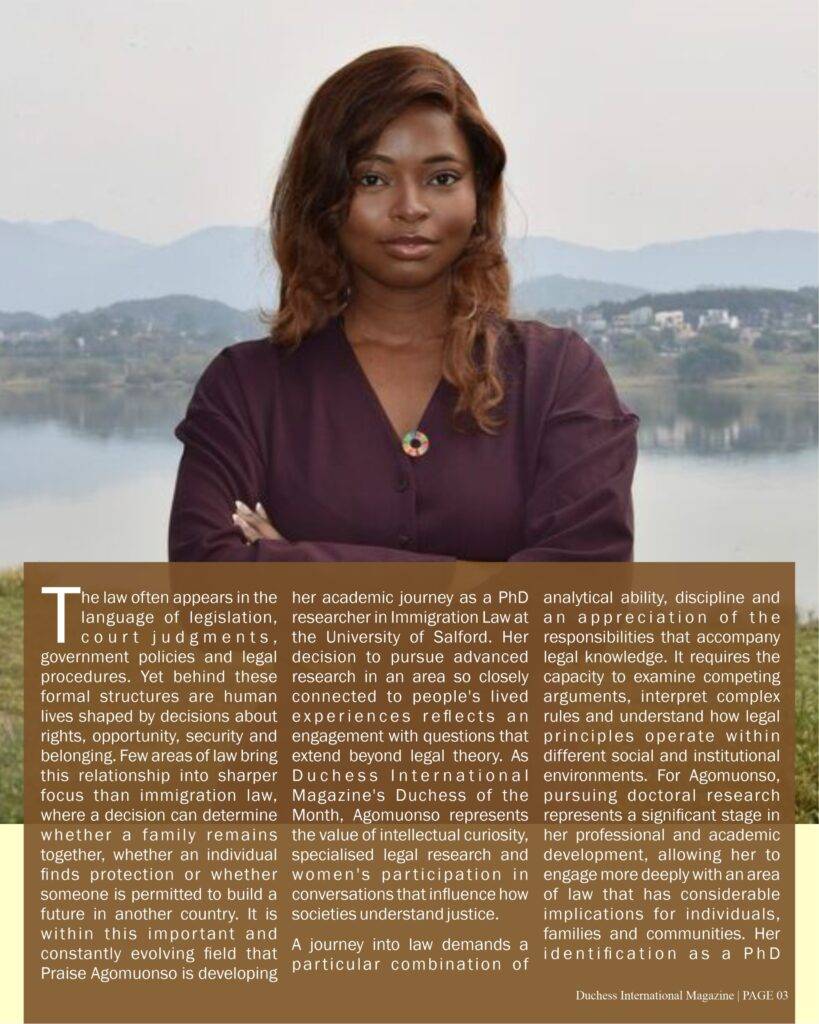
The law often appears in the language of legislation, court judgments, government policies and legal procedures. Yet behind these formal structures are human lives shaped by decisions about rights, opportunity, security and belonging. Few areas of law bring this relationship into sharper focus than immigration law, where a decision can determine whether a family remains together, whether an individual finds protection or whether someone is permitted to build a future in another country. It is within this important and constantly evolving field that Praise Agomuonso is developing her academic journey as a PhD researcher in Immigration Law at the University of Salford. Her decision to pursue advanced research in an area so closely connected to people’s lived experiences reflects an engagement with questions that extend beyond legal theory. As Duchess International Magazine’s Duchess of the Month, Agomuonso represents the value of intellectual curiosity, specialised legal research and women’s participation in conversations that influence how societies understand justice.
A journey into law demands a particular combination of analytical ability, discipline and an appreciation of the responsibilities that accompany legal knowledge. It requires the capacity to examine competing arguments, interpret complex rules and understand how legal principles operate within different social and institutional environments. For Agomuonso, pursuing doctoral research represents a significant stage in her professional and academic development, allowing her to engage more deeply with an area of law that has considerable implications for individuals, families and communities. Her identification as a PhD researcher at the University of Salford places her within an academic environment where legal questions can be investigated through sustained research, critical examination and scholarly discussion. Although the full details of her earlier education and professional milestones are not yet independently established, her current academic position provides a meaningful foundation for recognising her commitment to the study of law and the pursuit of specialised knowledge.
Her choice of immigration law is particularly relevant at a time when migration continues to influence international relations, national policies and the experiences of millions of people. Immigration is not simply about movement from one country to another; it involves questions of identity, family life, employment, education, safety and the opportunity to establish a secure future. The legal frameworks governing migration determine the conditions under which individuals can enter, remain in or seek protection within a country. They also establish procedures for citizenship, asylum, family reunification and other matters that can have lasting consequences for those involved. This makes immigration law an area in which legal interpretation and human experience are closely connected. Studying it requires an understanding of legislation and policy, but also an appreciation of the circumstances in which people encounter these systems. The significance of the field lies partly in this relationship: the law may be written in formal language, but its consequences are experienced in very personal ways.
Researching immigration law also presents considerable intellectual challenges. The subject is influenced by changing legislation, government priorities, international agreements, judicial decisions and wider political developments. A researcher must be able to examine these different sources, understand where they intersect and identify the questions that require further investigation. There is also an important distinction between what a legal framework promises and how it functions in practice. A policy may establish a procedure, but the experiences of individuals navigating that procedure can raise questions about accessibility, fairness, delay and the availability of appropriate legal support. Issues such as asylum applications, family separation, immigration detention and the protection of vulnerable migrants demonstrate why research in this field requires both legal precision and careful attention to context. It is not enough to understand what a particular rule says; meaningful scholarship also examines its purpose, interpretation and implications. This is the kind of intellectual engagement that makes specialised research an important part of the continuing development of legal knowledge.
The wider significance of immigration research extends into conversations about justice, inclusion and the responsibilities of governments and institutions. Public discussions about migration can become dominated by political positions, economic arguments and competing national interests. While these considerations form part of legitimate policy debates, they do not remove the need to examine the legal rights and protections of individuals affected by immigration decisions. Legal scholarship provides an important space for examining whether policies are consistent with established legal principles, whether procedures offer appropriate safeguards and where reforms may be necessary. It can also help distinguish between public perceptions and the actual legal obligations governing migration. For researchers such as Agomuonso, engagement with this field offers an opportunity to contribute to a body of knowledge that can inform academic discussion and broader understanding. It is a reminder that the study of law is not limited to interpreting existing rules; it also involves asking whether those rules adequately respond to the realities of the societies they are designed to regulate.
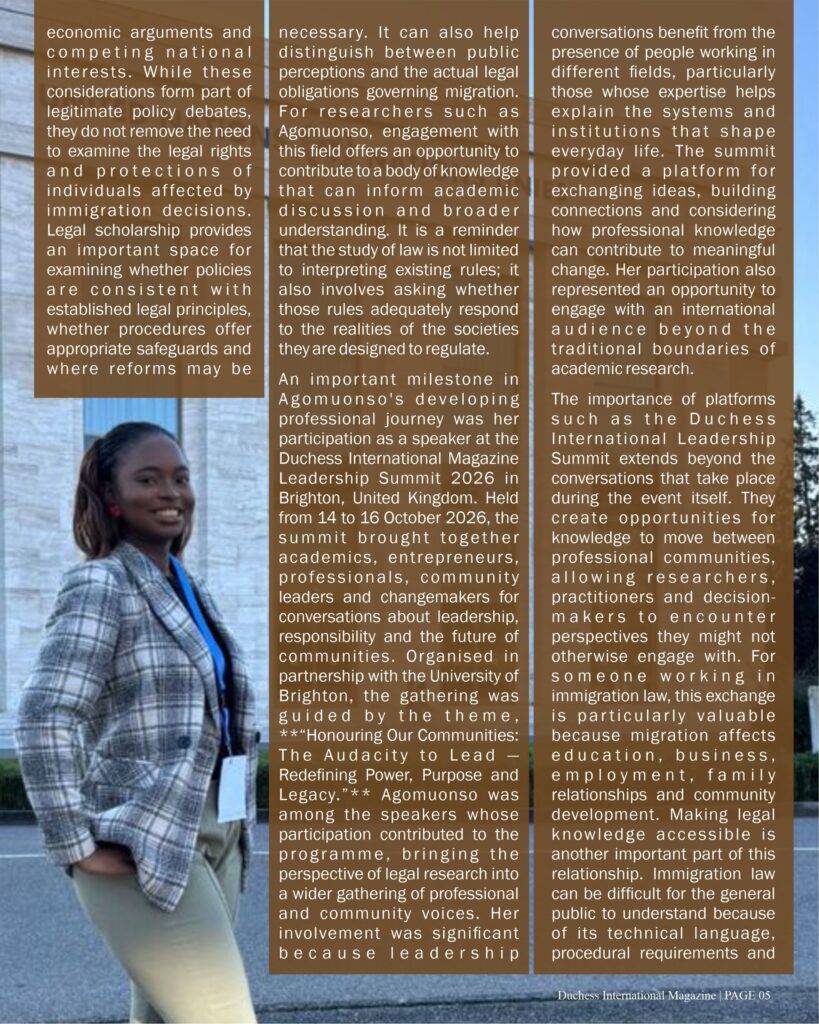
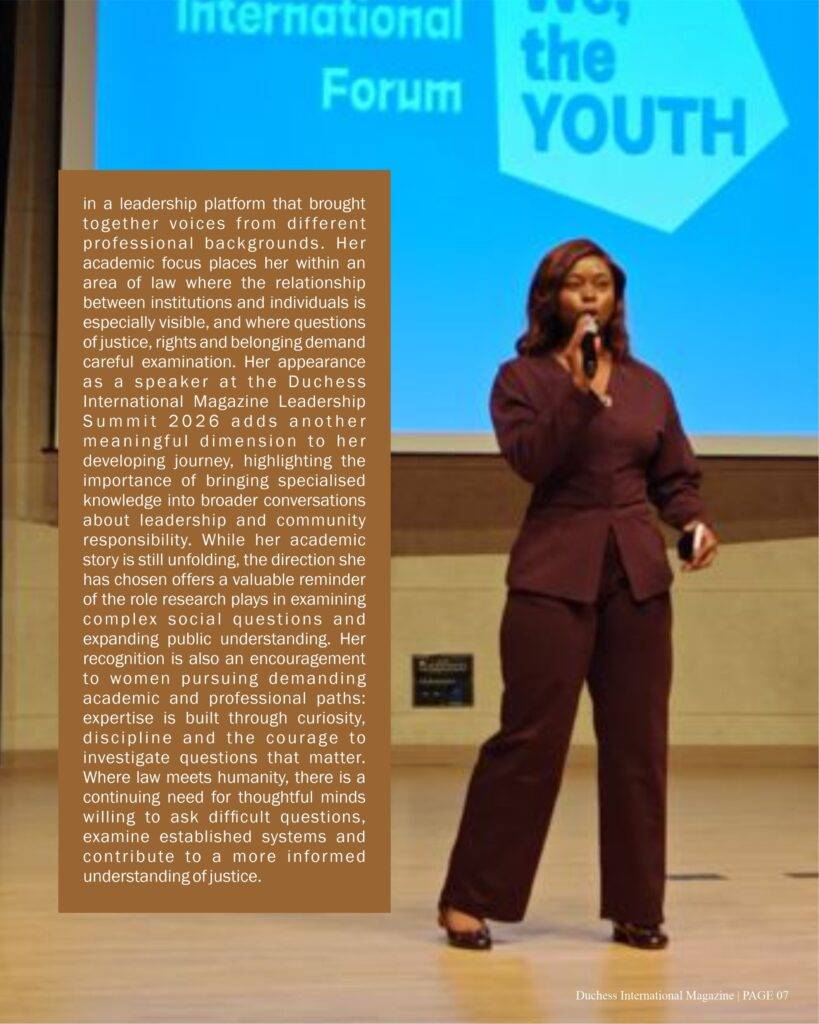
An important milestone in Agomuonso’s developing professional journey was her participation as a speaker at the Duchess International Magazine Leadership Summit 2026 in Brighton, United Kingdom. Held from 14 to 16 October 2026, the summit brought together academics, entrepreneurs, professionals, community leaders and changemakers for conversations about leadership, responsibility and the future of communities. Organised in partnership with the University of Brighton, the gathering was guided by the theme, “Honouring Our Communities: The Audacity to Lead — Redefining Power, Purpose and Legacy.” Agomuonso was among the speakers whose participation contributed to the programme, bringing the perspective of legal research into a wider gathering of professional and community voices. Her involvement was significant because leadership conversations benefit from the presence of people working in different fields, particularly those whose expertise helps explain the systems and institutions that shape everyday life. The summit provided a platform for exchanging ideas, building connections and considering how professional knowledge can contribute to meaningful change. Her participation also represented an opportunity to engage with an international audience beyond the traditional boundaries of academic research.
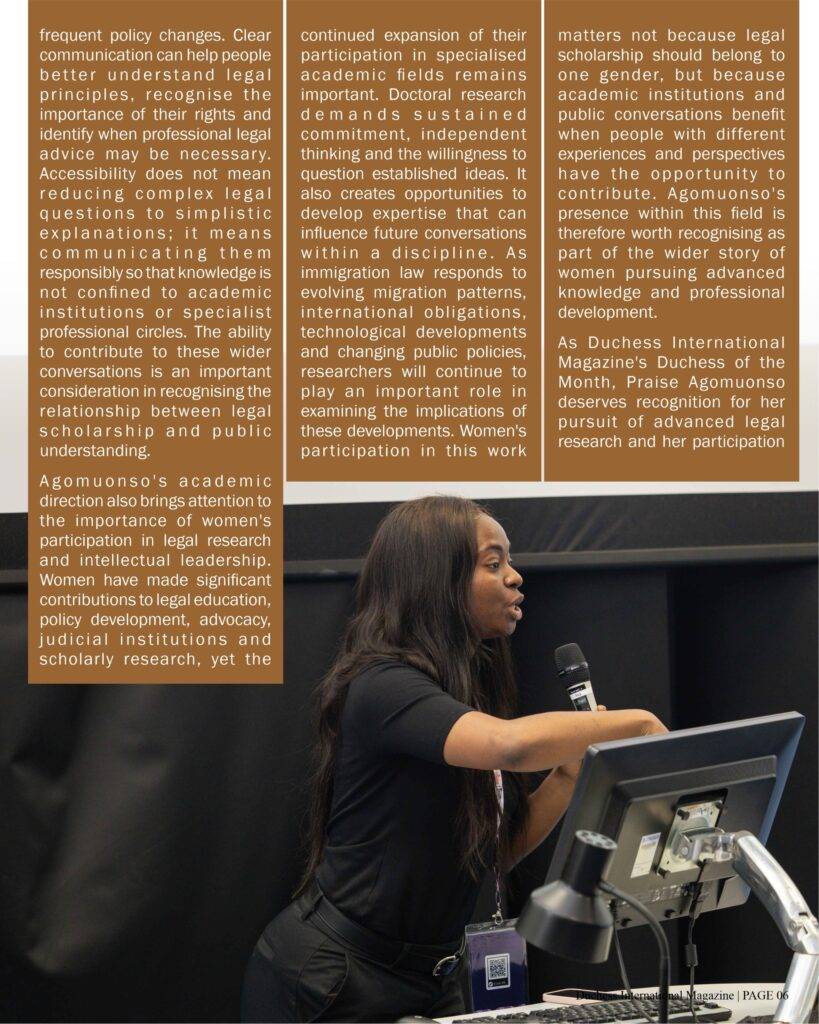
The importance of platforms such as the Duchess International Leadership Summit extends beyond the conversations that take place during the event itself. They create opportunities for knowledge to move between professional communities, allowing researchers, practitioners and decision-makers to encounter perspectives they might not otherwise engage with. For someone working in immigration law, this exchange is particularly valuable because migration affects education, business, employment, family relationships and community development. Making legal knowledge accessible is another important part of this relationship. Immigration law can be difficult for the general public to understand because of its technical language, procedural requirements and frequent policy changes. Clear communication can help people better understand legal principles, recognise the importance of their rights and identify when professional legal advice may be necessary. Accessibility does not mean reducing complex legal questions to simplistic explanations; it means communicating them responsibly so that knowledge is not confined to academic institutions or specialist professional circles. The ability to contribute to these wider conversations is an important consideration in recognising the relationship between legal scholarship and public understanding.
Agomuonso’s academic direction also brings attention to the importance of women’s participation in legal research and intellectual leadership. Women have made significant contributions to legal education, policy development, advocacy, judicial institutions and scholarly research, yet the continued expansion of their participation in specialised academic fields remains important. Doctoral research demands sustained commitment, independent thinking and the willingness to question established ideas. It also creates opportunities to develop expertise that can influence future conversations within a discipline. As immigration law responds to evolving migration patterns, international obligations, technological developments and changing public policies, researchers will continue to play an important role in examining the implications of these developments. Women’s participation in this work matters not because legal scholarship should belong to one gender, but because academic institutions and public conversations benefit when people with different experiences and perspectives have the opportunity to contribute. Agomuonso’s presence within this field is therefore worth recognising as part of the wider story of women pursuing advanced knowledge and professional development.
As Duchess International Magazine’s Duchess of the Month, Praise Agomuonso deserves recognition for her pursuit of advanced legal research and her participation in a leadership platform that brought together voices from different professional backgrounds. Her academic focus places her within an area of law where the relationship between institutions and individuals is especially visible, and where questions of justice, rights and belonging demand careful examination. Her appearance as a speaker at the Duchess International Magazine Leadership Summit 2026 adds another meaningful dimension to her developing journey, highlighting the importance of bringing specialised knowledge into broader conversations about leadership and community responsibility. While her academic story is still unfolding, the direction she has chosen offers a valuable reminder of the role research plays in examining complex social questions and expanding public understanding. Her recognition is also an encouragement to women pursuing demanding academic and professional paths: expertise is built through curiosity, discipline and the courage to investigate questions that matter. Where law meets humanity, there is a continuing need for thoughtful minds willing to ask difficult questions, examine established systems and contribute to a more informed understanding of justice.

