

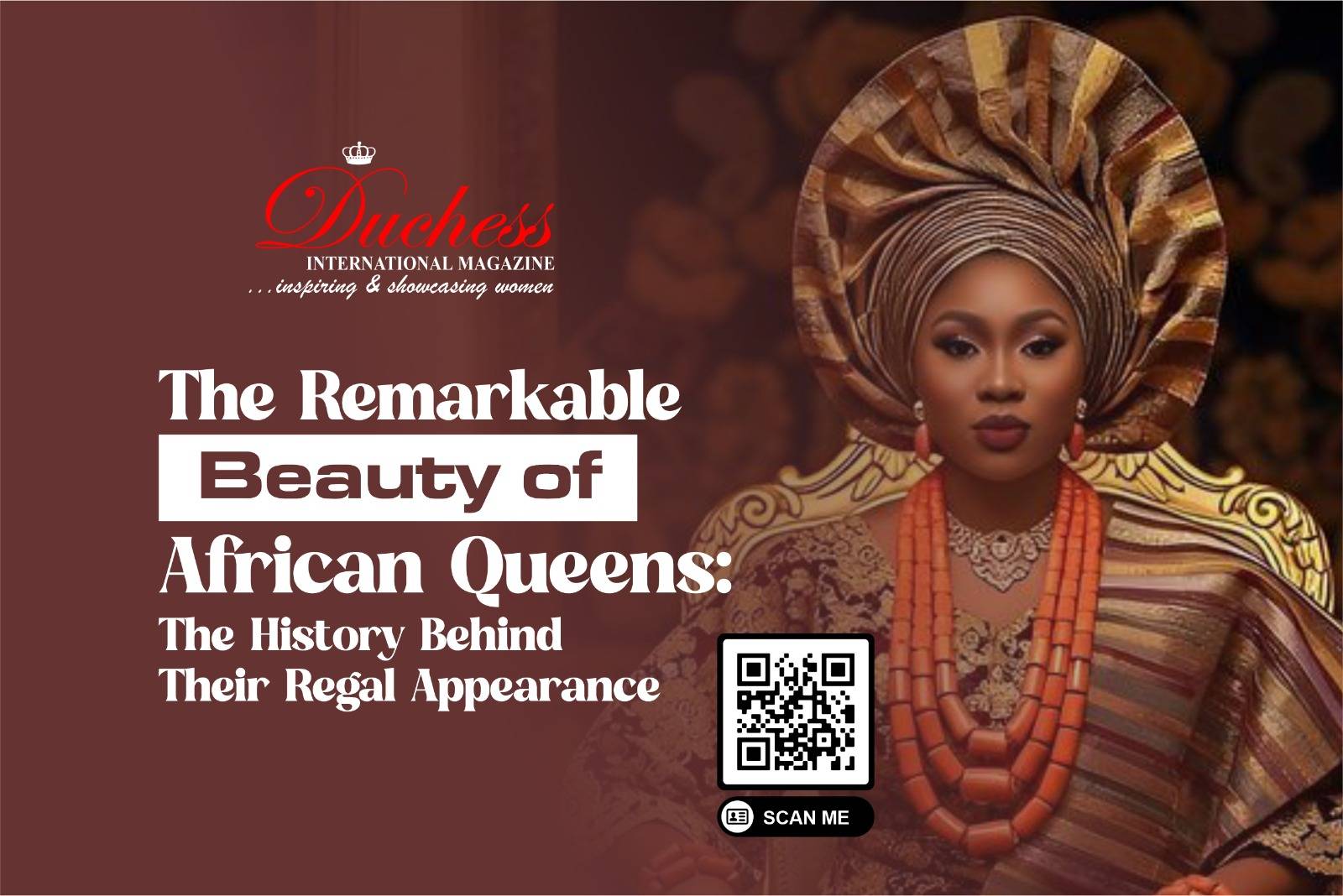
From elaborate hairstyles and handwoven royal textiles to coral-beaded crowns and ceremonial jewellery, the appearance of African queens has long communicated far more than beauty. Their regalia reflected authority, wealth, spiritual traditions and cultural identity, revealing the remarkable women whose presence helped shape the history of their kingdoms.
Long before the modern fashion industry turned personal appearance into a global business, African royal courts had developed distinctive visual traditions through which power, heritage and status could be seen and understood. A queen’s clothing, jewellery, hairstyle and ceremonial ornaments were not simply matters of taste. They could identify her position within the royal hierarchy, express connections to ancestors, demonstrate access to valuable materials and distinguish her from other members of society.
Across the continent, these traditions took different forms. In the Kingdom of Benin, coral beads and commemorative brass sculptures celebrated the authority of queen mothers. In Asante, royal traditions connected women such as Yaa Asantewaa to political leadership and national resistance. In the kingdoms of present-day Angola, Queen Njinga used traditional royal dress during a crucial diplomatic encounter with Portuguese officials. Among Yoruba communities in present-day Nigeria, prestigious handwoven textiles became enduring expressions of identity, ceremony and social distinction. Together, these histories reveal an important truth about African royal beauty: appearance was not separate from power. It was one of the ways power became visible.
Queen Mother Idia
Few examples illustrate the relationship between royal appearance and political authority more clearly than Queen Mother Idia of the historic Kingdom of Benin, in present-day southern Nigeria. Idia was the mother of Oba Esigie, who ruled during the early sixteenth century. Her political importance was such that Esigie established the title of Iyoba, or queen mother, in her honour. The position became a powerful institution within Benin’s royal hierarchy, giving subsequent queen mothers significant standing and the privilege of commissioning artworks associated with their personal and ancestral altars.
The visual language surrounding the Iyoba was equally distinctive. In royal sculptures, queen mothers are represented wearing coral-beaded regalia, including elaborate crowns with a characteristic forward-pointing peak. Their jewellery and ceremonial attire distinguished them from other figures at court, making their elevated status immediately recognisable.
Coral was particularly significant within Benin’s royal culture. Its use in crowns, collars and other objects of prestige demonstrated the importance of the material within courtly life and its association with royal authority. The elaborate regalia represented more than individual adornment; it belonged to a wider artistic and political system in which materials, craftsmanship and visual symbols helped communicate the hierarchy of the kingdom.
Idia’s legacy also extends beyond the beauty of her regalia. She is remembered for her political skill and role in helping her son preserve his kingdom during a period of conflict. Her story challenges the assumption that women’s influence in African royal courts was limited to ceremonial duties or family relationships. The beauty of Benin’s queen mothers was inseparable from their institutional significance. Their appearance communicated who they were, the authority they held and the traditions they represented.
Queen Njinga
In the seventeenth century, Queen Njinga Mbande of Ndongo and Matamba, in present-day Angola, demonstrated how clothing and presentation could become instruments of diplomacy. In 1622, before she became ruler of Ndongo, Njinga led a delegation to meet the Portuguese governor of Angola on behalf of her brother, the king. She entered a colonial political environment in which the balance of power was unequal, but her appearance remained firmly connected to her own culture and royal standing.
According to the Jamestown-Yorktown Foundation’s account of the encounter, Njinga wore traditional royal dress, accompanied by numerous cloths, jewellery and feathers in her hair. Her entourage also included attendants, and a sceptre carried on her behalf represented her authority. Her choice of attire was significant because the meeting was not simply a conversation between two individuals. It was a diplomatic encounter involving competing political interests. By presenting herself through the dress and symbols of her own court, Njinga maintained a visible connection to the authority she represented.
The encounter is also remembered for the governor’s decision to occupy the only chair in the room, leaving Njinga standing. Rather than accept the humiliation, she called one of her attendants to kneel and used the attendant’s back as a seat. The gesture has endured as a striking illustration of her refusal to accept a subordinate position. Njinga’s story reminds us that regal appearance is not only about the richness of a garment or the value of a jewel. It is also about the meaning a person gives to their presentation. Her royal dress, jewellery and ceremonial symbols helped communicate her identity at a moment when diplomacy, dignity and sovereignty were at stake.
Her legacy rests on far more than appearance. She was a formidable political leader who navigated warfare, negotiation and resistance to Portuguese expansion. Yet the details of her diplomatic encounter reveal how carefully chosen clothing and public presentation could reinforce a ruler’s position in a contested political world.
Yoruba Royal Women
Among Yoruba communities in southwestern Nigeria, clothing and adornment have long played important roles in expressing social position, identity and ceremonial significance. One of the best-known examples is aṣọ-òkè, a prestigious handwoven textile traditionally produced by weaving narrow strips of cloth and stitching them together to create a finished fabric. Made from materials including cotton and silk, it reflects generations of specialised weaving knowledge and artistic skill.
Aṣọ-òkè is not a single design with one universal meaning. Its appearance varies according to the materials, weave, colours, patterns and context in which it is worn. Particular textiles may carry associations with celebrations, family identity, social standing or important communal occasions. Their value lies not only in how they look but also in the labour, expertise and cultural knowledge involved in their creation.
For royal women and other prominent figures, prestigious textiles could form part of a larger ceremonial appearance that included head coverings, jewellery and other carefully selected accessories. Coral beads, in particular, have played a prominent role in the regalia of several Nigerian royal traditions, including the court of Benin. The Yoruba world also contains distinct royal titles and institutions, and the experiences of queens, queen mothers and royal wives have varied across kingdoms and historical periods. It would be misleading to suggest that every royal woman wore the same clothing or that every colour and pattern carried an identical meaning throughout Yoruba society.
The important point is that dress could communicate belonging and distinction. A carefully woven garment was the product of skill and cultural continuity, while its use at a ceremony or public gathering connected the wearer to a wider social world. These traditions show that African luxury has never been defined by imported labels alone. It has also been created through local materials, skilled craftsmanship and cultural knowledge passed from one generation to another.
Yaa Asantewaa
In Asante, present-day Ghana, Yaa Asantewaa occupies a powerful place in the history of women’s leadership and resistance to colonial rule. As Queen Mother of Ejisu, she held an important traditional position within the Asante political system. In 1900, following the exile of Asantehene Prempeh I and other leaders, tensions intensified when British colonial authorities demanded the Golden Stool, a sacred symbol of the Asante nation.
Yaa Asantewaa became associated with the resistance that followed, known as the War of the Golden Stool or the final Anglo-Asante War. Her leadership and defiance have made her one of the most celebrated women in Ghanaian history. Her story also adds another dimension to the history of African royal appearance. Royal identity was expressed through institutions, titles, ceremonies and the symbols a society recognised as meaningful. In Asante, the Golden Stool was not an ordinary piece of furniture; it embodied the spiritual and political identity of the nation. The controversy surrounding it revealed how profoundly material objects could represent collective authority and sovereignty.
Yaa Asantewaa’s place in history cannot be reduced to the clothing or ornaments she may have worn. Her significance lies in her position as a queen mother, her role in a defining episode of resistance and the enduring meaning of her actions. Her story nevertheless belongs in a discussion of African queens because it demonstrates the relationship between royal status, cultural identity and political responsibility. The British Museum identifies her as the Queen Mother and Regent of Ejisu who led resistance to British colonisation in 1900. Her legacy continues to inspire conversations about African women, leadership and the defence of cultural heritage.
Hair, Jewellery and the Art of Royal Presentation
Beyond textiles and crowns, hairstyles have been important expressions of identity and social distinction in many African societies. Braiding, sculpting, weaving, ornamenting and covering the hair have all formed part of diverse traditions, with styles changing according to community, period, age, status and occasion. In some settings, elaborate hairstyles required considerable time and specialised skill. Hair could be decorated with beads, ornaments or other materials, and particular styles could distinguish ceremonial occasions from everyday life. The significance of a hairstyle, however, depended on its cultural context; no single interpretation can explain the many traditions found across the continent.
The Mangbetu peoples of Central Africa, for example, became widely associated in historical photographs and artistic representations with elongated head shapes and elaborate hairstyles. These visual traditions have attracted considerable attention, but they should be understood within their own cultural history rather than treated as evidence of one universal African ideal of beauty. Likewise, among Himba communities in southwestern Africa, hairstyles and the use of red ochre mixed with other substances form part of distinctive traditions of personal presentation. These practices have meanings connected to community, identity and social life, although their interpretation varies with age and context.
Jewellery also deserves a place in this history. Beads, metal ornaments, ivory and other materials could signify wealth, rank, religious affiliation or membership in a particular social group. Their importance depended on local traditions and the circumstances in which they were worn.
What connects these different practices is not a single standard of beauty, but the sophistication with which African communities have used the human form as a medium of expression. Hair and adornment can preserve cultural knowledge, signal belonging and make identity visible without the wearer having to speak.
What African Queens Teach Us About Beauty Today
For the modern reader, the histories of African queens offer a compelling way to think about personal style, cultural inheritance and self-expression. Their examples show that appearance can carry meaning beyond trends. A textile may connect someone to a community. A hairstyle may preserve a tradition. A piece of jewellery may recall family history, a ceremonial role or a place of cultural significance. When these choices are made with an understanding of their origins, personal style can become a meaningful expression of identity.
This does not mean that modern women must dress like historical queens to honour their legacy. Nor does it mean that traditional clothing is more authentic than contemporary fashion. The lesson is broader: people can define elegance on their own terms, drawing on heritage, creativity and individual confidence without feeling compelled to conform to one narrow standard.
For the readers of Duchess International Magazine, this is where the history becomes especially relevant. In a world where beauty is often shaped by rapidly changing trends and commercial expectations, African royal traditions remind us that style can be rooted in knowledge, intention and belonging.
The women behind these traditions also remind us that appearance alone never tells the whole story. Queen Mother Idia’s coral regalia belonged to a woman remembered for political influence. Queen Njinga’s royal dress accompanied her into a consequential diplomatic encounter. Yaa Asantewaa’s place in history is inseparable from her resistance to colonial rule. Their lives show that the significance of a queen was never confined to how she looked.

