
Every great city tells a story through its skyline, and across Africa that story is increasingly being written by women. In cranes, towers, beach resorts and gated estates rise from the vision of women who have taken on one of the continent’s most capital-intensive and male-dominated industries. The stakes are high. Nigeria’s real estate sector accounts for about 6.39 per cent of the country’s GDP, yet the nation still faces a serious housing deficit, and Ghana’s housing shortfall is estimated at almost two million units. The six women profiled here answer that gap in different ways, as architects, developers and executives. Together they are proving that the built environment of Africa does not have to be designed only by men.

Olajumoke Adenowo, often called Africa’s “starchitect,” was born in Ibadan to parents who were both professors, in a home that prized knowledge and curiosity. In 1994, at the age of 25, she founded AD Consulting, a boutique architecture and interior design firm that has since designed and delivered more than 114 projects. Its work includes Abuja Film City, the Nigerian Stock Exchange and Heritage Bank’s headquarters, while its clients span Coca-Cola, L’Oréal, Access Bank and Guaranty Trust Bank. Behind the buildings is a design philosophy she calls NeoHeritage Architecture, which draws on heritage to define a contemporary African architecture of global relevance, and in 2019 she was appointed a visiting professor at the Technical University of Munich. She sums up her creed simply: “Architecture isn’t just about buildings; it’s about crafting ecosystems that uplift communities.” Her impact reaches beyond design, since she also founded the Awesome Treasures Foundation, a faith-based NGO recognised by the United Nations for its work empowering women and youth.
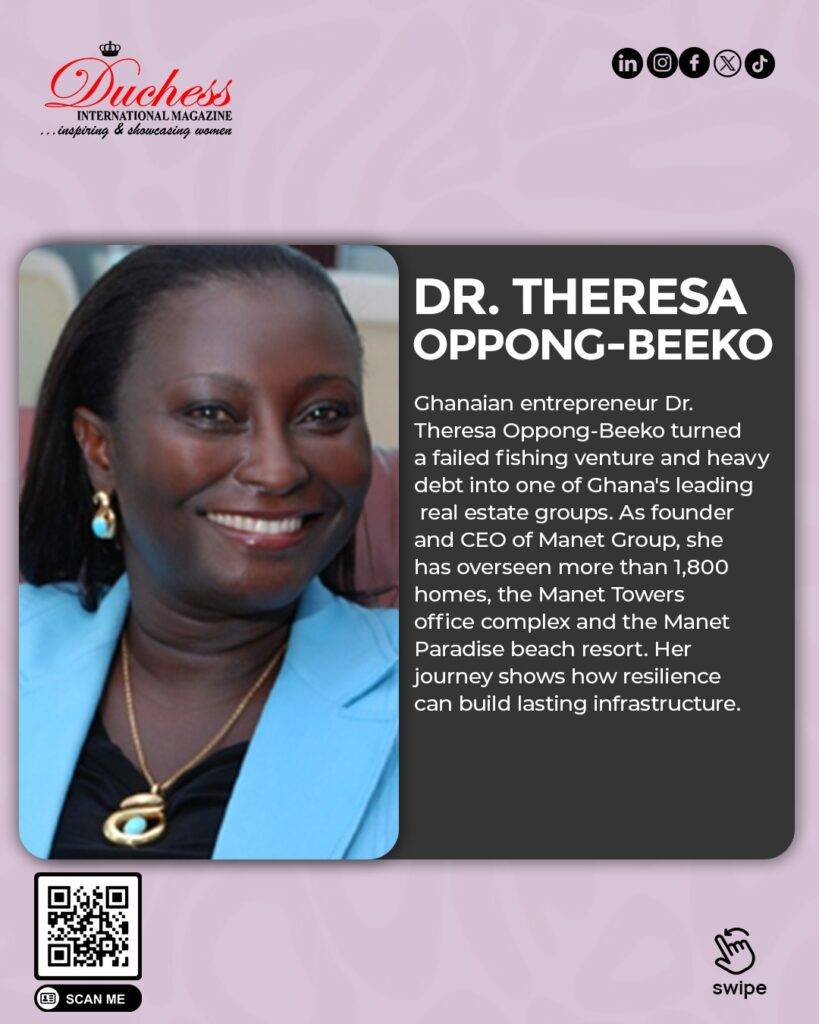
If Adenowo represents design excellence, Dr. Theresa Oppong-Beeko represents resilience. After graduating from the University of Ghana, she began her career in fishing, but the venture failed and left her about $2.5 million in debt. Instead of walking away from business, she returned to the University of Ghana for an MBA, spotted an opportunity in the fast-developing housing market, and in 1994 established Manet Housing Limited, though some profiles date the group’s founding to 1992. Manet has grown into a wider group: its hotel arm developed a beach resort at Ada into a three-star, 48-room hotel now known as Manet Paradise, and the group also includes Manet Construction and Manet Towers, an office complex. Manet has reportedly developed more than 1,800 homes across Accra, and is described as Ghana’s second-largest real estate firm. She has said the company set out to build homes that lower-income Ghanaians could afford, and the University of Ghana honoured her with an honorary doctorate for her contribution to the sector.
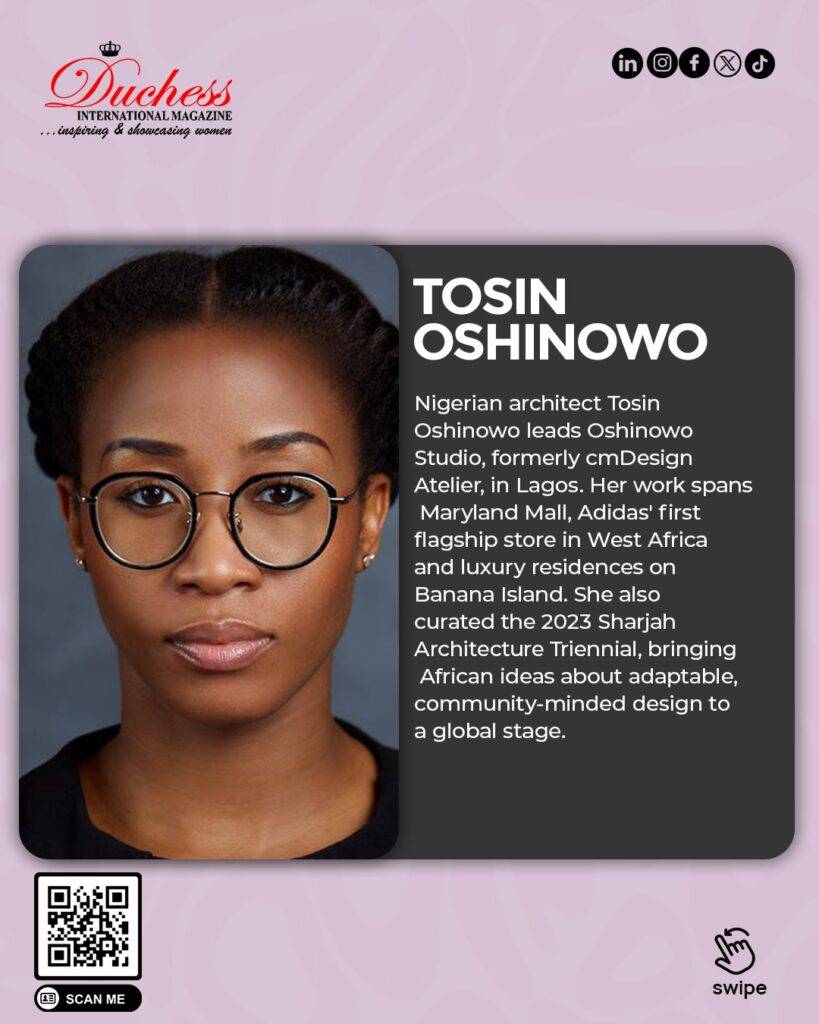
Tosin Oshinowo brings a global education and a curator’s eye to Lagos. She worked at Skidmore, Owings & Merrill in London and at OMA in Rotterdam before returning to Nigeria, where she led the master plan and corporate head office for Nigeria LNG in Port Harcourt. In 2013 she formed Oshinowo Studio, formerly cmDesign Atelier, and its portfolio is strikingly varied. It includes the Maryland Mall in Lagos, Adidas’ flagship store in West Africa and a UNDP-backed village reconstruction in northern Nigeria. In the luxury space, Lantern House, a Banana Island villa, uses perforated gold-toned metal screens to filter light and air, while the Coral Pavilion is a beach house accessible only by boat. Her influence extends well beyond construction sites: she curated the 2023 Sharjah Architecture Triennial, co-curated the 2019 Lagos Biennial, and received a special mention at the 19th Venice Architecture Biennale for her exhibition on Lagos’s self-organising markets. Her philosophy is grounded in context, and as she puts it, “architecture doesn’t exist in a vacuum”.

Ichechi Okonkwo came to property from banking, and her route shows how diverse the paths into the industry can be. She spent six years at Guaranty Trust Bank before launching Laundry King, a premium dry-cleaning brand in Lekki, in 2011, and then turned to real estate as CEO of Victoria Crest Homes and Dream Estate Lekki. She is candid about the company’s origins, saying it was her husband who founded it, while noting that her father was a surveyor whose commitment to property convinced her it was worth pursuing. Under her leadership, Victoria Crest Homes is credited with pioneering the first solar-powered estate in Nigeria, and the company has built more than 3,000 residences over two decades while keeping aspirational living affordable. She is frank about the industry’s realities, from currency swings that raise the cost of imported finishing materials to selling projects off plan to fund each stage of construction. She has also invested in the next generation, since she founded the Women in Real Estate and Development (WIRED) Africa Network to offer mentoring and networking to women in the sector. Her message to women is direct: “Anyone can excel anywhere, the only difference is your resolve.”
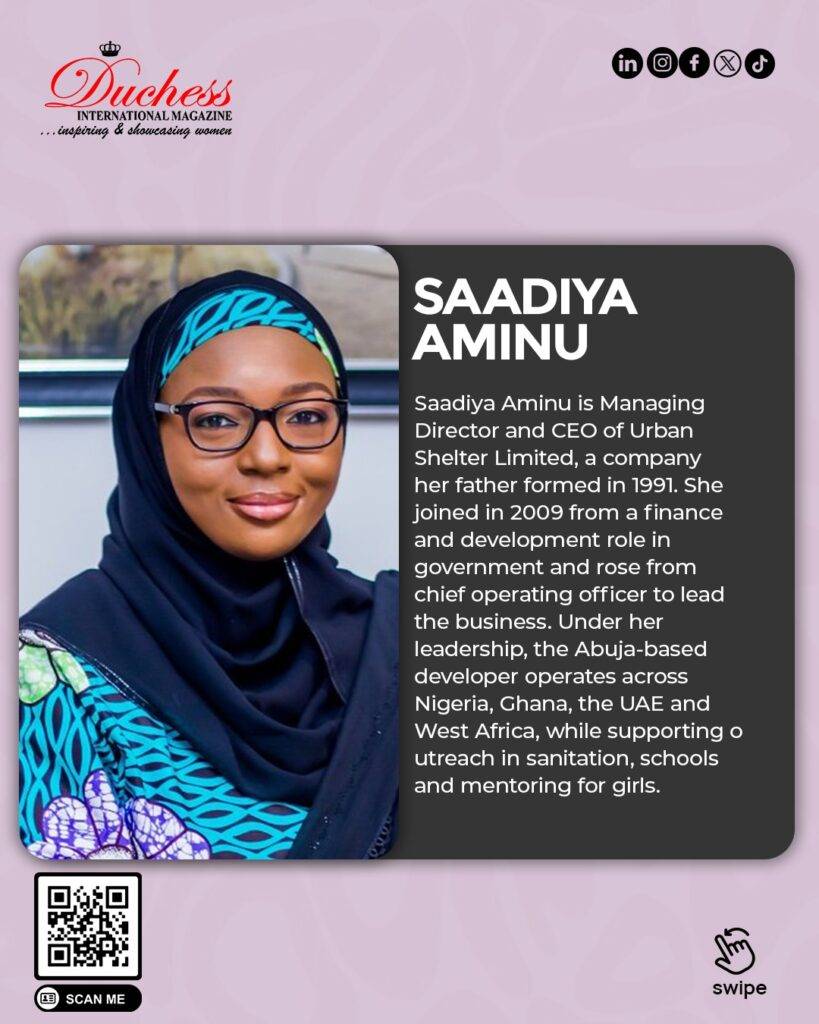
Saadiya Aminu grew up inside the industry she now leads. Her father formed Urban Shelter in 1991, and real estate was the constant topic at home even while she attended boarding school in the UK. She holds an MSc in Finance and Development from the School of Oriental and African Studies and began her career outside the family business. She joined Urban Shelter in 2009 from a finance and development role in government and rose from chief operating officer to managing director and chief executive. The Abuja-headquartered company operates across Nigeria, Ghana, the UAE and the wider West African region, and she is credited with a major repositioning in 2015 that strengthened its leadership in the sector. Urban Shelter makes homes more accessible through flexible payment plans and basic infrastructure, and its outreach includes sanitation projects, school improvements and mentoring for young girls. She has been open about the pressure of earning authority, recalling that she had to convince more senior male colleagues of the value she brought, and her advice to other women is captured in a single line: “Don’t wait until you’re a leader.”
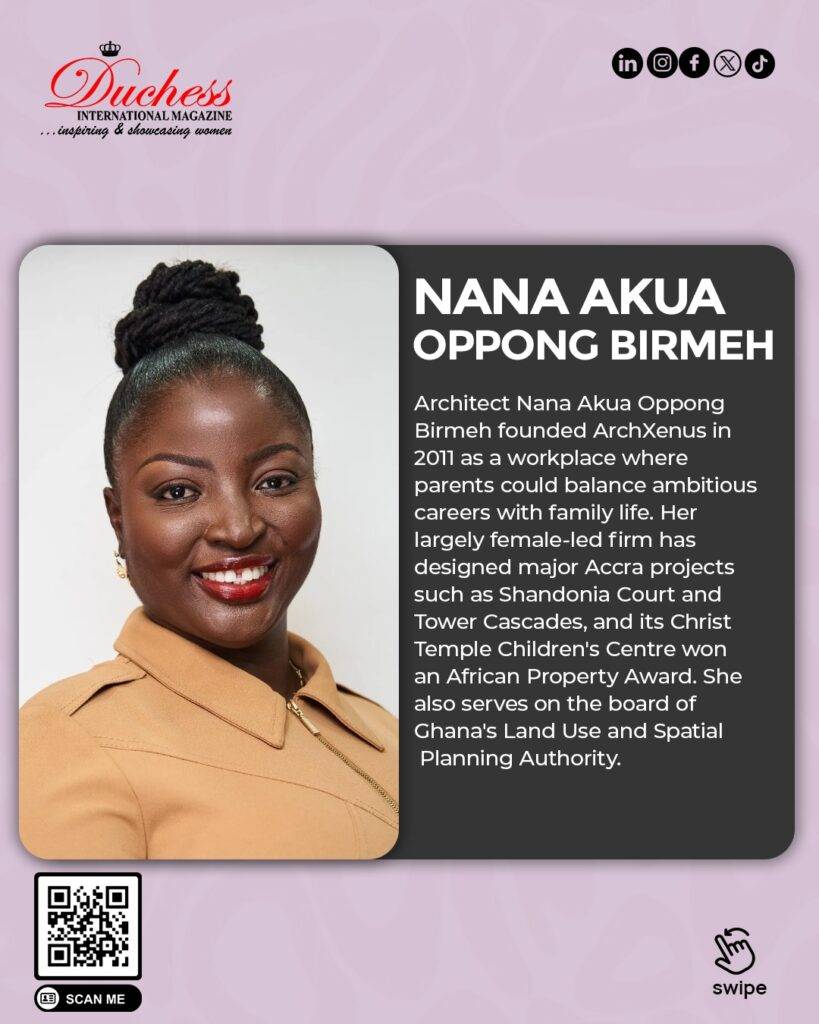
Nana Akua Oppong Birmeh shows what happens when a workplace is designed around real life. She founded ArchXenus in 2011 after the challenge of building a strong career while nurturing a meaningful family life, and created it as a place where parents could bring their children to work. The firm is largely female and has grown into a serious force in the market. It has worked on some of Ghana’s largest multi-residential projects, including Shandonia Court and the award-winning Tower Cascades in Accra, and its Christ Temple Children’s Centre, completed in 2017, won an African Property Award. A mother of four, she was recognised in the 2017 Forty under 40 awards, and she believes every ArchXenus design should benefit the environment where it is built. Her influence has moved into policy too: in November 2021 she was appointed to the governing board of the new Land Use and Spatial Planning Authority, representing the Ghana Institute of Architects. She is also committed to mentoring students and young professionals.
Their journeys could hardly be more different. Adenowo founded her firm at 25, Oppong-Beeko rebuilt from debt, Oshinowo trained abroad before returning home, Okonkwo left banking, Aminu stepped up within a family enterprise, and Oppong Birmeh built a firm around the way she wanted to live. Yet common threads run through all six stories. Each has faced the realities of a capital-intensive industry, from debt and foreign exchange pressure to the need to earn credibility among senior male colleagues. Each has also treated success as something to share, through mentoring networks, foundations, community projects and roles in policy and planning. Their focus on affordability, sustainability and human-centred design suggests that the next chapter of African real estate will be judged not only by how high buildings rise but by who they serve.
The skylines these women are shaping are more than steel and glass. They are proof that vision, resilience and a willingness to challenge convention can change a city’s silhouette and the expectations of the girls who grow up looking at it. As Lagos, Abuja and Accra keep growing, the question is no longer whether women belong in the boardrooms and design studios that decide what gets built. It is how quickly the industry will follow the example these six have set. For every young African woman who dreams of building, they offer the same message: the future skyline has room for her name.