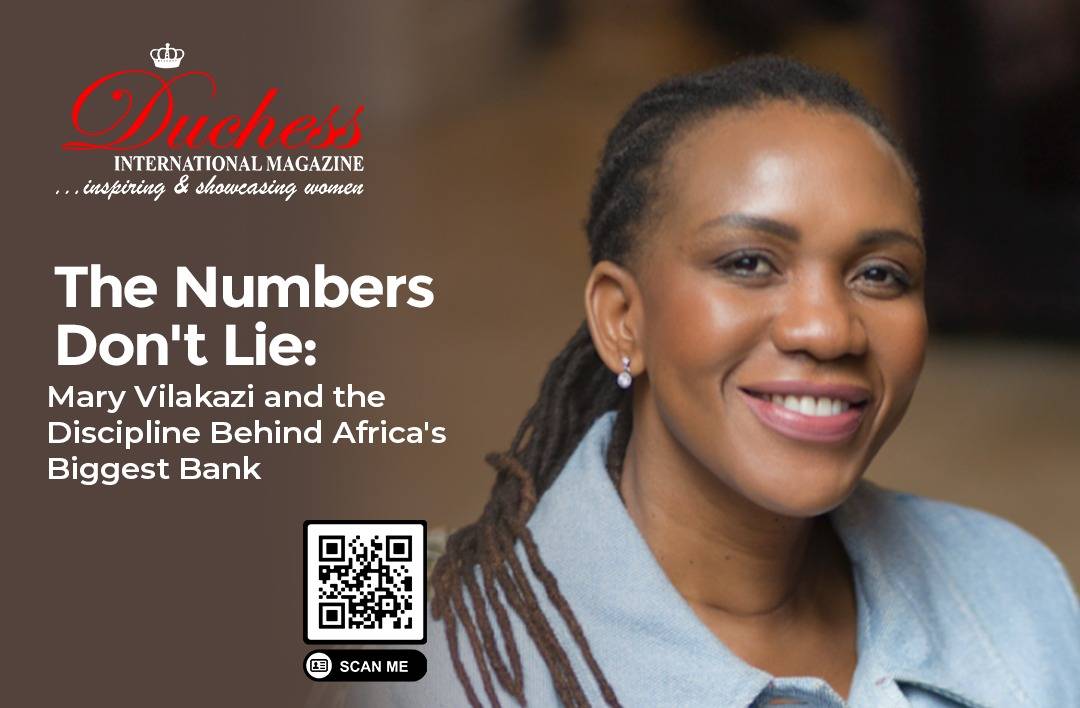
There is a temptation to measure Mary Vilakazi’s rise by the milestone. On 1 April 2024, she became Group CEO of FirstRand, making history as the first woman to occupy the position. It is an important moment in a financial sector where women remain underrepresented at the highest levels of corporate leadership. But history alone does not explain why Vilakazi’s leadership matters. The more revealing measure is found in the numbers. FirstRand entered her tenure as one of Africa’s most successful financial-services groups, and her challenge was never simply to make a struggling institution profitable. It was to lead an already powerful organisation without losing the discipline that made it powerful in the first place. That makes her tenure less a turnaround story and more a test of whether a leader can sustain performance while preparing a large institution for its next phase.
The scale of what Vilakazi inherited is important. FirstRand is not simply a traditional bank operating under one brand. It is a portfolio of integrated financial-services businesses that includes FNB, RMB, WesBank and other operations across South Africa, selected African markets and the United Kingdom. Its strength comes partly from this diversification: different businesses serve different customers, generate different sources of income and operate across different markets. Leading such a group requires more than a compelling vision. It requires decisions about capital, credit, technology, costs, customers, risk and growth to work together. Vilakazi’s background made that complexity familiar. Before becoming CEO, she had already served as FirstRand’s Group COO, a position she held from 2018 until her appointment as CEO. FirstRand’s own governance records confirm that she succeeded Alan Pullinger as Group CEO on 1 April 2024.
Her career before FirstRand also helps explain the emphasis on operational discipline. Vilakazi trained as a chartered accountant and built her early career at PwC, where she worked extensively with financial-services companies before moving into executive leadership at MMI Holdings. By the time she arrived at FirstRand, she was not coming into the organisation as an outsider trying to understand its machinery from scratch. Her years as COO placed her close to the execution of strategy and the management of the group’s operations. FirstRand’s 2023 remuneration report described her as an integral member of the executive team, working closely with the CEO and CFO on strategy execution and management. That history matters because the CEO role at a group of FirstRand’s size is ultimately an execution job. Vision may set the direction, but thousands of decisions about lending, investment, costs, technology, people and risk determine whether the strategy actually survives contact with reality.
The financial results provide the first serious test. For the financial year ended June 2025, FirstRand reported normalised earnings of R41.8 billion, an increase of 10% from the previous year, while normalised return on equity stood at 20.2%. The group also reported strong capital generation and maintained a credit-loss ratio of 85 basis points. Those figures do not prove that every result was created by Vilakazi personally—she had been CEO for only part of the reporting period and inherited strategies already in motion—but they do establish the environment in which she is leading. FirstRand was not looking for survival. It was trying to compound growth while preserving high returns and controlling risk. That distinction is crucial. Running a high-performing institution can be harder in some respects than rescuing a failing one because there is less room for unnecessary experimentation. The task becomes knowing what to change without damaging what already works.
FNB illustrates why the group’s performance cannot be reduced to a single headline earnings number. For the year ended June 2025, FNB delivered 7% growth in normalised profit before tax and recorded a 37.4% return on equity. The business also grew deposits in South Africa by 7%. These numbers matter because FNB sits at the centre of FirstRand’s relationship with millions of retail and commercial customers, making its performance an important indicator of the group’s ability to translate scale into recurring economic value. Behind those figures are decisions about customer acquisition, digital banking, lending, deposits, pricing and operational efficiency. The important point is not that Vilakazi personally produced every one of those outcomes. It is that she is now responsible for the system that must keep producing them. Leadership at this level is less about being the person who makes every decision and more about building an organisation capable of making good decisions repeatedly.
Risk provides the other side of the equation. Banking can make growth look deceptively easy: lend more, acquire more customers and report higher revenue. The real test comes later, when the quality of those loans is revealed. FirstRand’s 85-basis-point credit-loss ratio for the year ended June 2025 remained at the lower end of the group’s stated through-the-cycle range. That does not mean the institution is immune from credit stress, nor does it mean future performance is guaranteed. It does, however, show why the phrase “disciplined growth” is more useful than simply saying “growth.” A bank has to earn attractive returns while taking risks it can absorb. Vilakazi’s leadership therefore sits at the intersection of two competing demands: the organisation must continue finding opportunities to grow, but it must not sacrifice the quality of the balance sheet in pursuit of them. That tension is where much of banking leadership actually happens.
The same discipline appears in FirstRand’s approach to expansion. The group has not built its African strategy around planting operations everywhere simply because a market is available. Its model has been to identify markets and customer segments where its businesses can develop a competitive advantage and generate attractive returns. Its broader portfolio also gives it exposure to specialist financial-services opportunities outside traditional retail banking, including WesBank’s vehicle and asset-finance activities and its UK businesses. This approach is significant because Africa’s financial-services opportunity is enormous, but so are the differences between its markets. Regulation, currencies, infrastructure, customer behaviour and economic conditions vary widely. Expansion without a clear economic rationale can become expensive quickly. The discipline is therefore not in refusing to grow; it is in knowing where growth deserves capital.
There is another dimension to Vilakazi’s story that deserves attention: the challenge of leading a successful institution through change. FirstRand does not have the luxury of standing still. Customer expectations are changing, technology is reshaping financial services, competition from digital players continues to evolve and economic conditions can alter the behaviour of both consumers and businesses. Yet a company of FirstRand’s scale cannot respond to every new trend by abandoning what made it successful. Its strategy has continued to emphasise platform businesses, customer ecosystems, digital capabilities, data and disciplined capital allocation. Vilakazi’s role is therefore not to manufacture disruption for its own sake. It is to decide where change creates genuine economic value and where consistency is the smarter choice. That is a less glamorous definition of leadership, but perhaps a more useful one.
This is why the significance of Vilakazi’s appointment should extend beyond the phrase “first woman CEO.” Representation matters, but occupying the seat is only the beginning of the story. The harder question is what happens once the historic appointment becomes yesterday’s news. Can she preserve FirstRand’s returns? Can the group continue growing without taking disproportionate risk? Can its African businesses deepen their relevance? Can its technology and customer platforms continue to create an advantage? Can it remain efficient as the financial-services industry becomes more competitive? Those questions cannot be answered by a biography or a photograph. They will be answered over time through earnings, returns, capital strength, customer growth and the quality of the decisions behind those numbers. FirstRand’s next full-year results will provide another important data point in that assessment.
For Mary Vilakazi, then, the most interesting part of the story may not be that she broke through a ceiling. It is what she has to do after breaking it. She inherited an institution with strong franchises, significant scale and a record of generating high returns. Her challenge is to protect those advantages while making the choices required for the next decade. That requires patience when patience is appropriate, aggression when opportunity demands it, restraint when risk becomes excessive and the ability to distinguish genuine progress from activity that merely looks impressive. The numbers cannot tell us everything about a CEO’s character, judgment or leadership style. They can, however, reveal whether an institution is creating value, destroying it or standing still. And for now, the figures from FirstRand’s reported performance provide a compelling starting point for understanding Mary Vilakazi’s leadership: not as a story about symbolism alone, but as a story about the discipline required to keep a giant performing when there is no turnaround to hide behind.