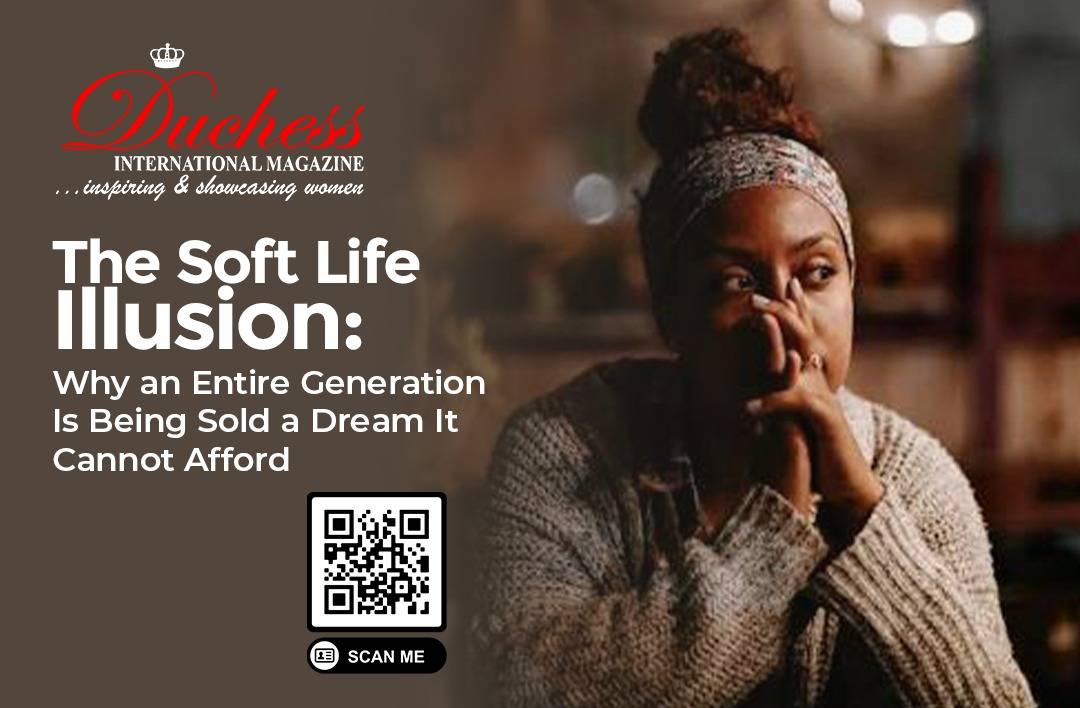
The soft life was never supposed to be a lie. When the phrase first entered Nigerian and Ghanaian internet culture, it meant something simple and honest: the desire to live comfortably, to rest without guilt, to be cared for without having to beg for it. Nobody needed to apologize for wanting that. But somewhere between the joke and the movement, travelling outward from Lagos to London to Los Angeles, the meaning was quietly rewritten. Soft life stopped describing how a woman lives and started describing how she appears. It became an aesthetic, then a brand, then a performance, and performances, unlike lives, must be maintained whether or not you can afford them.
Let us be precise about what has actually changed, because the term has been deliberately blurred and that blurring is part of the strategy. In its original usage, soft life was an aspiration, the simple wish to not struggle endlessly, to have comfort, to be cared for. There is nothing wrong with that wish. No woman, anywhere in the world, should be made to feel guilty for wanting ease. But aspiration describes a direction. A performance describes a product. And somewhere along the way, across borders, across platforms, across translations into a dozen different cultural contexts, the soft life stopped being something a woman moved toward and became something she had to display immediately, convincingly, and continuously.
Here is what rarely survives the caption: the people most visibly living this life, in Lagos, London, or Los Angeles, are almost never the people who built it from nothing in front of you. Somewhere behind nearly every effortless morning sits a husband’s income, a sponsor’s quiet terms, a parent’s property, a credit line, or a photograph of a hotel room taken while the rent on an actual apartment goes unpaid. A twenty-four-year-old in Nairobi, Accra, or Brooklyn, working two jobs to make rent, is not watching an aspiration when she opens that feed. She is watching what looks like a peer, apparently living proof that the comfort is reachable right now, if only she adjusted her choices correctly, with no way of knowing she is comparing her unfinished chapter to someone else’s inheritance, her own hustle to someone else’s debt. A generation of young women is being taught to look rich before they are stable, to appear rested before they have earned rest, and to perform ease while quietly drowning. And the worst part is that the performance is working. The likes come. The comments call her a soft life queen. Nobody asks how it is being financed.
None of this happens by accident. Africa’s digital economy, and the global creator economy feeding off it, has produced a vast content marketplace, and the most lucrative currency in that marketplace is aspiration, not satisfaction. Brands pay for it. Influencers monetize it. Platforms amplify it, because envy holds attention far better than contentment ever will. And young women, especially those who watched their mothers work themselves into exhaustion for wages that never stretched far enough, are the ideal audience. They do not want to repeat their mothers’ lives. They were promised something better. Someone simply realized that the promise could be sold to them long before it could ever be delivered.
But here is what the soft life, as marketed, will never tell you: ease that you did not build is not ease. It is dependency, dressed up as luxury, and dependency has always been one of the oldest traps set for women, in every culture that has ever asked them to be comfortable rather than free. The marriage that was really a transaction. The job that was really a favor. The lifestyle that was really a leash. The soft life is simply the current decade’s version, wrapped in aesthetics and sold with a caption about healing. When a woman’s comfort rests entirely on another person’s continued willingness to provide it, she has not escaped struggle. She has traded control for comfort, and control, once surrendered, is very difficult to get back.
This is not an argument for suffering, and it is not a defense of hustle culture, which is its own lie and its own exploitation in the opposite direction. The real alternative to the soft life illusion is something far less glamorous and far more durable: a life you own. A life where the rest is earned and therefore genuinely restful. A life where the comfort is yours, not borrowed, not rented, not dependent on someone else’s affection or algorithm. A life where you can be soft because you built the ground you are standing on, not because someone else is temporarily holding you up for the photograph.
If you have been chasing the appearance of a soft life while your actual life stays fragile, the first step is not shame. It is an honest audit. What do you earn? What do you owe? Who are you depending on, and what happens to your comfort the moment they withdraw it? What skills do you actually have that the market will pay for, not someday, but now? What would your life look like if it were built on assets you control rather than appearances you maintain? These questions are uncomfortable in every language and every currency. They are also the only questions that lead anywhere real.
The soft life is not the enemy. The illusion is. The dream of comfort is legitimate, and every woman, wherever she is reading this, deserves a life that does not grind her down. But you cannot purchase your way into stability, you cannot perform your way into peace, and you cannot post your way into freedom. The women who will be genuinely soft in ten years, who will rest without fear, spend without guilt, and choose without pressure, are the ones quietly building today, while everyone else is busy looking like they already have it. That is not a glamorous message. But it is the truth, and the truth, unlike the illusion, will still be standing when the balance comes due. The soft life is not the dream. A life you own is. Everything else is just content.