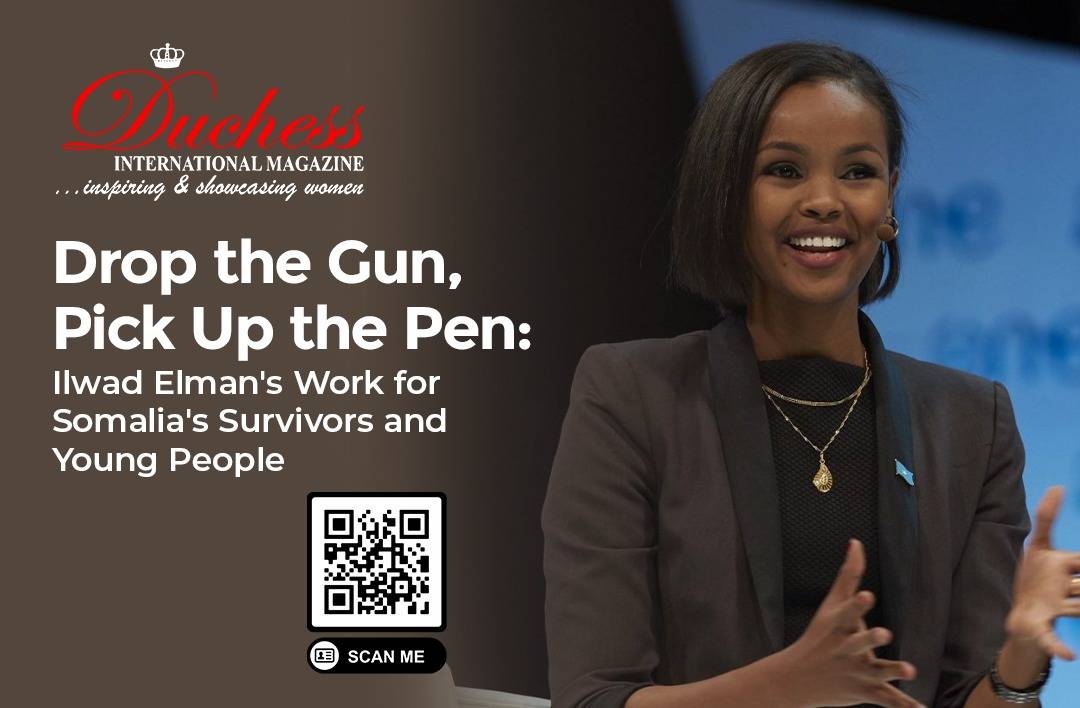
On the 9th of March, 1996, a Mogadishu entrepreneur and peace activist named Elman Ali Ahmed was assassinated for the work he had spent years building: disarming and rehabilitating child soldiers in a country tearing itself apart. He left behind a mantra that would outlive him by decades, four words repeated across Somalia long after his death: drop the gun, pick up the pen. He also left behind four children, among them a daughter named Ilwad, barely old enough to remember him clearly, who would eventually return to the exact city that killed her father and spend her adult life trying to finish what his assassins had tried to end.
The family fled Somalia for Canada as civil war consumed the country in 1991, and Ilwad grew up there with almost nothing positive to hold onto about the home she had left, only her father’s story and the fragments her mother, Fartuun Adan, carried with her. In 2006, a decade after her husband’s murder, Fartuun made the decision to return to Mogadishu and rebuild the organisation he had started, Elman Peace. Four years later, in 2010, a nineteen-year-old Ilwad went to visit her mother and see the work firsthand. She never properly left again. Mogadishu was still, at that point, a city where large parts of the south and central regions remained under the control of Al-Shabaab, an Al-Qaeda-linked terrorist group. She walked into that reality anyway, carrying a father’s mantra she had never actually heard him say in person.
What she and her mother built together, as co-founders, became Sister Somalia, the country’s first rape crisis centre, established the same year Ilwad arrived. It emerged in direct response to a surge in sexual violence against women displaced by the ongoing conflict, women arriving in Mogadishu with nowhere else to turn and no existing institution built to receive them. At just twenty years old, Ilwad had helped found a centre addressing one of the most dangerous, stigmatised, and politically fraught issues in the entire country, in a context where speaking openly about sexual violence could itself invite retaliation.
That retaliation is not abstract. Women human rights defenders in Somalia face reprisals, threats, unlawful arrest, sexual and gender-based violence, kidnapping, and killing specifically because of their work, a reality Ilwad has spoken about directly rather than minimising. The danger reached her own family in the most devastating way possible in November 2019, when her sister, Almaas Elman, who had also returned to Somalia as an aid worker after growing up in Canada, was killed near Mogadishu’s airport. The family that had already lost a father to the fight for peace lost a daughter to the same unfinished struggle, a full generation later.
Despite that cost, the work never contracted, it expanded. As Director of Programs and Development at the Elman Peace and Human Rights Centre, Ilwad built a portfolio spanning human rights, gender justice, protection of civilians, and peacebuilding, with particular focus on two groups most societies find easiest to overlook: survivors of sexual and gender-based violence, and children and youth disengaging from armed groups. The latter work means designing actual pathways, not slogans, for young people who were recruited, sometimes forcibly, into Al-Shabaab and other armed factions, to leave that life and re-enter civilian society with real economic opportunity waiting for them, rather than returning them to the exact conditions of poverty and desperation that made recruitment possible in the first place.
Her influence has never stayed confined to Mogadishu. In 2015, she briefed the United Nations Security Council during its Open Debate on the Protection of Civilians, the first time a civil society representative had ever been invited to address that specific debate, and the first time the annual thematic discussion centred on women’s empowerment and participation. She has since been named an expert in the Women Waging Peace Network for Inclusive Security, served as a One Young World Ambassador to Somalia since 2013, and was selected as an advocate for the Kofi Annan Foundation’s Extremely Together initiative, working alongside nine other young leaders worldwide on preventing violent extremism. In 2016, she was voted African Young Personality of the Year at the Africa Youth Awards. In 2015, Harvard Kennedy School’s Center for Public Leadership awarded her and her mother the Gleitsman International Activist Award, recognising their joint leadership rehabilitating child soldiers, supporting survivors, and shaping Somalia’s human rights policy discussions.
She has also made space, deliberately, for ideas her father’s generation never had access to, organising TEDxMogadishu, bridging a gap between Somalis living inside the country and the vast Somali diaspora scattered across the world, people who share a homeland but have had almost no shared platform to exchange ideas across that distance until she built one. It is a smaller, quieter initiative next to crisis centres and UN briefings, but it reflects the same underlying instinct: that rebuilding Somalia requires more than physical reconstruction, it requires rebuilding the connective tissue between people the war had scattered and silenced.
What makes Ilwad Elman’s story difficult to reduce to a single achievement is that the work was never really a career choice in the conventional sense. It was an inheritance, handed to her by a father she barely knew, carried forward by a mother who returned to danger rather than stay safely in exile, and paid for, in the most literal sense, by a sister who did not survive the same mission. She has built crisis centres, briefed the Security Council, and created reintegration pathways for former child soldiers, but underneath all of it sits a four-word sentence her father never lived to see fully realised, a sentence she has now spent more than a decade proving was never naive. It was simply ahead of its time.
Somalia’s path out of three decades of conflict was never going to be resolved by a single family, a single centre, or a single generation. But Ilwad Elman has spent her entire adult life treating her father’s assassination not as the end of an argument, but as the opening line of one she intends to keep making, in crisis centres, at the United Nations, and in the quiet, unglamorous work of helping a nineteen-year-old former fighter learn a trade instead of a weapon, until the mantra her father died for finally stops sounding like a slogan and starts sounding, simply, like how things are done.