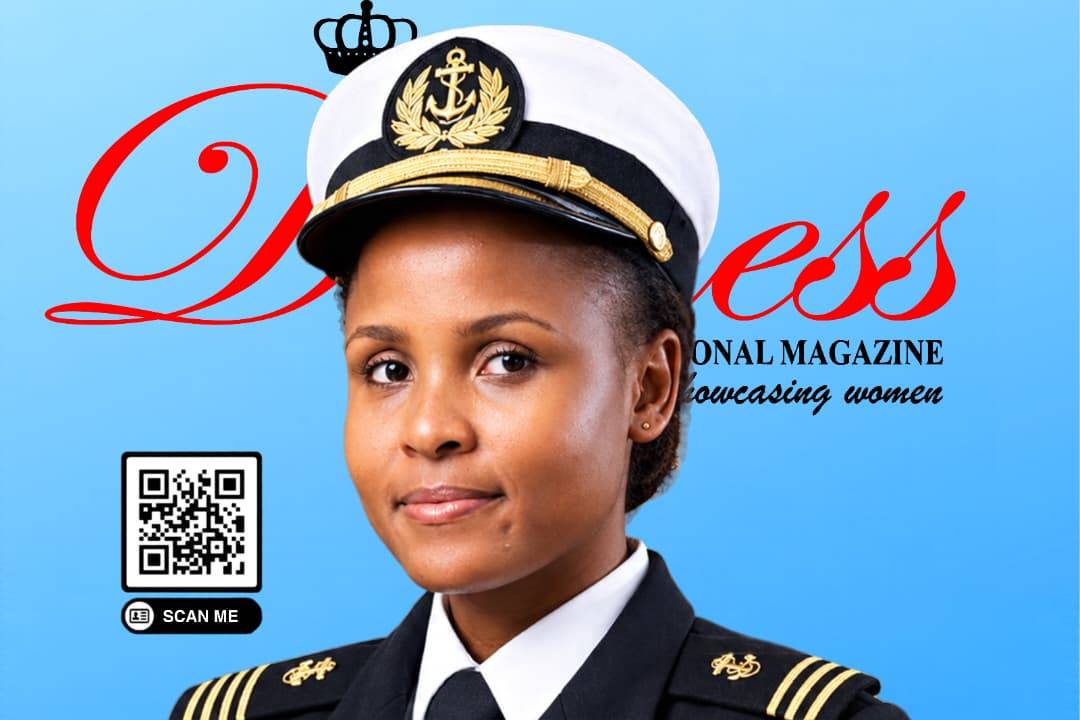
Before becoming one of Kenya’s pioneering women in maritime navigation, Elizabeth Marami faced a challenge that no amount of academic preparation could solve on its own: finding an industry willing to give her the opportunity to prove what she could do.
Growing up in Mombasa, Kenya, Elizabeth Wakesho Marami was surrounded by the sight of ships moving through the Indian Ocean, entering and leaving the harbour as part of the rhythm of coastal life. Yet the idea of working aboard those vessels was not necessarily an obvious career choice for a young woman in a profession long associated with men. Marami, however, was drawn to the possibility of doing something different. Rather than follow the conventional route into a familiar profession, she chose to pursue a career that would take her far beyond the shores she knew. Today, she is recognised as Kenya’s first female marine pilot, a pioneering achievement built on years of study, professional persistence and a determination to establish herself in an industry where women remain underrepresented. Her journey is not simply a story about becoming the first woman to occupy a particular professional position; it is about what happens when ambition meets the difficult realities of gaining access to an unfamiliar and demanding field.
Marami’s first major decision came when she had to choose between two very different professional futures. Although she had an opportunity to study Law at the University of Nairobi, she pursued a scholarship to study nautical science at the Arab Academy for Science, Technology and Maritime Transport in Alexandria, Egypt. The programme offered a route into navigation, ship operations and a specialised profession that few Kenyan women had entered before her. Between 2009 and 2013, she undertook the demanding academic training required to understand the science and discipline behind maritime operations. Navigation requires more than knowing how to steer a vessel; it involves understanding charts, weather, ship handling, safety procedures and the complex decisions necessary to move ships through waterways. Marami committed herself to acquiring that knowledge, graduating with the qualifications needed to begin building a career at sea. Her decision demonstrated an important quality of professional ambition: the willingness to pursue an opportunity because it aligns with your interests and aspirations, even when it leads somewhere unfamiliar.
But completing her education was only the beginning. In maritime careers, academic qualifications must be supported by practical experience at sea, and aspiring officers need the appropriate sea time and professional certification to progress. For Marami, this next stage proved particularly difficult. In accounts of her experience, she described the frustration of watching male colleagues secure opportunities to advance while she struggled to obtain suitable placements. In a 2025 interview with Seatrade Cruise News, she recalled that after obtaining her Second Officer licence in 2014, she could not find a job at sea that would allow her to progress. Although she secured an apprenticeship opportunity with the Kenya Ports Authority, the position did not provide the same career progression she sought through her qualifications. This was a defining obstacle because the problem was no longer simply whether she could complete the training. She had done that work. The challenge was finding an employer willing to provide the practical experience necessary for her to move forward. Her experience exposed a difficult gap between preparing qualified professionals and ensuring they have a genuine opportunity to use their qualifications.
The period that followed tested her persistence. Marami has spoken about approaching shipping companies and being turned away, sometimes because she was a woman. The repeated rejections were especially frustrating because her male peers were progressing through the profession while she remained uncertain about how to obtain the experience required for her next qualification. It is easy to celebrate a pioneering woman after she has made history, when her professional title is established and her achievements are visible. It is harder to appreciate the uncertainty that can precede that recognition, when years of preparation have not yet translated into the opportunity a person needs. Marami’s experience illustrates why talent alone cannot guarantee professional advancement. Qualifications matter, but so do access, industry networks, recruitment decisions and employers willing to recognise potential. For an aspiring professional, rejection can be difficult enough when a skill needs improvement or an application is unsuccessful. It becomes a different challenge when the path forward appears narrower because of a characteristic unrelated to the ability to do the job. In Marami’s case, the experience became part of a larger determination to make the maritime industry more accessible to women following a similar path.
Her breakthrough did not arrive as one effortless leap from rejection to success. It developed through a series of opportunities that gradually expanded her experience. After working as a marine pilot apprentice at the Kenya Ports Authority, she secured a deck cadet position with CMA CGM in 2017. She subsequently joined MSC Cruises in 2018 as a third deck officer before moving to Celebrity Cruises, where she advanced through increasingly senior responsibilities. These opportunities mattered because they placed her within international maritime operations and allowed her to build the professional experience required for further progression. Working at sea brings responsibilities that cannot be learned from textbooks alone: officers must understand bridge procedures, communicate clearly with their teams, follow safety protocols and make decisions within a disciplined operational environment. On cruise ships, these responsibilities are part of a much larger operation involving passengers, crew, equipment and the safe movement of a vessel across international waters. Marami’s progress through these roles demonstrated the value of combining academic preparation with practical experience. The opportunity to work internationally did not erase the difficulties she had encountered, but it gave her another route through which to establish her capabilities and continue developing her career.
There is another important dimension to Marami’s story: the ability to keep learning while working in an environment where expectations are high and responsibilities are substantial. Maritime work is a team effort, and the safe operation of a ship depends on training, communication, technical competence and respect for established procedures. For women entering a profession in which they may be among very few female colleagues, there can also be the additional challenge of navigating assumptions about who belongs in a particular role. Marami’s career demonstrates why competence must be developed, recognised and given room to grow. Her experience also challenges the idea that women who enter male-dominated industries should have to become symbols of exceptional strength before they are accepted as professionals. They should be able to learn, make progress, gain experience and be assessed according to the standards of their work. What makes Marami’s achievement noteworthy is not that she somehow escaped the demands of maritime training, but that she pursued the same demanding professional pathway while confronting barriers that her male counterparts did not necessarily face in the same way.
Beyond her individual career, Marami has also worked to bring attention to the experiences of other women in the maritime sector. She founded the Against the Tide Foundation as a digital storytelling initiative to give women in maritime spaces an opportunity to share their experiences and draw attention to the challenges they encounter. The initiative grew out of her own frustration with the difficulties of securing employment and progressing after completing her training. Its purpose reflects an understanding that a pioneering achievement becomes more meaningful when it helps other people imagine a future for themselves. When women share their experiences in industries where their presence is less visible, they help challenge assumptions about who can succeed and provide aspiring professionals with examples of possible career paths. This kind of visibility is particularly important in specialised sectors such as shipping, where many young people may have little exposure to women working in technical or operational roles. Marami’s work therefore extends beyond her own professional milestones: she has also contributed to a wider conversation about representation, opportunity and the need to make maritime careers more accessible.
Her professional journey has continued to evolve. In May 2025, industry reporting documented her return to the Kenya Ports Authority in the role of Senior Marine Pilot in Mombasa, bringing her career back to the Kenyan maritime environment where she first pursued her ambition. The milestone carries particular significance because it connects the international experience she gained at sea with the port operations she helped pioneer at home. A marine pilot assists vessels as they navigate the local waters and harbour approaches required to enter or leave port safely. The role demands detailed knowledge of the waterways, an understanding of vessel behaviour and the ability to work closely with ship crews and port teams. It is a specialised responsibility that combines technical expertise with sound judgement. For Marami, reaching this stage represents the continuation of a career built across different maritime environments, from training in Egypt to professional service on international vessels and leadership within Kenya’s port system. It also provides a concrete example of how experience gained abroad can contribute to professional development and expertise at home.
For readers of Duchess International Magazine, Marami’s story offers a valuable lesson about ambition, but it also raises a question that deserves attention: how many capable people are prevented from reaching their potential because they cannot obtain the first opportunity their training requires? Her journey illustrates the importance of more than individual determination. Educational institutions must prepare students for the realities of professional life, employers must provide fair access to practical experience, and industry leaders must recognise that recruitment and advancement decisions shape the future workforce. Encouraging women to study maritime science, engineering, aviation or other technical disciplines is important, but encouragement alone is not enough. Those women must also have access to placements, mentorship, professional development and clear routes into employment. Marami’s experience makes the distinction plain. A person can invest years in acquiring specialised knowledge and still struggle to progress if the opportunities needed to apply that knowledge remain out of reach. Her achievement is worth celebrating, while the barriers she encountered offer a reason to keep examining how professional pathways can become fairer and more accessible.
Elizabeth Marami’s journey is ultimately a story of persistence, professional growth and the importance of creating room for talent to flourish. She chose an unconventional career, completed demanding training, faced difficulties in securing the experience required to advance and continued pursuing opportunities across the international maritime sector. She then brought that experience back into a professional environment in Kenya, while using her platform to highlight the experiences of other women in the industry. Her story does not suggest that determination makes every obstacle disappear or that every aspiring professional can overcome structural barriers through effort alone. Rather, it shows why determination matters—and why institutions must do their part to ensure that ability has a fair chance to develop. As Duchess International Magazine celebrates women whose work expands what future generations can imagine for themselves, Marami stands as a compelling example of a woman who pursued a demanding professional ambition and helped make the maritime world more visible to those who might one day follow her. Her first big break was not the end of her story. It was one important step in a career that continues to demonstrate what becomes possible when preparation, opportunity and persistence meet.