

Every organisation has two charts. The first is the one pinned to the wall: boxes, lines and names, arranged by seniority. The second is never drawn, but everyone who works there knows it by heart. It shows who people actually turn to when a decision is hard, who they trust when the pressure rises and whose judgement settles the room. The two charts rarely match.
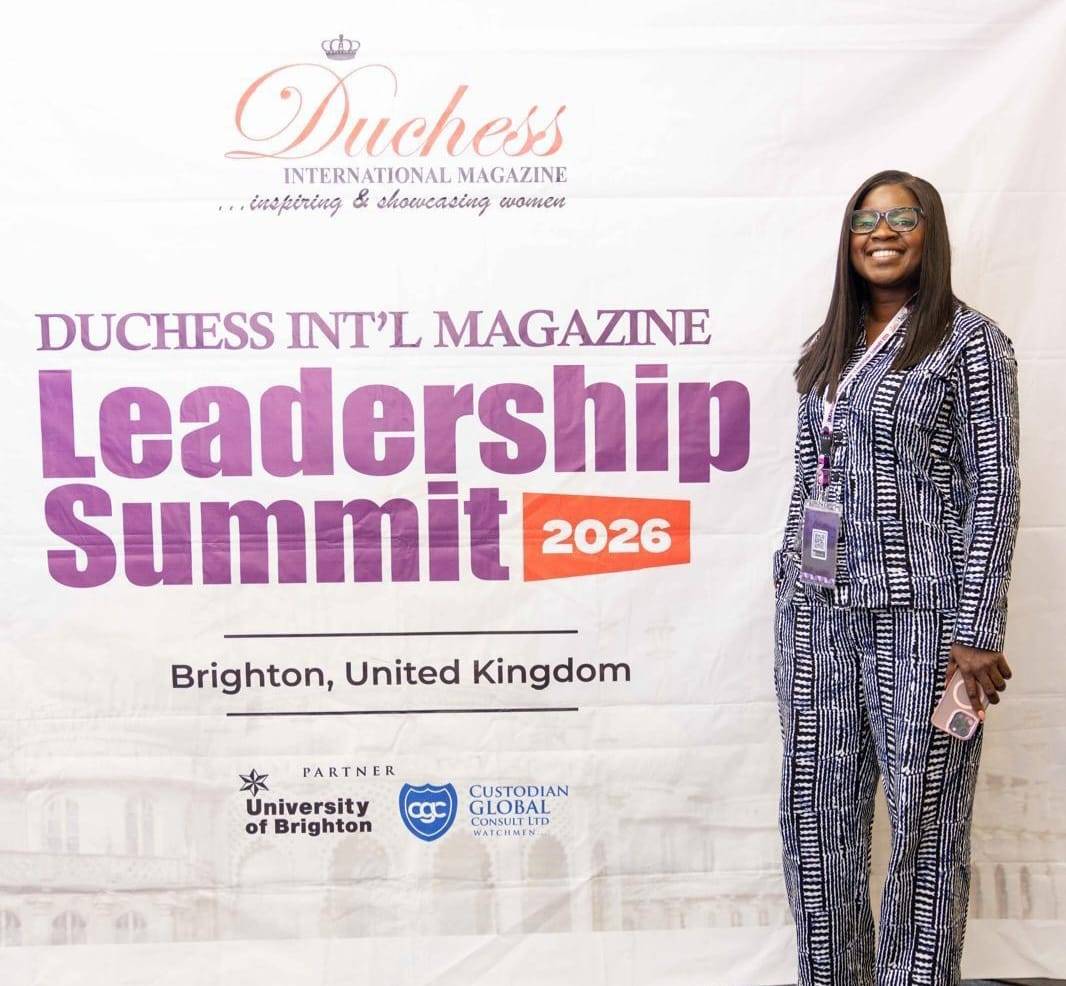
That gap, between the position a person holds and the leadership a person practises, sat quietly beneath the Duchess International Magazine Leadership Summit (DIMLS) 2026, held at the University of Brighton. The theme was Honouring Our Communities: The Audacity to Lead: Redefining Power, Purpose & Legacy. Read slowly, it is less a slogan than a set of questions. Who do we answer to? What is power for? Why are we doing any of this? What will be left when we are gone?
When delegates gathered across three intensive days in the United Kingdom under that banner, the conversation immediately dismantled the comfortable myths of the corner office. For decades, institutional culture across Africa and the diaspora has treated titles as terminal destinations, proof that an individual has arrived. Yet, as recent history across our boardrooms, state houses, community assemblies and neighbourhood networks painfully demonstrates, a title is merely rented furniture. It confers administrative access, not moral gravity. When the crisis hits and the structural scaffolding shakes, a title evaporates, leaving behind only the unmasked reality of who you are to the people you claim to serve.
To honour our communities, leadership must first be stripped of its performative vanity and re-engineered as an act of radical accountability. Traditional corporate and political frameworks have long operated on a transactional currency: authority is hoarded at the top, wielded through gatekeeping and measured by proximity to privilege. Outside the glass and steel of the corporate tower, the same test applies. The market matriarch who organises credit cooperatives, the community elder who mediates land disputes before they reach a courtroom, or the grassroots organiser who holds local municipal councils accountable on sanitation and schools holds no corporate letterhead. Yet they exercise supreme operational authority because their legitimacy is earned in the open square, not assigned by a resolution. The Brighton summit challenged our scarcity-driven habits by demanding the audacity to decentralise power everywhere. True leadership is not about building a pedestal that elevates you above the village; it is about acting as a load-bearing pillar that keeps the structure from crushing those beneath it. If your ascension costs your community its autonomy, your promotion is not a victory, it is an annexation.
Redefining power requires recognising that real leverage is relational, not positional. Whether it is a civil society advocate mobilising voters at a polling unit, leaders do not succeed because an organisational chart gave them permission. They succeed because they command technical competence and operational truth. Power, when detached from community responsibility, mutates into tyranny or indifference. The modern African leader must possess the tactical audacity to sit at global tables while refusing to internalise the logic of global exploitation, ensuring that every financial or diplomatic win cascades directly into local capacity.
Equally urgent is the redefinition of purpose, shifting it from an individual career narrative to a collective intergenerational contract. Too many ambitious individuals climb ladders leaning against the wrong wall, measuring fulfilment by personal accumulation rather than systemic repair. Purpose is the compass that keeps a founder, a public defender or a community worker steady when the applause stops and the institutional friction begins. It is the understanding that your individual brilliance, whether in quantum engineering, maritime logistics, community health or media production is raw material entrusted to you by a lineage of survivors who prayed for the exact room you now occupy. If your vision for tomorrow does not actively solve the structural vulnerabilities of the local trader, the rural student or the working-class mother, your purpose is incomplete.
This brings us to the true definition of legacy: legacy is not a bronze bust in a lobby, a ceremonial chieftaincy title or a flattering obituary written in past tense. Legacy is operational continuity. It is the school that survives your departure, the legal protection that outlasts your tenure, the cooperative society that keeps functioning after you step down and the financial pipeline you built so the next generation never has to beg for an open door. As highlighted during the summit’s dialogues on community, a legacy that cannot be inherited by the collective is merely a monument to ego. When we look at trailblazers who turned long public or corporate tenures into institutional springboards or built grassroots movements that outlasted their founders, their enduring power lies in the fact that they institutionalised access instead of hoarding it.
The audacity to lead, therefore, is an invitation to unlearn the quiet cowardice of compliance. It takes courage to stand in a boardroom and reject a profitable policy because it harms the public trust, just as it takes courage to challenge a local neighbourhood syndicate or political godfather demanding silence in exchange for peace. It takes audacity to tell an establishment, corporate, political or traditional that their version of submission is a brake on progress. Most importantly, it takes fierce internal discipline to realise that leadership is a daily, unglamorous negotiation between your personal ambition and your public duty. The title on your door or the prefix before your name will not save you when history asks what you did with the microphone.
For the readers carrying the charge from every community, the mandate is clear: The leaders who leave the deepest mark are rarely defined by the positions they held. They are defined by what they made possible for others. So the question for any of us is not whether we have the title. It is what we are doing with the responsibility we already carry. Whose life is better because you led? What door are you holding open? And when your time in the room is over, what will be different because you were there?
Titles change. Organisations restructure. Positions end. Leadership, the real kind, goes with you into every room and every community you touch, long after the nameplate has been taken down.

