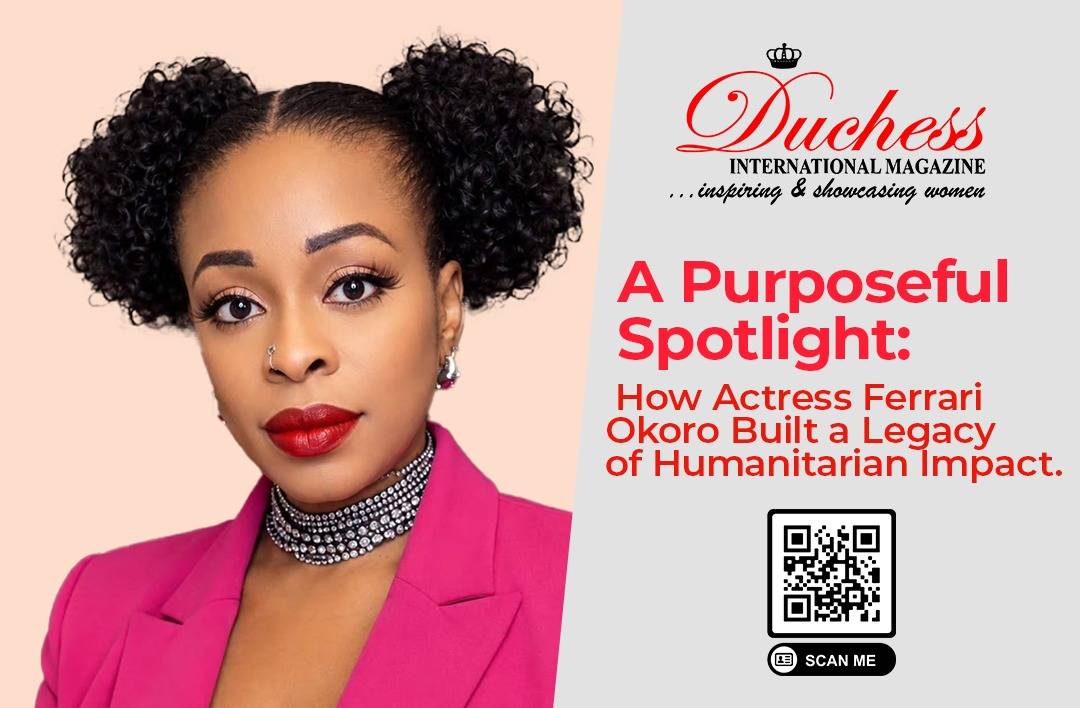
Born to a Cameroonian mother and a Nigerian father, Ferrari Okoro has always carried a global perspective on identity and community responsibility. Today, as an Eminent UN Peace Ambassador and a celebrated Nollywood filmmaker, her impact reaches far beyond the cinema screen. Having recently been honored with a prestigious Lifetime Achievement Award from elite Connecticut-based institutions, Okoro represents a new vanguard of African women who are leveraging creative success to drive sustainable social change.
Her early life in Lagos, shaped by a rich blend of Nigerian and Cameroonian cultures, instilled in her a profound understanding of the complex human and economic realities facing West African communities. Before stepping into the unpredictable world of media and arts, Okoro built a solid foundation in the corporate sector. Graduating with an Accounting degree from the Yaba College of Technology, she transitioned into corporate banking—a background that honed her sharp analytical skills, institutional discipline, and strategic mindset, which she later deployed into her creative and philanthropic ventures.
The pull of the arts eventually led her away from the banking halls and onto the movie screen, where she rebranded her professional identity under the name Tonia Ferrari. Her transition into Nollywood was marked by a deliberate choice to seek out roles that challenge conventional narratives and reflect the multifaceted realities of the modern African woman. Rising to prominence through stellar performances in both Yoruba and English-language blockbusters like Angela, Omotoke Gold, Ese, and Divorce Not Allowed, Okoro quickly established herself as a versatile actress capable of commanding deep emotional resonance.
For Okoro, cinema was never merely about entertainment or personal celebrity; it was conceived from the onset as an architectural tool for social advocacy. She recognized early on that the immense distribution networks of Nollywood could serve as powerful mirrors for societal reform, prompting viewers to question systemic biases, domestic challenges, and socio-economic inequality. By steering her production choices toward thought-provoking storytelling, she bridged the gap between popular culture and public enlightenment, ensuring her creative output always carried an undercurrent of purpose.
This artistic excellence has served as the ultimate resource engine for her deep-seated commitment to humanitarian work. Long before she commanded international headlines or stood on global stages, Okoro operated quietly on local soil, using her personal earnings to fund critical interventions for vulnerable populations. From settling hospital bills for indigent patients to sponsoring educational scholarships for brilliant but underprivileged children, her early philanthropy was a grassroots effort driven by pure empathy rather than public relations.
The global community has taken notice of this unique blend of cinematic artistry and structured social responsibility. In a historic moment of recognition, Okoro was recently honored with prestigious humanitarian accolades and a coveted Lifetime Achievement Award from a consortium of elite Connecticut-based institutions, including HBI University and the University of Hartford. This international validation underscores the reality that her impact has long transcended regional borders, positioning her as a distinguished cultural ambassador on the global stage.
Her formal designation as an Eminent UN Peace Ambassador further elevates her mission, providing a high-level diplomatic platform to scale her advocacy. Okoro treats this global microphone not as a badge of personal honor, but as a functional vehicle to broker resources, awareness, and partnerships for marginalized groups. On international stages, she consistently champions the critical causes of gender equity, maternal health awareness, child education, and economic inclusion, translating diplomatic influence into localized, actionable solutions.
What sets Okoro’s humanitarian model apart is her strict emphasis on sustainable empowerment rather than temporary relief. Drawing from her rigorous background in corporate finance, her foundation’s initiatives are meticulously designed to lift beneficiaries out of structural dependency through targeted vocational training and financial literacy programs for market women. By applying corporate transparency, strict budgeting, and long-term asset management to her charitable operations, she ensures that every donor resource and personal investment yields a measurable, lasting societal growth.
As a signature feature for Duchess International Magazine, Ferrari Okoro’s life offers a brilliant blueprint for the modern woman who refuses to be confined to a single professional box. She embodies the essence of an inspired life, one that balances the rigorous demands of international filmmaking with the deeply disciplined work of global humanitarianism. Her trajectory sends an empowering message to women worldwide: professional talent is a powerful currency, but it achieves its highest value only when spent in the selfless service of uplifting humanity.