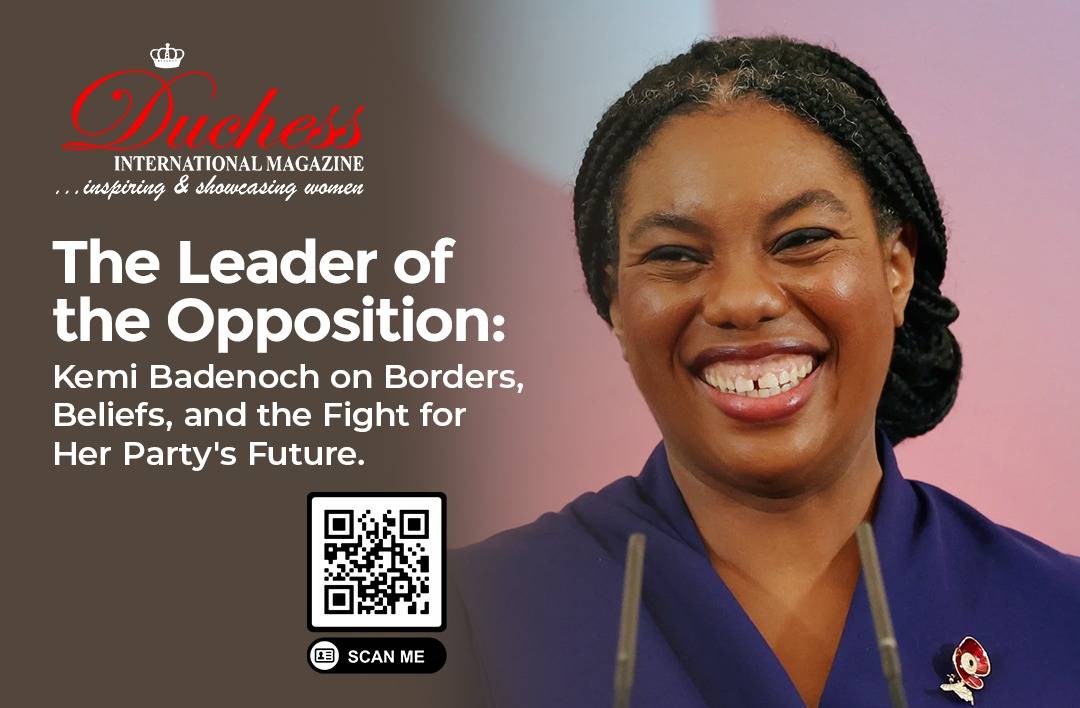
She is the first Black leader of Britain’s Conservative Party. She says she is not Nigerian. Nigeria says otherwise. Her supporters see clarity of purpose, her critics see a party narrowing itself. Either way, Kemi Badenoch is not easy to ignore.”
Olukemi Adegoke was born in Wimbledon, London, in 1980, but was brought up and educated mainly in Lagos, with part of her childhood spent in the United States, where her mother worked as a physiology professor. Her family were comfortable, but eventually lost their money, and at 16 she was sent to the UK, where she worked at McDonald’s while studying hard. She went on to study engineering at the University of Sussex and later qualified in law. On 2 November 2024, she won the Conservative leadership with 56.5 per cent of the members’ vote, beating Robert Jenrick, and became the first Black person to lead the party. She now heads the official opposition, and her party is still recovering from the worst election defeat in its history.
For African readers, her story comes with a complication worth stating plainly. Badenoch does not present herself as a Nigerian success story. In 2025 she said she no longer identifies as Nigerian and has not held a Nigerian passport for over two decades, describing her ancestry as Nigerian but her identity as British. As she put it, “Home is where my now family is.” The remarks stirred debate in Nigeria, where Vice-President Kashim Shettima suggested she might drop “Kemi” from her name if she felt no pride in her country of origin, and her spokesperson replied that she is not Nigeria’s public relations representative. Whether one finds her candour bracing or painful, it reflects a leader who insists on telling her own story in her own way.
Her defining policy fight concerns Britain’s place in the European Convention on Human Rights (ECHR). In October 2025, after a review led by Lord Wolfson, she announced that the next Conservative government would leave the Convention, arguing that it creates legal barriers to policies voters expect to be delivered. In her words, “It is time for Britain to leave the ECHR.” By July 2026 she had gone further, making clear that would-be candidates who reject the party’s position on the issue are unlikely to be selected. Critics answer that the plan carries serious risks. Legal experts and rights groups have warned about its effect on human rights commitments and on the Good Friday Agreement, while the centre-right group Prosper UK has cautioned that a selection test built around a single issue risks producing a narrower party. One analysis notes that 27 per cent of 2024 Conservative voters want Britain to remain in the Convention, a reminder that the question divides her own supporters.
The same insistence on hard choices runs through her approach to defence. In September 2026, Badenoch set out how she would raise defence spending to 3 per cent of GDP by 2030, saying her party would fund an extra £10 billion a year through further welfare cuts, restoring the two-child benefit cap, redirecting £2 billion from civilian research spending and leaving the Chagos Islands agreement. Her message to the government was direct: “The first duty of every government is defence.” The gap she is aiming to close is real, since NATO estimates put UK defence spending at 2.3 per cent of GDP in 2025, rising to about 2.6 per cent in 2026. The debate she has started is about trade-offs, with supporters seeing hard choices faced honestly and opponents asking whether families who rely on welfare should carry the cost.
Her hardest battle may be the one closest to home. Reform UK has polled ahead of the Conservatives since early 2025, and the May 2026 local elections were painful, with the Conservatives losing 44 of the 52 seats they were defending in Norfolk alone, 38 of them to Reform. Her answer has been to sharpen the party’s identity rather than soften it, a wager that voters will reward clarity over compromise. Her opponents believe it may push away the moderate voters the Conservatives need to win again, and how that argument is settled will decide whether her leadership is remembered as a rebuilding or a retreat.
Badenoch will not be everyone’s idea of a role model, and she would probably say she does not want to be one. Yet her path has real force. She went from a childhood shaped by instability to the top of British politics, and she refuses to trim her views in order to be liked. What she achieves next will depend on whether conviction can win an election. For readers who admire leadership, the question is not whether she is right on every issue but what it costs to stand firm, and who ends up paying for it.