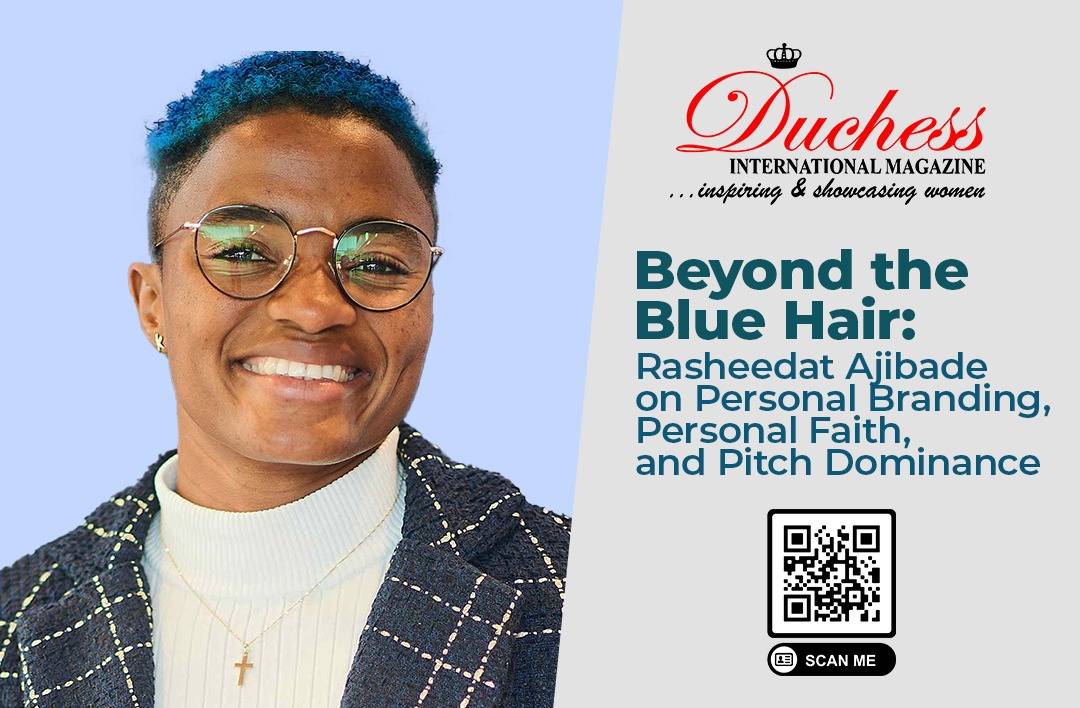
Before she ever touches the ball, you already know her. The bright blue hair catches the floodlights before her first sprint does, a flash of color against the green that has made her instantly recognizable on pitches from Lagos to Paris. It is easy to assume a signature look like that is simply styling, a flourish for the cameras. But for Rasheedat Ajibade, the woman fans call “Rash” and, just as often, “The Girl With The Blue Hair,” the color has become something closer to a statement: a refusal to shrink herself to fit anyone’s idea of what a footballer, or a Nigerian woman, is supposed to look like.
That refusal did not arrive fully formed. It was built, quietly and early, on some of the roughest pitches in Lagos. Ajibade turned professional at FC Robo Queens at just thirteen or fourteen years old, in a football culture where young female athletes routinely face cultural resistance simply for choosing the sport at all. By her late teens she was already the club’s captain, finishing as joint top scorer in the league, the kind of quiet dominance that precedes recognition rather than follows it. Before she turned eighteen, she had represented Nigeria at the U-17 and U-20 World Cups and been ranked among the continent’s ten best young footballers. The blue hair, when it eventually arrived, was not a rebrand. It was a woman who had already proven herself deciding she no longer needed to look the part everyone expected.
Personal branding, in Ajibade’s case, is really an extension of self-possession rather than a marketing strategy borrowed from elsewhere. She has built a recognizable identity without leaning on controversy or manufactured drama, something increasingly rare for athletes whose visibility online often outpaces their achievements on the field. Hers works in the opposite order: the achievements came first, captaining Nigeria’s U-17 side at sixteen, scoring at a U-20 World Cup before adulthood, becoming a fixture for the Super Falcons by 2018, and the brand followed as an honest expression of who she already was, not a costume built to generate attention. That instinct extends past merchandise into infrastructure: she launched her own RASH clothing line, and in 2023 became brand ambassador for Pluralcode Academy, through which she started the RASHxPluralcode Tech Scholarship, funding free UI/UX and web development training for sixty young Nigerians every year. Asked what drives that side of her work, she put it simply: she is motivated by how much value she can add to other people’s lives. It is a rare thing for a young athlete at the peak of her playing career to already be planning for the version of herself who exists after the whistle stops, holding an accounting degree from Lagos State Polytechnic alongside her boots.
Faith is the second thread running through her public identity, and it complicates a lazy assumption many people make about her before they know anything else. Her first name, Rasheedat, commonly signals a Muslim background in Nigeria, and she has spoken about the assumptions people carry about her religion because of it. She is, in fact, a practicing Christian who shares her faith openly on social media, unbothered by the mismatch between her name and people’s expectations. It is a small detail, but a telling one: a woman comfortable enough in her own identity to let people be surprised by her, rather than editing herself to fit the story others have already written.
That same steadiness shows up most clearly in the moments that matter most on the pitch. In July 2025, Ajibade captained the Super Falcons to a tenth Women’s Africa Cup of Nations title, a record-extending achievement for Nigerian football, defeating Morocco 3-2 in a final that demanded composure under real pressure. She did not merely participate in that history, she was named Most Valuable Player of the tournament for her performance, the individual recognition layered on top of the collective trophy. She had also been central to the Super Falcons’ qualification for the Paris 2024 Olympics, following a historic win over South Africa, another instance of her stepping up precisely when the stakes rose rather than shrinking from them.
Her club career tells a parallel story of steady ascent rather than a single lucky break. From FC Robo in Lagos, she moved abroad to Norway’s Toppserien league with Avaldsnes IL, before joining Atlético Madrid in Spain’s Liga F, where she continued building her reputation as one of the league’s most dynamic attacking players. She has since moved to Paris Saint-Germain, wearing the number 10, a shirt number that in football culture is reserved for a team’s most creative and trusted attacking presence, not handed out casually. Two FIFA Women’s World Cup appearances, in 2019 and 2023, sit alongside that club trajectory, further evidence that her rise has been built tournament by tournament, not manufactured by a single viral moment.
What ties the branding, the faith, and the pitch dominance together is a kind of consistency that is easy to undervalue precisely because it never asks for attention. She has not needed scandal to stay visible, and she has not needed to downplay her faith or her appearance to be taken seriously as an athlete. She has simply kept being excellent, repeatedly, in front of larger and larger audiences, and allowed her identity, blue hair, quiet Christian faith, captain’s armband and all, to remain fully intact throughout.
For a generation of young Nigerian girls watching women’s football finally gain the visibility it has long deserved, Rasheedat Ajibade offers something more useful than a highlight reel. She offers proof that you do not have to choose between standing out and being taken seriously, between holding a strong personal identity and commanding a locker room’s respect. The blue hair gets people’s attention first. It is everything she has built underneath it, the discipline from those early Lagos pitches, the quiet certainty in who she is, the trophies won under real pressure, that has kept it.