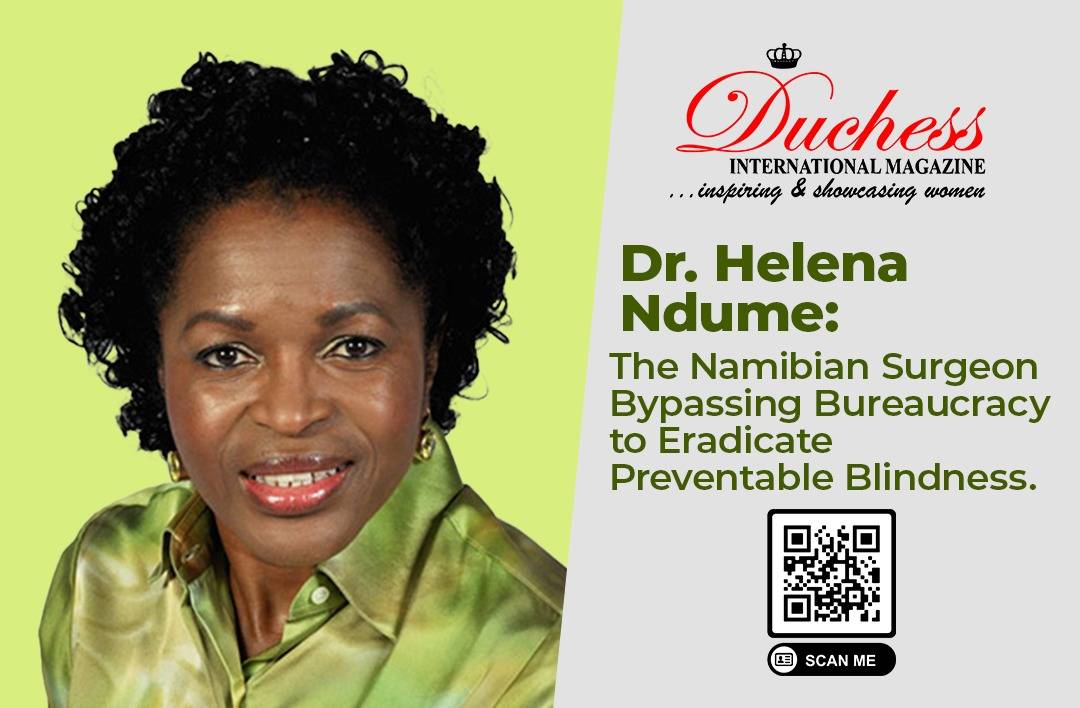
What happens when a doctor refuses to accept that blindness should be determined by geography, poverty, or circumstance? In many parts of the world, losing one’s sight can mean losing far more than vision. It can mean losing independence, employment, education, mobility, and dignity. For millions of people, preventable blindness remains one of the most devastating yet solvable health challenges of our time. While governments, institutions, and international organizations often spend years debating solutions, Dr. Helena Ndume chose a different approach. She decided to bring treatment directly to the people who needed it. In doing so, she transformed the lives of tens of thousands of Namibians and became one of Africa’s most celebrated medical humanitarians.
Today, Dr. Helena Ndume is recognized internationally as one of Namibia’s most accomplished ophthalmologists. As head of ophthalmology at Windhoek Central Hospital, she has dedicated her career to fighting preventable blindness, particularly among people who would otherwise never have access to specialized eye care. Yet her story is not simply about medicine. It is about identifying a problem that disproportionately affects the poor and refusing to allow logistical obstacles, limited resources, or institutional delays to become excuses for inaction.
The challenge she confronted was enormous. Cataracts, one of the leading causes of blindness globally, can often be treated through relatively straightforward surgery. The problem was not always the procedure itself. The problem was access. Many patients lived in remote communities far from specialist hospitals. Others could not afford treatment. Some had spent years living in darkness because the healthcare system could not easily reach them. Ndume understood that waiting for patients to come to the system was not enough. The system had to go to the patients.
That realization became the foundation of one of the most remarkable public health efforts on the continent. Working alongside SEE International and local partners, Ndume helped establish outreach eye camps that brought surgical services directly to underserved communities across Namibia. Instead of allowing distance and bureaucracy to determine who received care, these mobile initiatives took treatment to people who had long been forgotten by traditional healthcare structures. Since beginning this work in the 1990s, she has helped restore sight to tens of thousands of patients through free surgeries and blindness-prevention programs.
What makes her work particularly compelling is that it challenges a common assumption about leadership. We often associate leadership with titles, offices, and formal authority. Yet some of the most transformative leaders are those who see a problem and redesign the system around solving it. Ndume recognized that preventable blindness was not merely a medical issue. It was an economic issue, a social issue, and a human dignity issue. A grandmother who regains her sight can care for herself again. A parent can return to work. A child can continue attending school. Restoring vision frequently restores opportunity.
Her commitment to this mission is deeply personal. Having experienced displacement during the apartheid era and spending part of her youth in refugee environments, Ndume witnessed hardship and inequality firsthand. Those experiences helped shape a worldview rooted in service. After studying medicine in Germany and receiving specialist ophthalmology training, she returned to Namibia determined to use her skills where they were needed most. Rather than pursuing a career focused solely on private success, she built one centered on public impact.
Over the years, her efforts have attracted global recognition. In 2015, she became one of the first recipients of the United Nations Nelson Mandela Prize, an award honoring individuals whose lives reflect service to humanity. She has also received numerous international humanitarian awards, including recognition from Lions Clubs International, Forbes Woman Africa, and global blindness-prevention organizations. Yet what stands out in interviews is how consistently she redirects attention away from herself and toward the broader mission. Again and again, she emphasizes teamwork, partnerships, and the collective effort required to eliminate preventable blindness.
There is another reason her story resonates far beyond medicine. In a world where complex social problems are often discussed endlessly, Ndume represents the power of practical action. She did not wait for perfect conditions. She did not allow institutional limitations to become permanent barriers. Instead, she found ways to move around them, building partnerships, organizing outreach programs, training teams, and creating systems that delivered results. Her career demonstrates that meaningful change often begins when someone decides that a problem is too urgent to leave unsolved.
Ultimately, Dr. Helena Ndume’s legacy cannot be measured solely by awards, titles, or professional achievements. It is measured in moments: a grandmother seeing her grandchildren again, a worker returning to a job, a child recognizing a parent’s face, a patient stepping out of darkness into light. Tens of thousands of people have experienced those moments because one surgeon refused to accept preventable blindness as an unavoidable reality. In an age that often celebrates disruption, Helena Ndume offers a different model of leadership. She reminds us that some of the most powerful revolutions begin not with speeches or slogans, but with restoring something as fundamental as sight.