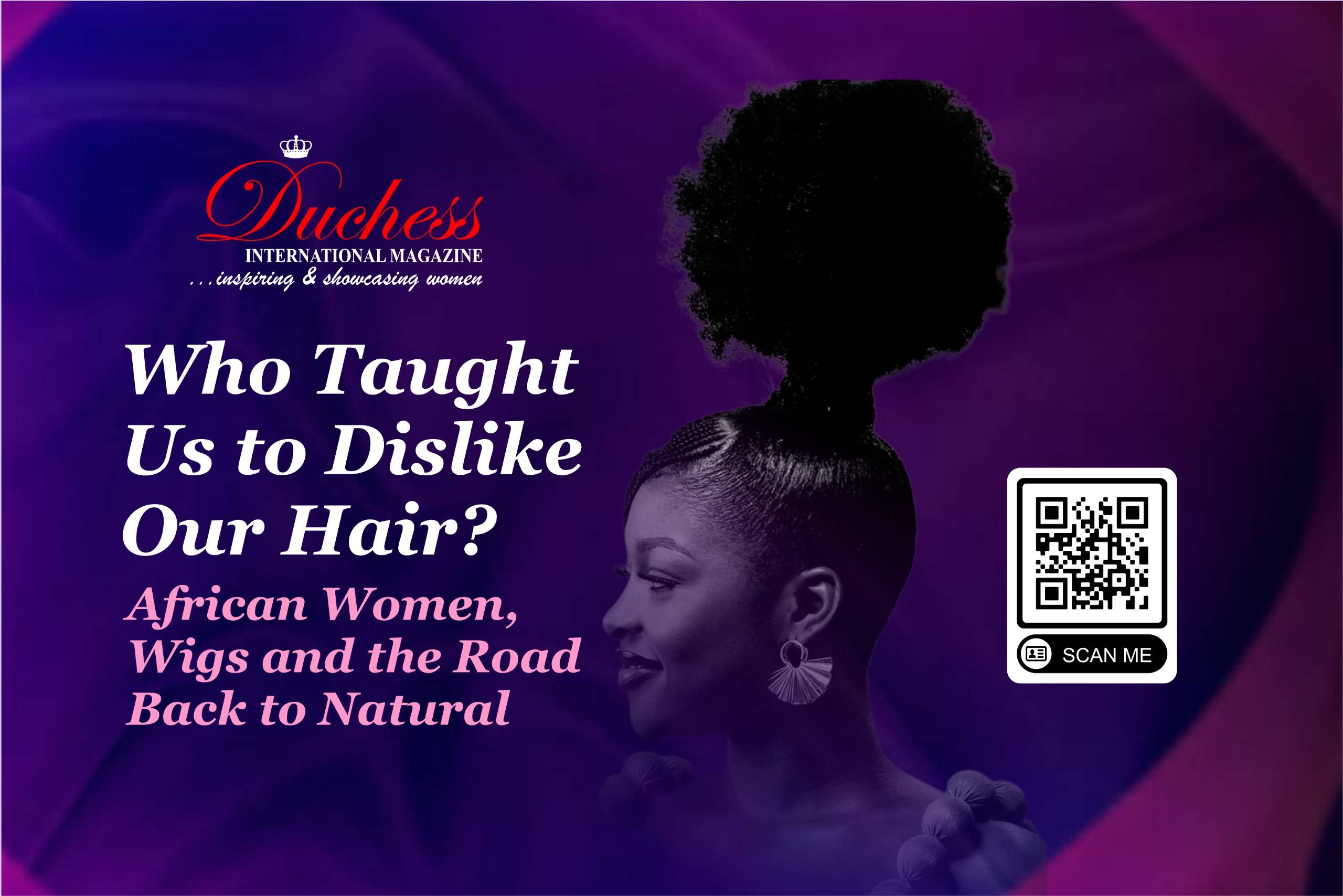
The healing and exhausting journey of going natural.
Many women remember the tingle first. It starts as a warmth at the scalp, then becomes a sting, and somewhere in the chair someone says the words that countless girls have heard: it means it is working. You wait. You hold your breath. You are told that beauty is pain, and that the pain is the price of hair that finally behaves, hair fit for church, for school, for being seen. Nobody explains what the lesson is really about. But a child sitting through it learns something far bigger than a hair routine. She learns that the hair growing out of her own head needs to be fixed before it can be accepted.
Who taught us that? It was not always this way. In many pre-colonial African societies, hair was a language. Styles could signal a person’s age, marital status, ethnic identity, religion, wealth or rank. Among the Yoruba, hair was treated as the most elevated part of the body, and braiding was one way of sending messages to the gods. Styling took hours, sometimes days, and those hours were social: mothers, aunts and friends washing, oiling, parting and braiding together. Scholars also note that hair extensions were part of pre-colonial Africa. Nothing about our hair was a problem to be solved. The idea that it was came later.
Historians of Black hair trace that shift to slavery, colonialism and, in southern Africa, apartheid. Captives’ heads were shaved on capture, one of the first acts in a long erasure of identity. Eurocentric beauty standards then ranked straight, soft hair as “good” and coily hair as its opposite, and those rankings came with consequences. To be seen as civilised, employable and presentable, a woman learned to flatten, straighten and tame her hair. A study of Black women in post-apartheid South Africa describes how, under colonialism and apartheid, African hair became an object of ridicule, and how straightening it became, for many women, a route to acceptance and to the privileges reserved for whiteness. Hair was never only about hair. It was about who got in.
Those rankings did not disappear when the laws did. In August 2016, girls at Pretoria High School for Girls, a formerly all-white school, walked out in protest over hair rules. The written code only asked for hair to be “neat” and “conservative,” but students said afros were treated as untidy and that they were told to fix them. One said a teacher told her to comb her hair because it looked like a bird’s nest. Thirteen-year-old Zulaikha Patel became the face of the protest. She told CNN that even in primary school she had been told her hair was not natural but “exotic.” Protests followed at other schools, and the school’s hair policy was suspended pending an investigation. A teenager had named, in public, what generations of girls had absorbed in private.
For many women, the lesson came with a chemical attached, and the cost was not only emotional. Relaxers can burn the scalp, and researchers have begun linking frequent use of chemical straighteners to serious health risks, though they say more work is needed to understand how strong the link is and which chemicals are responsible. It is a sobering thing to learn about a ritual so many of us were taught to endure, often long before we were old enough to question it.
Then came another chapter: the wig and the weave, where this conversation too often goes wrong. For the woman moving through boardrooms, public office or international spaces, a wig can be armour. It saves time, protects her own hair from heat and styling damage, and lets her look polished in rooms that were never built to welcome her texture. It also offers glamour, versatility and a creative playground. None of that is a confession, and extensions have a long history on this continent. But armour can quietly become a hiding place. Many women describe feeling exposed, insecure and unpresentable if their own hair is seen, and spending weekends in salon chairs for a look that bears no resemblance to what grows from their scalp. The question is not what is on your head. It is why. Wearing a style because you love it is one thing. Wearing it because you were taught, for years, that your own hair is unacceptable is another. Only the woman wearing it can say which it is, and for many of us the honest answer is a mixture of both.
What does a childhood of correction do to a person? It is hard to measure, but many women describe it. A child who learns early that her hair needs fixing can carry that into adulthood: avoiding rain and swimming, hesitating before a partner touches her hair, feeling uneasy about being seen without the style she has chosen to hide behind. Researchers studying South African women say the Eurocentric ideal became dominant in how many women saw themselves. Self-esteem is not built in a single moment, and it is not undone in one either. It is shaped by thousands of small messages, and for many African girls, hair delivered some of the earliest.
This is why going natural so often feels like healing and exhaustion at the same time. For some women it is a homecoming: the big chop, the day the wigs are put away, the first time they step out with a full afro and feel that the crown they were born with never needed fixing. It can feel like reclaiming authority over their own bodies. But there is also the long in-between phase, the trial and error of learning a texture nobody ever taught us to care for, and wash days that can take hours. It is not a straight line, and some women return to relaxers or wigs along the way. That is not failure. Zulaikha Patel, now grown, wrote a children’s book in 2021 called My Coily Crowny Hair so that young Black girls would meet their own hair with pride, not correction.
Even the road back has its own traps. As the natural hair movement grew, it was quickly commercialised, and many women with tightly coiled hair describe a new hierarchy: soft, loose, well-defined curls celebrated on social media and in product marketing, while tighter coils are left wondering why their hair does not fall the way an influencer’s does. The old pressure to straighten has, for some, been replaced by a pressure to have the “right” kind of natural. Unlearning means letting go of that too, and accepting hair that shrinks, that is dense, that behaves like itself.
So who taught us to dislike our hair? History did, and school rules, and salons, and a beauty industry that profited from the lesson. Sometimes we did too, passing along what we had been taught to the girls in our own chairs. But the question has a second half: who teaches the next girl? She should be able to wear a wig, a relaxer, braids or an afro and know that every one of them was her choice, made without fear. The real work of going natural is not the wash day or the right oils. It is the quiet decision to choose peace over performance, and to let your hair, whatever you do with it, belong to you. That freedom, not any particular hairstyle, is the road back.