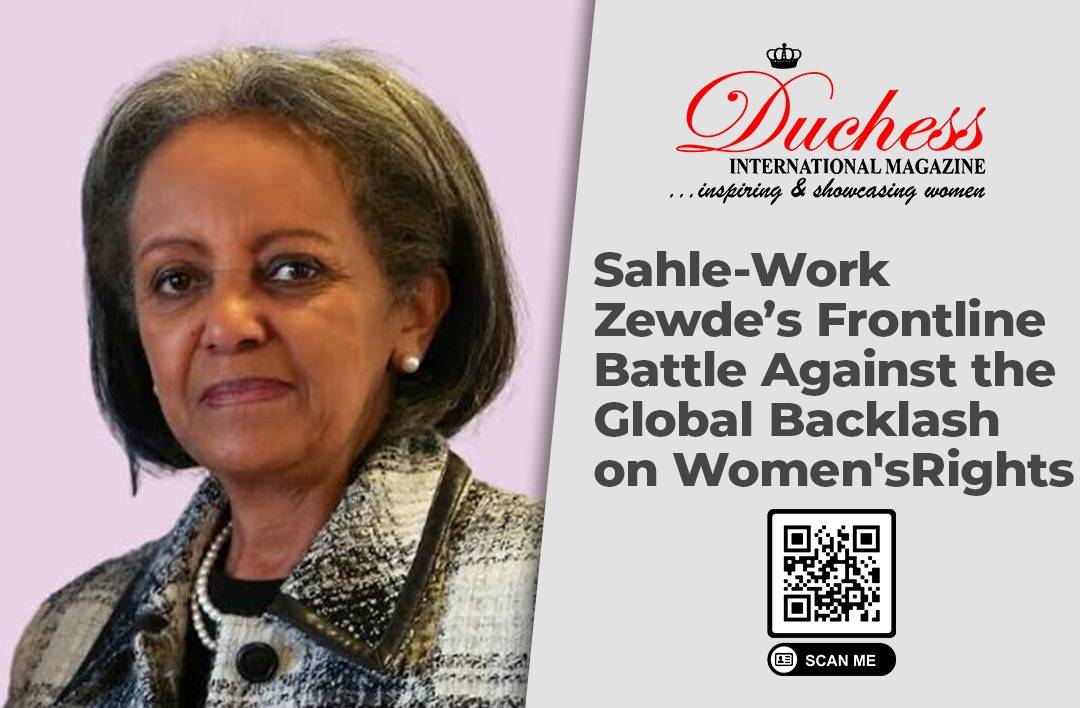
When Sahle-Work Zewde left Ethiopia’s presidential palace in 2024, many might have assumed she was stepping away from public life. After all, six years as Ethiopia’s first female president had already secured her place in history. For countless African women and girls, her election in 2018 represented a powerful symbol of progress in a continent where women have often had to fight for space in political leadership. Yet retirement was never part of the story. If anything, leaving office marked the beginning of a different chapter. Rather than retreating from public service, Sahle-Work stepped onto a larger and more complex battlefield, one that extends far beyond Ethiopia’s borders and concerns the future of women’s rights around the world.
Her transition reflects a growing concern that has become increasingly difficult to ignore. Across different regions of the world, rights that once appeared secure are being questioned, challenged, and, in some cases, rolled back. Debates over women’s participation in politics, access to education, economic opportunities, and bodily autonomy have returned to the center of public discourse. Progress that took decades to achieve is proving more fragile than many assumed. While the global conversation often focuses on advances in representation and inclusion, Sahle-Work has become one of the most prominent voices warning that progress is not permanent. Rights can move forward, but they can also move backward if societies fail to protect them.
What gives her warning particular weight is the perspective from which it comes. Sahle-Work is not merely commenting on world affairs from the sidelines. She spent decades navigating some of the world’s most challenging diplomatic environments, serving in senior positions across Africa and at the United Nations before becoming president. Throughout that journey, she witnessed firsthand how institutions function, how power is exercised, and how easily vulnerable groups can be excluded from decision-making. Her experience has taught her a lesson that history repeatedly confirms: when women begin losing rights and representation, it is often a sign that broader democratic principles are also under threat. The struggle for women’s rights, in her view, has never been separate from the struggle for justice, accountability, and inclusive governance.
Speaking at the Forbes Woman Africa Leading Women Summit, Sahle-Work delivered a message that was both urgent and unsettling. She argued that the growing backlash against women’s rights is not always presented openly. Instead, it is often wrapped in the language of culture, tradition, nationalism, or social preservation. According to her, some political actors increasingly frame gender equality as an external influence rather than a universal human right. This framing can be remarkably effective because it transforms a conversation about fairness and opportunity into a debate about identity and belonging. In doing so, it creates space for restrictions that would have been difficult to justify in previous generations. Her concern is not with tradition itself, but with the selective use of tradition as a political tool to limit women’s participation in public life.
For Sahle-Work, the consequences extend far beyond individual freedoms. She believes that attacks on women’s rights should be understood as warning signs for society as a whole. History offers numerous examples of communities where the exclusion of women from education, leadership, and economic participation weakened social institutions and concentrated power in fewer hands. When women are prevented from contributing fully to society, entire nations lose talent, ideas, innovation, and leadership capacity. More importantly, societies begin normalizing exclusion as a governing principle. This is why Sahle-Work consistently frames gender equality not as a women’s issue but as a democratic issue. The health of a society can often be measured by how effectively it protects the rights and dignity of all its citizens.
Her commitment to these issues has also shaped her work on the international stage. In 2025, United Nations Secretary-General António Guterres appointed her to lead an independent strategic review of the United Nations Office for West Africa and the Sahel (UNOWAS), a region facing persistent challenges related to conflict, instability, and governance. The appointment reflects the confidence global institutions continue to place in her diplomatic judgment. Yet beyond the title itself lies something more significant. Sahle-Work understands that women are often disproportionately affected by conflict, displacement, insecurity, and institutional breakdown. Her involvement ensures that discussions about peace and security do not overlook the experiences and needs of the people who frequently bear the heaviest burdens during times of crisis.
What makes her current work particularly compelling is her belief that defending progress requires more than symbolic representation. Throughout her career, she has advocated for women to occupy leadership positions, but she now argues that visibility alone is not enough. Having women in positions of power matters, but what those leaders do with that influence matters even more. She has repeatedly emphasized the importance of building systems that protect vulnerable communities, supporting grassroots organizations, strengthening legal protections, and ensuring that gains made by one generation are not lost by the next. In her view, leadership is not simply about reaching the table; it is about ensuring that the table remains open to those who come after.
This philosophy is especially evident in her involvement with the African Women Leaders Network (AWLN), where she serves as an Elder and mentor to emerging leaders across the continent. There, she advocates for a model of leadership built not on individual success but on collective advancement. She understands that isolated achievements, while important, are rarely enough to withstand systemic challenges. Lasting change requires networks, mentorship, solidarity, and institutions capable of supporting women through every stage of their professional journeys. By helping cultivate these structures, she is investing in a future where the next generation of African women leaders will not have to navigate the same barriers alone.
Ultimately, Sahle-Work Zewde’s post-presidential journey challenges a common assumption about leadership, that its influence ends when a title does. Her work today suggests the opposite. Some leaders spend their years in office managing the present; others spend the years after office shaping the future. At a time when many people assume progress is inevitable, she is reminding the world that every generation must decide whether it will protect the gains it inherited or allow them to erode. Her message is neither pessimistic nor alarmist. It is a call to vigilance. The rights enjoyed today were secured through decades of persistence, courage, and advocacy. Preserving them will require the same commitment. Through her continued work, Sahle-Work is demonstrating that leadership is not defined by the office one holds, but by the causes one refuses to abandon.