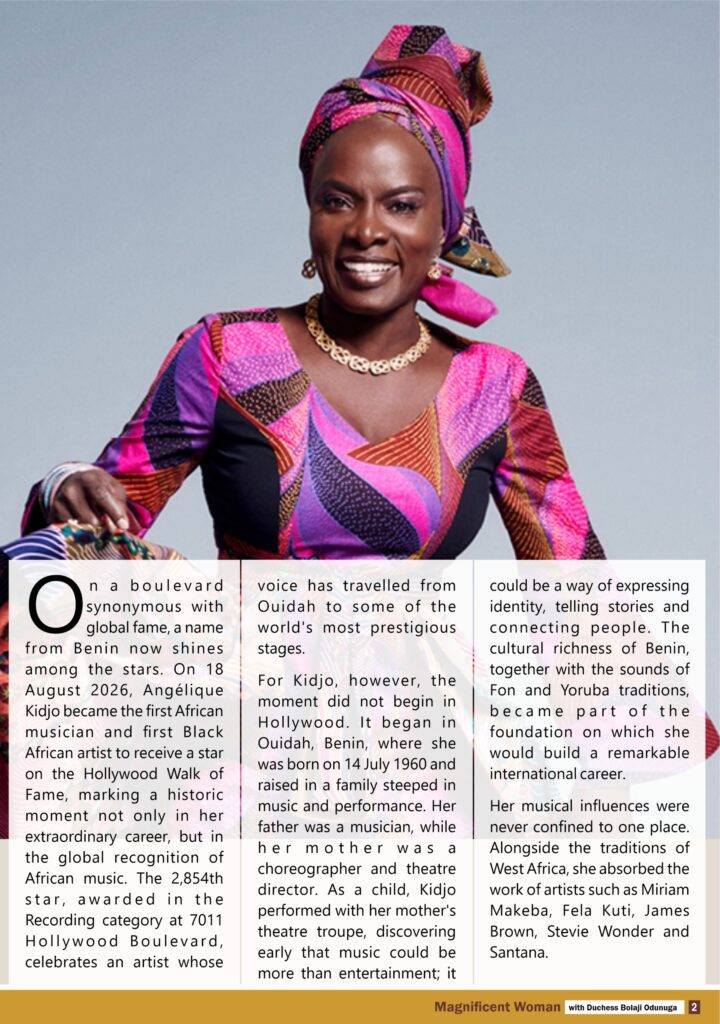
On a boulevard synonymous with global fame, a name from Benin now shines among the stars. On 18 August 2026, Angélique Kidjo became the first African musician and first Black African artist to receive a star on the Hollywood Walk of Fame, marking a historic moment not only in her extraordinary career, but in the global recognition of African music. The 2,854th star, awarded in the Recording category at 7011 Hollywood Boulevard, celebrates an artist whose voice has travelled from Ouidah to some of the world’s most prestigious stages.
For Kidjo, however, the moment did not begin in Hollywood. It began in Ouidah, Benin, where she was born on 14 July 1960 and raised in a family steeped in music and performance. Her father was a musician, while her mother was a choreographer and theatre director. As a child, Kidjo performed with her mother’s theatre troupe, discovering early that music could be more than entertainment; it could be a way of expressing identity, telling stories and connecting people. The cultural richness of Benin, together with the sounds of Fon and Yoruba traditions, became part of the foundation on which she would build a remarkable international career.
Her musical influences were never confined to one place. Alongside the traditions of West Africa, she absorbed the work of artists such as Miriam Makeba, Fela Kuti, James Brown, Stevie Wonder and Santana. That eclectic foundation would become central to her artistry. Kidjo did not simply reproduce the sounds she grew up with; she explored what could happen when African musical traditions met jazz, funk, soul, gospel, Latin music, Afrobeat and contemporary global sounds. The result was an artistic identity that was unmistakably African while refusing to be confined by geography.
In the early 1980s, political circumstances in Benin led Kidjo to leave the country and settle in Paris. There, she studied music and continued developing her craft, performing and building the foundation of the career that would eventually take her around the world. Her international breakthrough came with Logozo in 1991, an album that brought her energetic sound, commanding vocals and vibrant musical fusion to a much wider audience. From that point, the world began to recognise what audiences in West Africa had already begun to see: an artist with the ability to turn cultural specificity into universal connection.
Over the decades that followed, Kidjo built one of the most distinguished careers in African music. Her catalogue spans more than a dozen albums and reflects an artist who has consistently challenged the boundaries between genres, cultures and generations. She has collaborated with internationally acclaimed figures including Peter Gabriel, Alicia Keys, Bono, John Legend, Philip Glass, Yo-Yo Ma and Burna Boy. Her collaboration with Burna Boy on “Do Yourself” also underscored the generational bridge she represents, connecting an established African musical pioneer with one of the continent’s contemporary global stars.
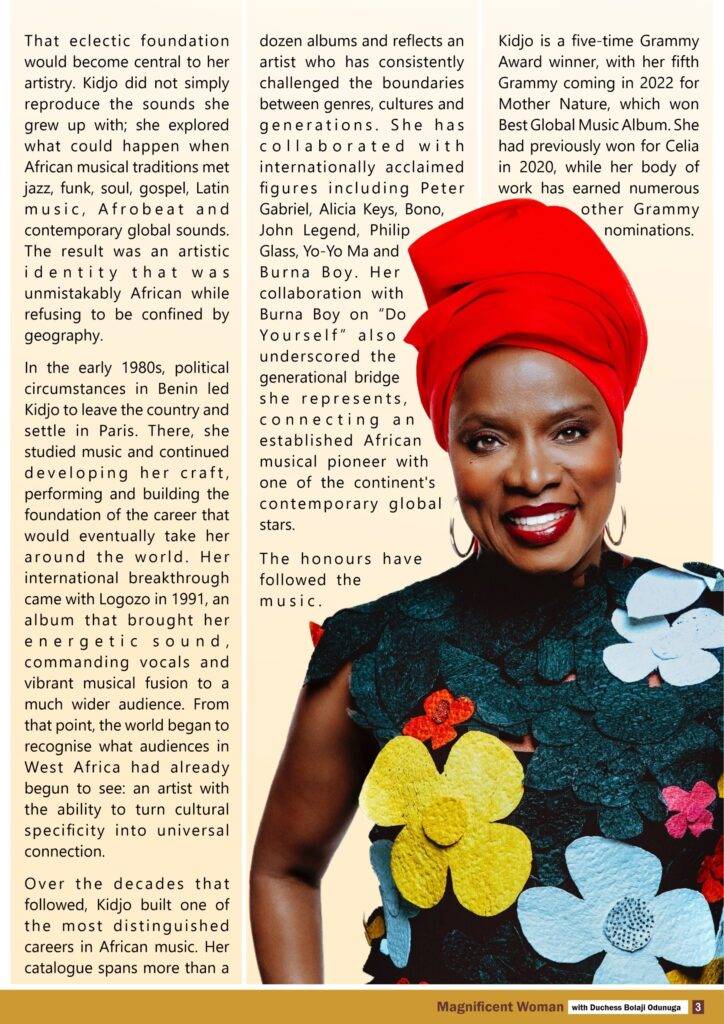
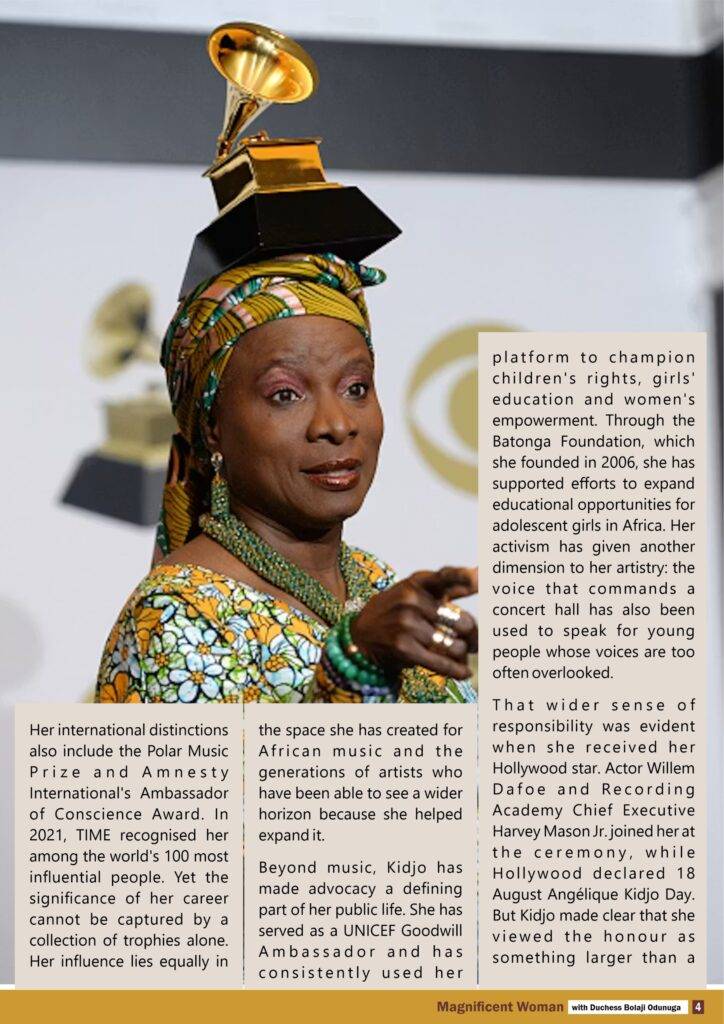
The honours have followed the music. Kidjo is a five-time Grammy Award winner, with her fifth Grammy coming in 2022 for Mother Nature, which won Best Global Music Album. She had previously won for Celia in 2020, while her body of work has earned numerous other Grammy nominations. Her international distinctions also include the Polar Music Prize and Amnesty International’s Ambassador of Conscience Award. In 2021, TIME recognised her among the world’s 100 most influential people. Yet the significance of her career cannot be captured by a collection of trophies alone. Her influence lies equally in the space she has created for African music and the generations of artists who have been able to see a wider horizon because she helped expand it.
Beyond music, Kidjo has made advocacy a defining part of her public life. She has served as a UNICEF Goodwill Ambassador and has consistently used her platform to champion children’s rights, girls’ education and women’s empowerment. Through the Batonga Foundation, which she founded in 2006, she has supported efforts to expand educational opportunities for adolescent girls in Africa. Her activism has given another dimension to her artistry: the voice that commands a concert hall has also been used to speak for young people whose voices are too often overlooked.
That wider sense of responsibility was evident when she received her Hollywood star. Actor Willem Dafoe and Recording Academy Chief Executive Harvey Mason Jr. joined her at the ceremony, while Hollywood declared 18 August Angélique Kidjo Day. But Kidjo made clear that she viewed the honour as something larger than a personal achievement. Speaking at the ceremony, she reflected on Africa’s enormous contribution to world music and described the recognition as belonging to the continent as much as to herself. Her message captured what has defined her career: an unwavering belief that African music is not peripheral to global culture, but fundamental to it.
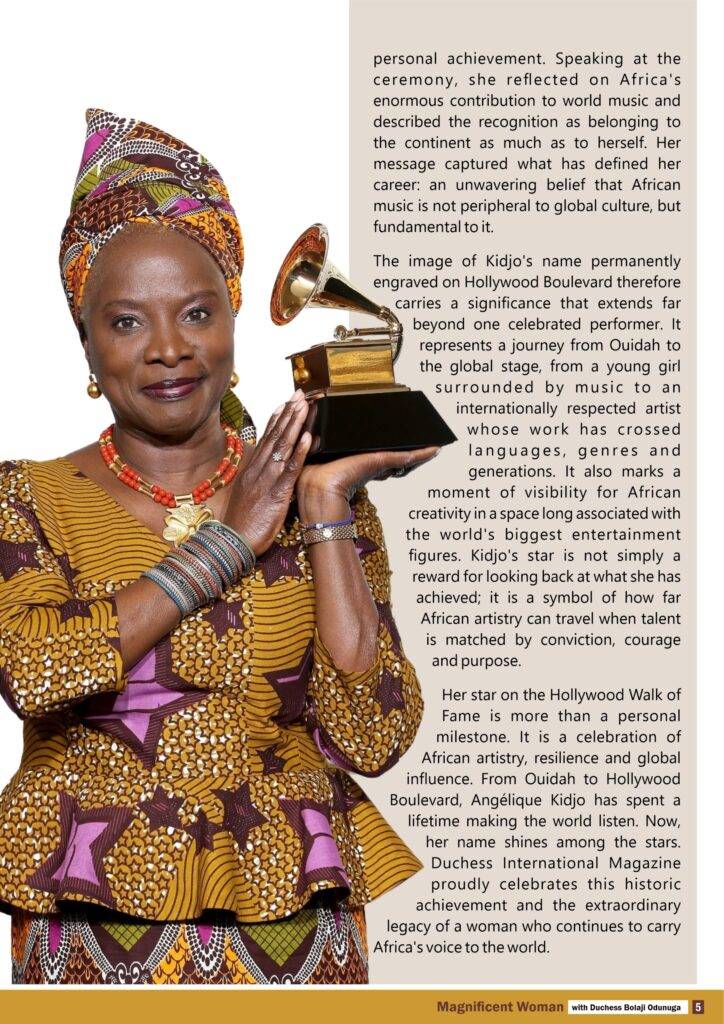
The image of Kidjo’s name permanently engraved on Hollywood Boulevard therefore carries a significance that extends far beyond one celebrated performer. It represents a journey from Ouidah to the global stage, from a young girl surrounded by music to an internationally respected artist whose work has crossed languages, genres and generations. It also marks a moment of visibility for African creativity in a space long associated with the world’s biggest entertainment figures. Kidjo’s star is not simply a reward for looking back at what she has achieved; it is a symbol of how far African artistry can travel when talent is matched by conviction, courage and purpose.
Her star on the Hollywood Walk of Fame is more than a personal milestone. It is a celebration of African artistry, resilience and global influence. From Ouidah to Hollywood Boulevard, Angélique Kidjo has spent a lifetime making the world listen. Now, her name shines among the stars. Duchess International Magazine proudly celebrates this historic achievement and the extraordinary legacy of a woman who continues to carry Africa’s voice to the world.