

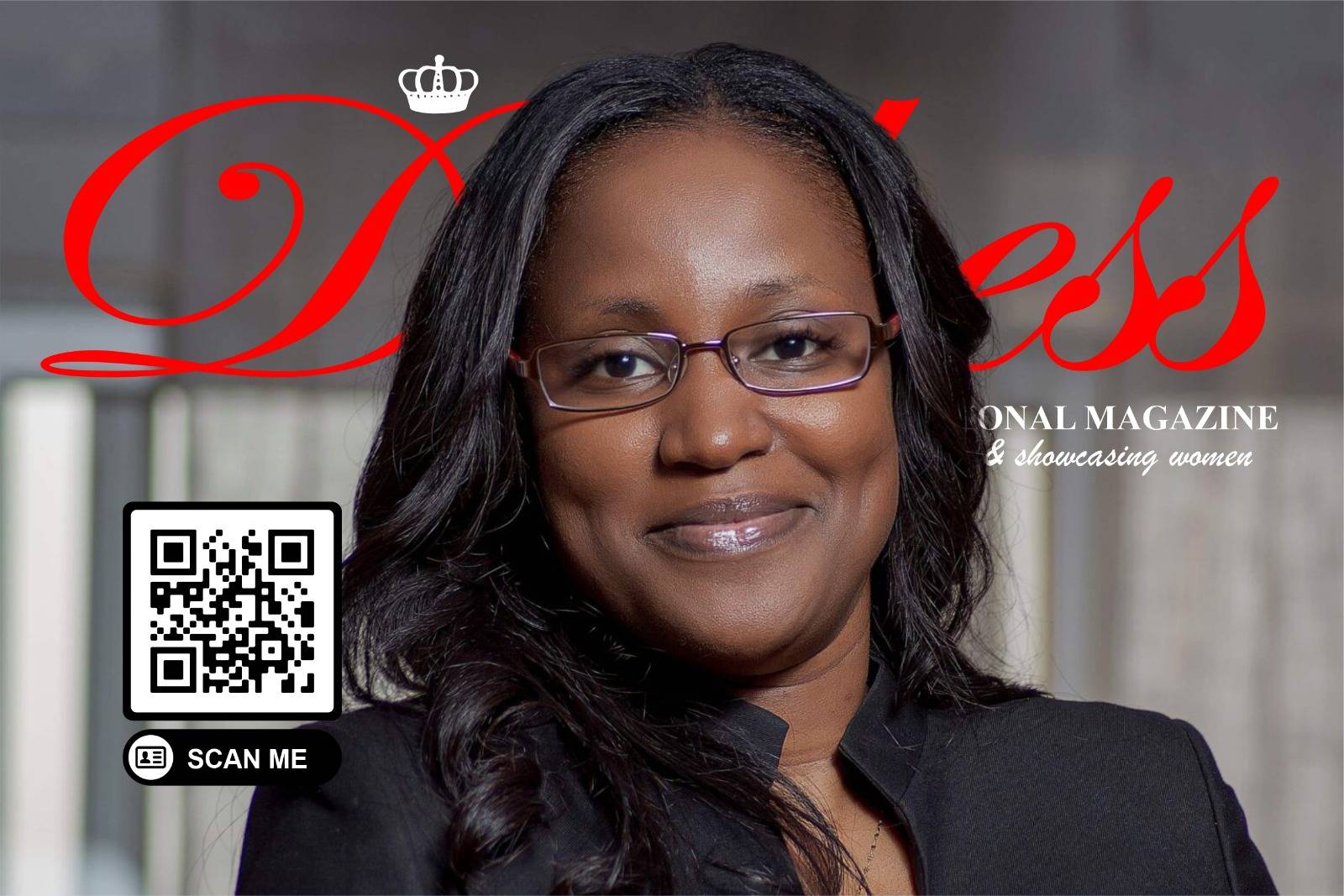
The realization did not arrive in a single, dramatic moment, but rather as a slow accumulation of frustration. Diallo Aïssata Béavogui had spent years working as an auditor and compliance specialist in the United States, a career built on precision and the architecture of numbers. By all external measures, she was successful. Yet she felt a growing disconnect between the work she was doing and the impact she wanted to have. As she would later reflect, she felt like she was simply adding up numbers without making a real difference, and she became afraid that if she did not make a change, she would live to regret it. That quiet, persistent realization prompted her to leave the stability of the United States and return to the continent, setting her on a path that would eventually make her the first woman to hold the title of Director General at an international company in Guinea.
Her path to that position was neither linear nor inevitable. Born in Guinea and raised in Senegal, Béavogui arrived in the United States for college with dreams of becoming the next Oprah, armed with a love of literature and a mind shaped by writers like Aimé Césaire and Victor Hugo. It was her father who gently steered her elsewhere. “You are black, from Guinea, and on an F1 visa. Oh, and you’re a girl, that makes things even tougher,” she remembered him telling her. He was right. She pivoted to accounting, a decision she describes not as a compromise but as a strategic foundation: “Accounting is the backbone of any industry. You need financial numbers, and from there you can branch out to anything.” That pragmatism would become a signature of her leadership.
She joined Guinea Alumina Corporation (GAC) in 2014 as Director of Compliance, a role that placed her at the intersection of governance and the complex realities of operating in a developing economy. At the time, GAC was not yet a producing mine; it was a vast, ambitious project requiring monumental infrastructure and coordination to become real. Within two years, she was elevated to Director General. The promotion made headlines not just because of her gender, but because of what it signaled: that competence, not optics, had earned her the chair. In September 2019, she also took on the role of head of Corporate Social Responsibility at GAC, further intertwining her corporate leadership with the direct development of the communities affected by the company’s operations.
What she did with that power is the part of her story that matters most. Béavogui did not treat her position as a ceremonial crown. One of her first actions as Director General was to establish Guinea’s first anti-corruption hotline, a free, green number that allowed ordinary citizens to report graft, directly connecting their concerns to leadership. She also participated in founding the Guinean Bauxite Environmental Network, an initiative bringing together mining companies to address the ecological impact of bauxite extraction. Crucially, she made a deliberate choice to ensure that women were not invisible in the economic life of the communities GAC touched. This commitment to gender equality and the economic advancement of women would earn her the prestigious MIGA Gender CEO Award in 2020.
The award was not a token. Under her leadership, GAC supported agricultural initiatives in communities near its operations, with Béavogui framing the work in terms of tangible livelihood: “This project is a genuine opportunity offered to the communities of Taïgbé Island to improve their income and agricultural productivity.” She understood that a mining license is a social contract, and that the measure of a company’s success is not only what it extracts but what it leaves behind. When she stepped down as Director General in 2021, she left behind an operation that had transitioned from a distant plan to a fully functioning reality, one designed to generate value for both Guinea and its international partners for years to come.
But power, once held, does not exist in a vacuum. In 2025, Béavogui’s name returned to the headlines in a very different context. As Country Manager of Predictive Discovery, a company seeking a gold mining permit in the buffer zone of the Haut Niger National Park, a UNESCO-protected area, she became the subject of a critical investigation by journalist Toumany Camara. The article alleged potential environmental risks and questioned the appropriateness of mining in a protected zone. Béavogui filed a defamation complaint, and Guinea’s media regulator suspended the journalist and his website for three months. The Guinean Press Professionals Union called the decision “unfair, arbitrary, and dangerous,” defending the article as a matter of public interest. The episode complicated her legacy. It raised questions not about her competence, but about the choices that competence is asked to serve.
For the women watching her career, the complication is not a reason to look away. It is a reason to look closer. Béavogui’s story is not a simple fable of a woman who broke a glass ceiling and lived happily ever after. It is a story about what happens when a woman enters a system built by and for others, and must decide, day by day, what she will protect and what she will challenge. She built an anti-corruption hotline in a country where corruption is structural. She championed environmental responsibility while working in an industry that is, by its nature, extractive. She supported women’s economic participation in communities that had rarely seen it. These are not contradictions to be resolved. They are the messy, human reality of leadership in a world that rarely offers clean choices.
What remains undeniable is the precedent she set. Before Béavogui, no woman had led an international mining company in Guinea. After her, that ceiling no longer exists. The young women who watched her rise, who saw a Guinean woman educated abroad return home not to be a symbol but to run something, now have a reference point that did not exist before. She proved that the highest echelons of a male-dominated, globally significant industry could be occupied by someone who looked like them, spoke like them, and understood the particular weight of representing a nation’s resources to the world. That is not a small thing. It is the kind of thing that changes what a generation of girls believes is possible.
The title on her office door has changed since 2016. The company has changed. The headlines have shifted from celebration to scrutiny. But the question the headline of her story asks remains the same: what did she do with that power? The honest answer is that she used it to build institutions, to open doors, and to make choices, some of which history will praise, and some of which history will question. That is what leadership actually looks like, stripped of the polished narratives we prefer. It is not a straight line from obscurity to sainthood. It is a series of decisions made by a woman who refused to spend her life adding up numbers without making a difference. And in that refusal, she changed what was possible for every woman who came after her.

