

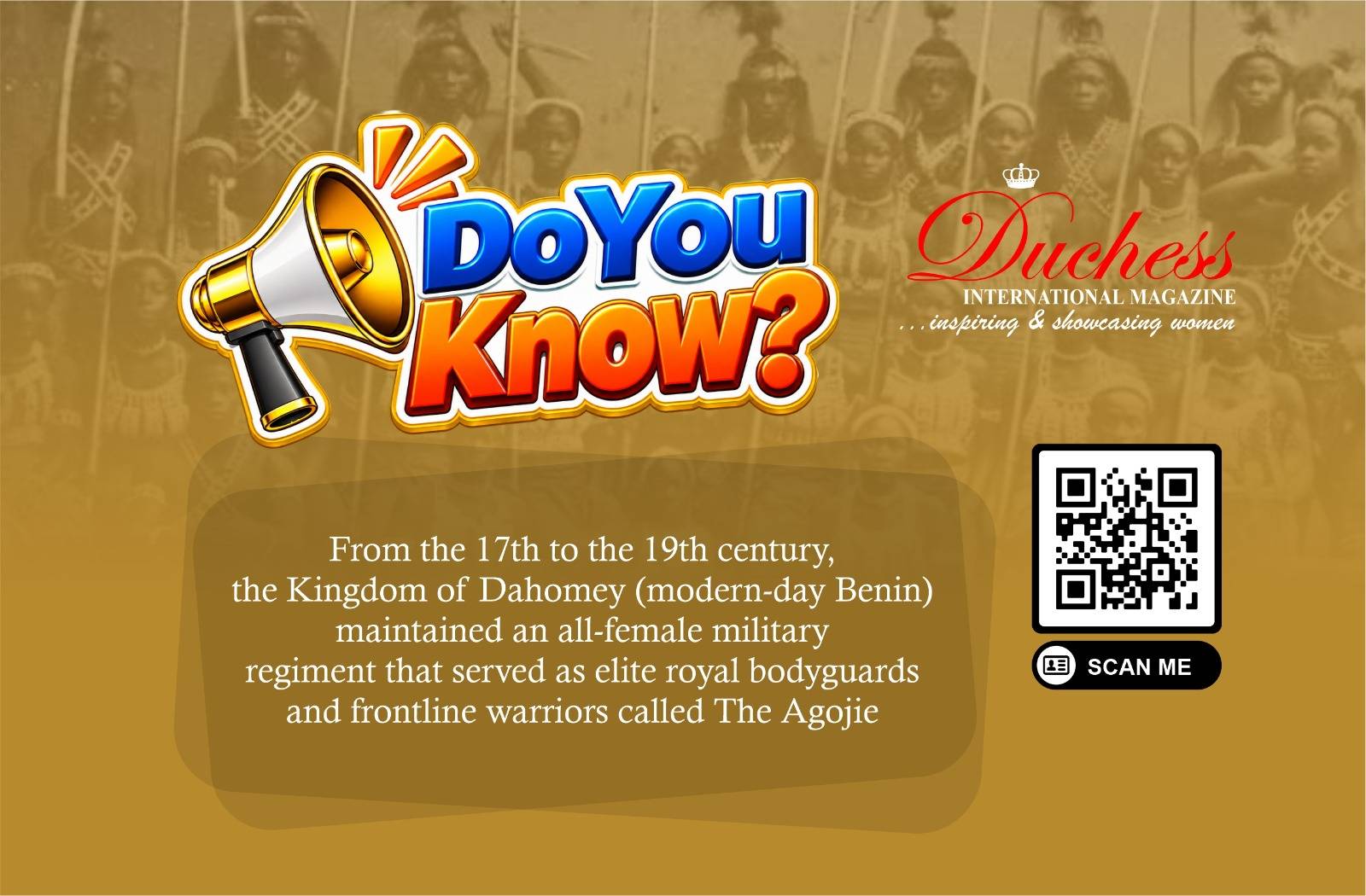
They Guarded a King and Faced an Empire.
Imagine a royal palace where the king’s closest guards, the people sworn to stand between him and any enemy, were all women. From the 17th to the 19th century, that was not a story but a fact of life in the Kingdom of Dahomey, in what is now Benin. Known as the Agojie, and also as the Mino, they were an all-female military regiment of the Fon people, and Europeans who met them called them Amazons, after the female warriors of Greek myth. They served as elite royal bodyguards and as warriors on the front line, and their reputation travelled far beyond West Africa.
Their beginnings are wrapped in legend. Tradition holds that the unit began when a group of renowned elephant huntresses, called gbeto, was brought before the king. One account places these hunters under King Houegbadja, who ruled from around 1645 to 1685. The first recorded mention of the Agojie dates to 1729. Historians still debate the full story, because most of the records from the period were destroyed by colonialists. What is certain is that the women of Dahomey were not an afterthought. They were an institution.
Under King Gezo, who reigned from 1818 to 1858, they became a powerhouse. Records suggest roughly 600 women served in the Dahomean army from the 1760s to the 1840s, until Gezo expanded the corps to as many as 6,000, probably after a defeat by the Yoruba in 1844. Recruits underwent intense training, and each division had its own uniforms, weapons and female commanders. Their discipline impressed even the foreigners who feared them. European observers who watched them fight the French wrote of their “incredible courage and audacity.” They were, in every sense, a force to be reckoned with.
The final chapter was written in the face of an enemy with far greater firepower. In the Second Franco-Dahomean War of 1892, the Agojie fought in 23 engagements over seven weeks, and from a starting strength of 1,200, fewer than 100 were fit to fight by the end. They last saw action at Cana on 4 November 1892, which means this very month marks 134 years since that last stand. The kingdom fell in 1894 and was annexed into French West Africa, and the territory later gained independence in 1960.
Their story did not end on the battlefield. A woman named Nawi, thought to be the last surviving Agojie, was interviewed in 1978 in the village of Kinta, where she claimed to have fought the French in 1892. She died in November 1979, aged well over 100. Decades later, the 2022 film The Woman King introduced the Agojie to a worldwide audience, though historians note that its characters Nanisca and Nawi share names with documented members of the Agojie but are not exact mirrors of those women. For the readers of Duchess, the real lesson is bigger than any film. Long before anyone wrote about women in leadership, African women were guarding kingdoms, commanding regiments and shaping history. Greatness, it turns out, has always been part of our heritage.

