

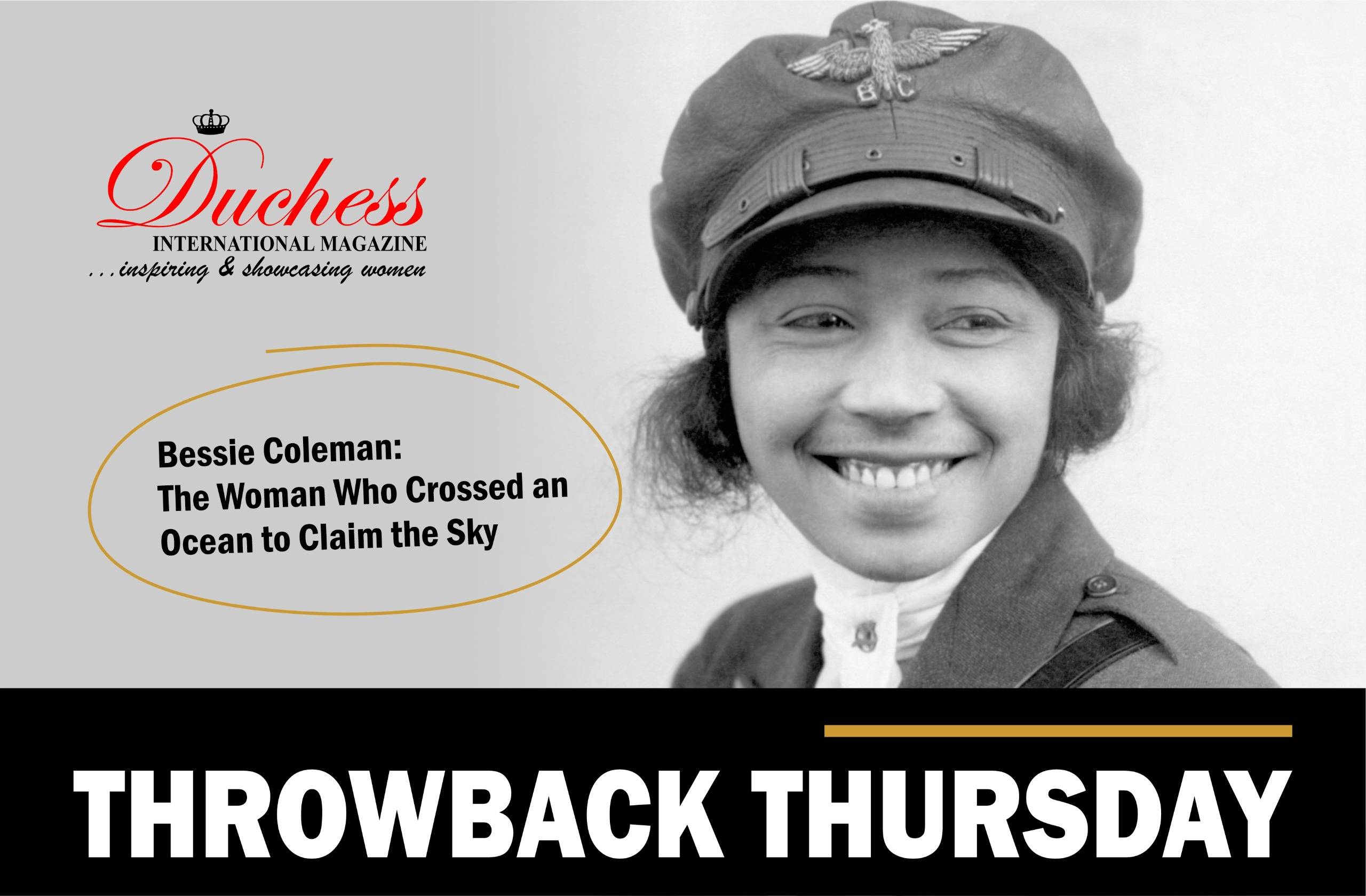
Some dreams are so powerful that even the barriers built around them cannot keep them grounded. For Bessie Coleman, the dream was to fly. Born on 26 January 1892 in Atlanta, Texas, she grew up in a society where racial segregation and discrimination sharply restricted opportunities for Black Americans, particularly women. Yet she imagined a future far beyond the limitations imposed on her. At a time when aviation was still a developing industry, Coleman set her sights on becoming a pilot, determined to claim a place in a field that had little room for someone like her.
After moving to Chicago in 1915, Coleman worked as a manicurist, eventually becoming well known for her skill. Her interest in aviation grew after hearing stories from returning World War I pilots and conversations with her brother, who had served in France. When she attempted to find flight training in the United States, American aviation schools refused to admit her because she was both Black and a woman. Rather than abandon her ambition, she sought advice from Robert S. Abbott, publisher of the influential Chicago Defender, who encouraged her to pursue aviation training in France.
Coleman took the advice seriously. She learned French, saved money and secured financial support to make the journey across the Atlantic. In November 1920, she travelled to France and enrolled at the Caudron Brothers School of Aviation in Le Crotoy. The training was demanding, but she persevered. On 15 June 1921, she earned her international pilot’s licence from the Fédération Aéronautique Internationale, becoming the first African American woman to achieve the distinction. She was also recognised as the first woman of Native American descent to hold an international pilot’s licence.
Returning to the United States, Coleman received considerable attention for her achievement. However, obtaining her licence was only the beginning. She wanted to become a professional exhibition pilot and knew she needed additional training to perform safely. She returned to Europe, training in France and Germany, including with experienced military pilots. By September 1922, she was ready to make her first public flight in the United States. She soon became known as “Queen Bess”, thrilling audiences with daring aerial manoeuvres, including loops and figure-eights.
Her performances were not simply about entertainment. Coleman understood the significance of her visibility in an industry that had largely excluded Black people. She insisted on performing before desegregated audiences, refusing to participate in shows where Black spectators were denied equal access. She also used her growing public profile to speak about aviation and encourage African Americans to consider flying. Her ambition extended beyond personal success: she wanted to establish a flight school where Black men and women could receive the training and opportunities that had been denied to her.
Tragically, Coleman never lived to see that dream fulfilled. On 30 April 1926, during a practice flight in Jacksonville, Florida, she was killed after falling from an aircraft. Her death, at just 34, brought an abrupt end to a pioneering aviation career. Yet the ambition she had carried across the Atlantic did not disappear with her. In the years that followed, Black aviation organisations, pilots and flying clubs invoked her name and continued the work of expanding opportunities for African Americans in aviation. Her influence became part of a much larger movement challenging racial exclusion in the skies.
Nearly a century after her death, Bessie Coleman’s place in aviation history remains significant. She crossed an ocean because the doors available to her at home were closed, earned a licence that challenged the boundaries of her era and used her achievement to encourage others to follow. Her story is not simply about a woman who learned to fly; it is about someone who refused to accept that race or gender should determine the limits of her ambition. This Throwback Thursday, we remember Bessie Coleman (1892–1926), the pioneering aviator who did not wait for permission to claim the sky.

