

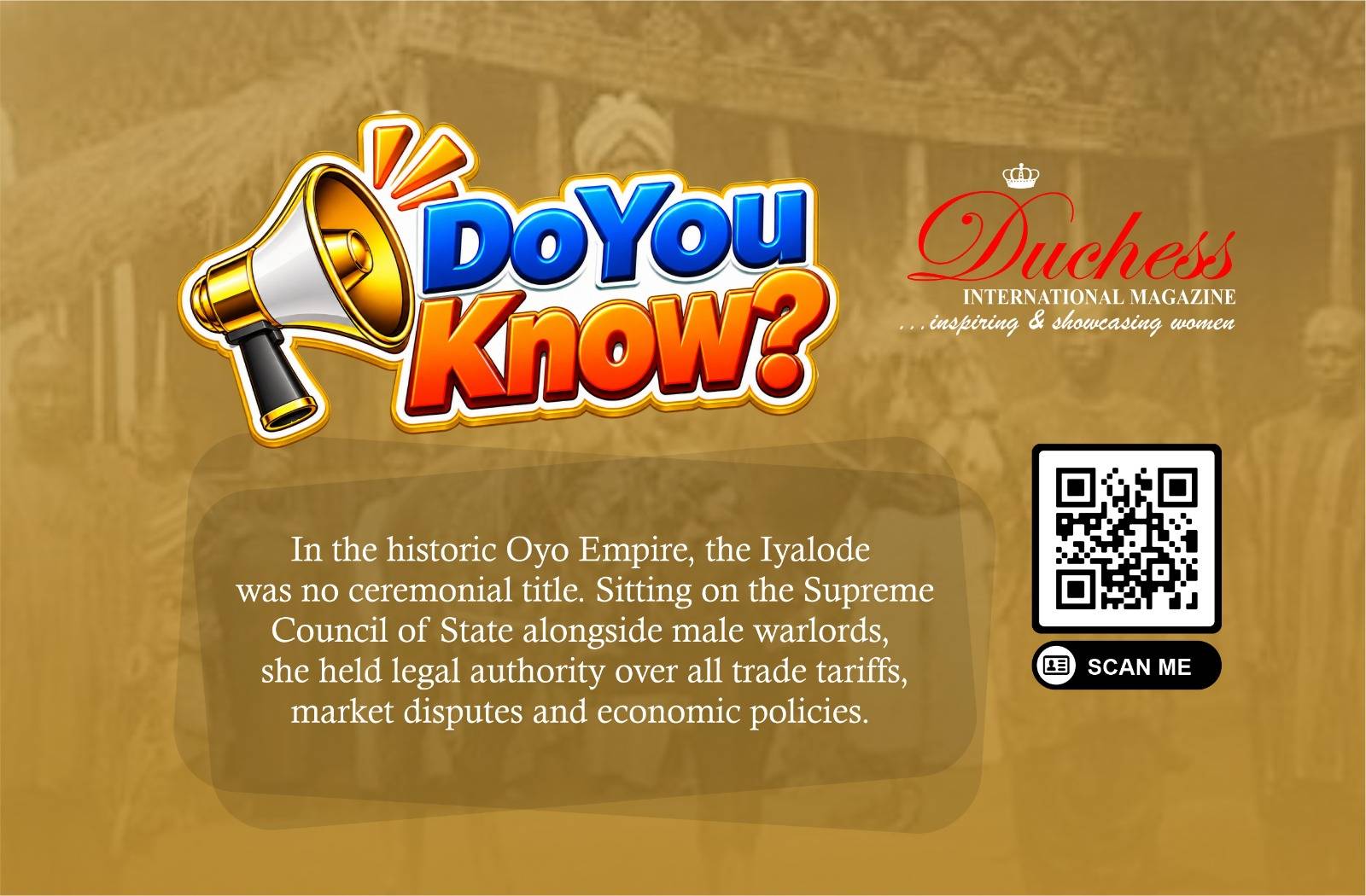
In Yoruba history, leadership was not always a position reserved for men, and one of the most remarkable examples of female authority was the office of the Ìyálóde. Far more than a title of prestige, the Ìyálóde represented a respected female chief whose influence extended into political affairs, commerce, community leadership and the representation of women’s interests. In several Yoruba kingdoms, she occupied a significant position within the traditional hierarchy, demonstrating that women could hold recognised authority and participate in the structures through which society was governed. africaknowledgeproject.
The title Ìyálóde is commonly associated with the leadership and representation of women in public affairs. The holder was often a distinguished woman whose wealth, influence, leadership ability and standing within the community earned her the position. She served as an important intermediary between women and the traditional authorities, bringing their concerns, grievances and interests into the wider political space. In some Yoruba communities, the Ìyálóde held a seat among the chiefs and could contribute to discussions concerning the affairs of the town. Her presence represented an established avenue through which women could participate in traditional governance. africaknowledgeproject.
Commerce was another important sphere in which the influence of prominent Yoruba women was visible. Women played significant roles in local and long-distance trading networks, and market leadership was an important part of the traditional economic structure. The Ìyálóde was closely associated with the interests of market women and female traders, although market administration could also involve other titled officials depending on the particular Yoruba kingdom. These institutions demonstrate how economic influence could translate into social standing and political authority, allowing accomplished women to shape community affairs beyond their individual businesses.
Among the historic women who made the office particularly memorable were Ẹfúnṣetán Aníwúrà of Ibadan and Madam Tinubu of Abeokuta and Lagos. Both became prominent figures in nineteenth-century Yoruba political and economic life. Ẹfúnṣetán was known for her considerable wealth and influence in Ibadan, while Madam Tinubu became a formidable trader and political figure whose influence extended into the affairs of Abeokuta and Lagos. Their stories illustrate how commercial success, political connections and leadership could create significant authority for women within societies where formal power was often dominated by men. africaknowledgeproject.
The history of the Ìyálóde also challenges simplistic assumptions about women’s participation in African political systems before colonial rule. Yoruba political structures differed from one kingdom to another, and the authority exercised by women was neither uniform nor unrestricted. Nevertheless, historical records demonstrate that female chiefs could hold recognised positions, represent constituencies, influence public affairs and participate in traditional systems of governance. The office reminds us that African history contains complex political institutions and leadership traditions that cannot be adequately understood through a single narrative of male authority.
Today, the title Ìyálóde continues to hold cultural significance in Yoruba communities, honouring women whose leadership, contributions and standing command respect. Its historical legacy offers an important reminder that women’s influence in business, governance and community affairs has deep roots in African societies. Long before modern conversations about women in leadership became widespread, accomplished Yoruba women were building wealth, representing their communities and occupying positions of authority. The story of the Ìyálóde is therefore not simply a history of a traditional title; it is a story of leadership, influence, enterprise and the enduring place of women in Yoruba heritage.

