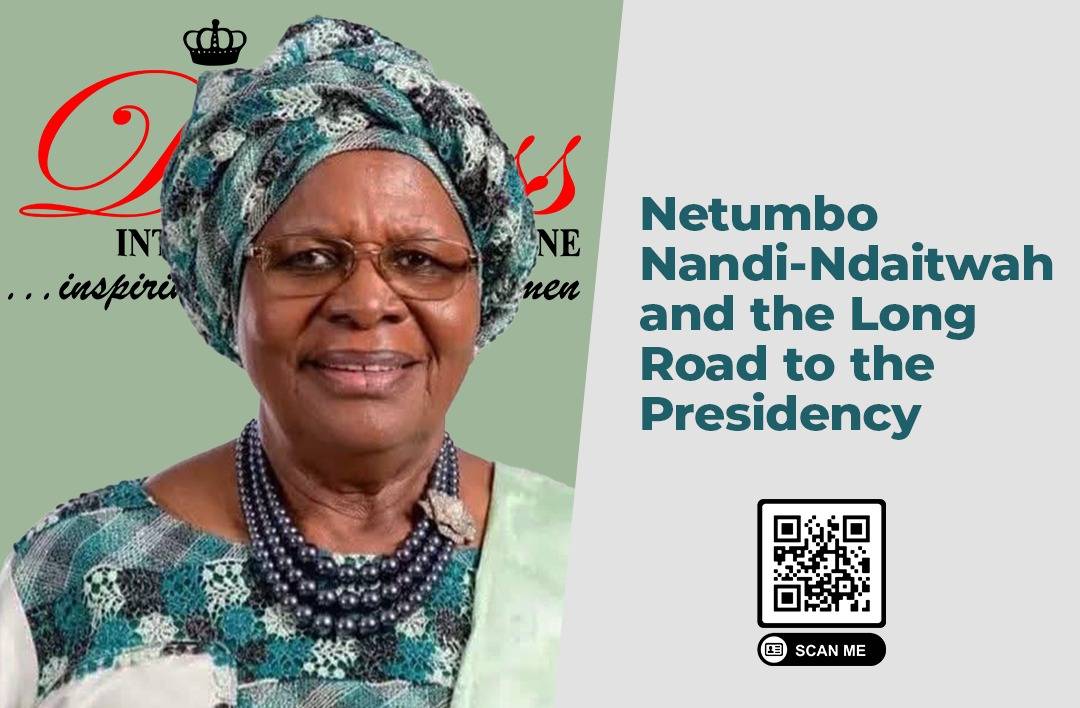
For Netumbo Nandi-Ndaitwah, the road to Namibia’s State House did not begin with an election campaign. It began when she was 14 years old. In 1966, as Namibia was still under South African rule, Nandi-Ndaitwah joined the South West Africa People’s Organisation, better known as SWAPO. Almost six decades later, on 21 March 2025, she stood before the nation and took the oath of office as Namibia’s first woman president. Between those two moments lies a political career that spans liberation, exile, diplomacy, government and party leadership. Her presidency is therefore not the story of a newcomer suddenly reaching the top. It is the culmination of a political life that began in adolescence and developed through nearly every layer of Namibia’s modern political history.
Born on 29 October 1952 at Onamutai in what is now the Oshana Region, Nandi-Ndaitwah grew up in northern Namibia in a family shaped by both religion and traditional culture. Her political awakening came while the country was still under apartheid-era South African administration. By the early 1970s, her involvement with SWAPO had become serious enough to attract the attention of the authorities. She served as chairperson of the SWAPO Youth League in northern Namibia between 1972 and 1974 and was arrested for her political activities. In 1974, she left Namibia and joined SWAPO in exile. That departure changed the trajectory of her life. What followed was not a brief period of activism but decades of political work in which she represented the liberation movement abroad while helping build the diplomatic case for an independent Namibia.
Exile became an education in international politics. Nandi-Ndaitwah served as SWAPO’s deputy chief representative and later chief representative in Lusaka, Zambia, before becoming the organisation’s representative in East Africa and to the Organisation of African Unity’s Liberation Committee in Dar es Salaam. She was part of SWAPO’s international efforts to advance the Namibian independence cause and addressed the United Nations as early as 1974. Her work placed her inside the diplomatic machinery surrounding Namibia’s liberation struggle, far removed from the electoral politics that would eventually define her presidency. She later pursued formal studies in public administration, international relations and diplomatic studies in the United Kingdom, adding academic training to an experience that had already been shaped by years of political representation and negotiation.
When Namibia became independent in 1990, Nandi-Ndaitwah did not step away from public life. She returned to a country that was beginning the difficult transition from liberation struggle to state-building and took on a succession of government responsibilities. Over the following decades, she served as deputy minister of foreign affairs, director general for women’s affairs, minister of women’s affairs and child welfare, minister of information and broadcasting, minister of environment and tourism, and eventually minister of international relations and cooperation. In 2015, she became deputy prime minister while retaining the foreign affairs portfolio. The sequence is significant because it shows the breadth of her political apprenticeship. She moved through social policy, communications, environmental affairs and international diplomacy before reaching the highest levels of government. By the time the presidency became a realistic possibility, she had already spent decades learning how the Namibian state worked from the inside.
Her influence was not confined to Namibia’s borders. Nandi-Ndaitwah played a role in international discussions on women, peace and security and served as the African Group’s chief negotiator during preparations for the Fourth World Conference on Women in Beijing in 1995. She was also involved in the discussions that contributed to United Nations Security Council Resolution 1325 on women, peace and security, adopted in 2000. Earlier, as Namibia’s first Minister of Women Affairs and Child Welfare, she was associated with legislation including the Married Persons Equality Act of 1996 and the Combating of Domestic Violence Act of 2003. These episodes matter because they add another dimension to her political identity. Her career was built not only around the struggle for national sovereignty, but also around questions of women’s rights, equality and Namibia’s place within the international system.
Inside SWAPO, however, her journey to the presidency required another kind of endurance. In 2017, she became the party’s first woman vice-president, a position that placed her directly in the line of senior party leadership. She subsequently became Namibia’s vice-president in February 2024. Her eventual nomination as SWAPO’s presidential candidate came after decades of party service rather than a sudden political breakthrough. By then, she had been a member of SWAPO’s senior structures for much of the post-independence era. The significance of that history is easy to miss when viewed only through the lens of the 2024 election. Her presidential candidacy represented the convergence of two long careers: the activist who had joined a liberation movement as a teenager and the government official who had spent more than three decades participating in the administration of the independent country that movement helped create.
The 2024 election nevertheless presented a very different political environment from the one SWAPO had dominated for decades. Namibia went to the polls on 27 November 2024, and the election was marked by technical problems, including ballot shortages that resulted in voting being extended in some areas. Opposition parties challenged aspects of the process, while the Electoral Commission maintained that the election was free and fair. Despite the controversy, the official results were decisive enough to put Nandi-Ndaitwah in the presidency: she received 638,560 votes, the highest total among the presidential candidates, and was declared duly elected. Her victory gave Namibia its first female head of state, but it also came at a moment when SWAPO’s political dominance was showing signs of strain. The party retained power, yet its share of the vote had fallen substantially from previous elections, making the mandate more politically complicated than the headline of a historic victory might suggest.
That tension is central to understanding the presidency she inherited. Nandi-Ndaitwah entered State House with the authority of a historic electoral victory but also with a country facing serious economic and social pressures. Youth unemployment, inequality and the distribution of economic opportunity have remained major concerns, while discoveries of oil and gas and Namibia’s ambitions around green hydrogen have created the possibility of significant new investment and wealth. Before taking office, Nandi-Ndaitwah spoke of the need for what she called “radical shifts” on poverty, unemployment, land reform and wealth distribution. After her inauguration, she also emphasised economic diversification, agriculture, domestic food production, ethical governance and ensuring that Namibians benefit more directly from the country’s natural resources. The presidency therefore began with a difficult balancing act: preserve the stability associated with decades of SWAPO rule while demonstrating that stability does not have to mean standing still.
On 21 March 2025, exactly 35 years after Namibia’s independence, Nandi-Ndaitwah took the oath of office and became the country’s fifth president. The symbolism was difficult to miss. A woman who had entered the liberation movement at 14 had reached the highest office in the nation she had once fought to see become independent. But the ceremony also marked the end of the easy part of the story. Becoming the first woman president is a historical achievement; governing a country with high expectations is a different test altogether. Her administration has set out priorities around economic growth, inclusiveness, resilience, industrialisation, food security, investment and improved service delivery, while her presidency has promoted the theme of “One Heart, One Mind” and described its approach as “Not Business as Usual.” The language signals an attempt to combine continuity with change. Whether that ambition translates into measurable improvements will be one of the defining questions of her presidency.
The long road to the presidency is what makes Netumbo Nandi-Ndaitwah’s story larger than the moment of her inauguration. From a teenage SWAPO activist to a woman working in exile; from international diplomacy to Namibia’s post-independence government; from ministerial office to the vice-presidency; and finally from presidential candidate to the country’s first female head of state, her career has unfolded alongside the history of modern Namibia itself. Her presidency will ultimately be judged not by how long she waited for the opportunity, nor simply by the historic nature of her election, but by what she does with the authority she spent decades preparing to receive. The road behind her explains why she arrived at State House. The decisions she makes from there will determine what that long road ultimately means.