

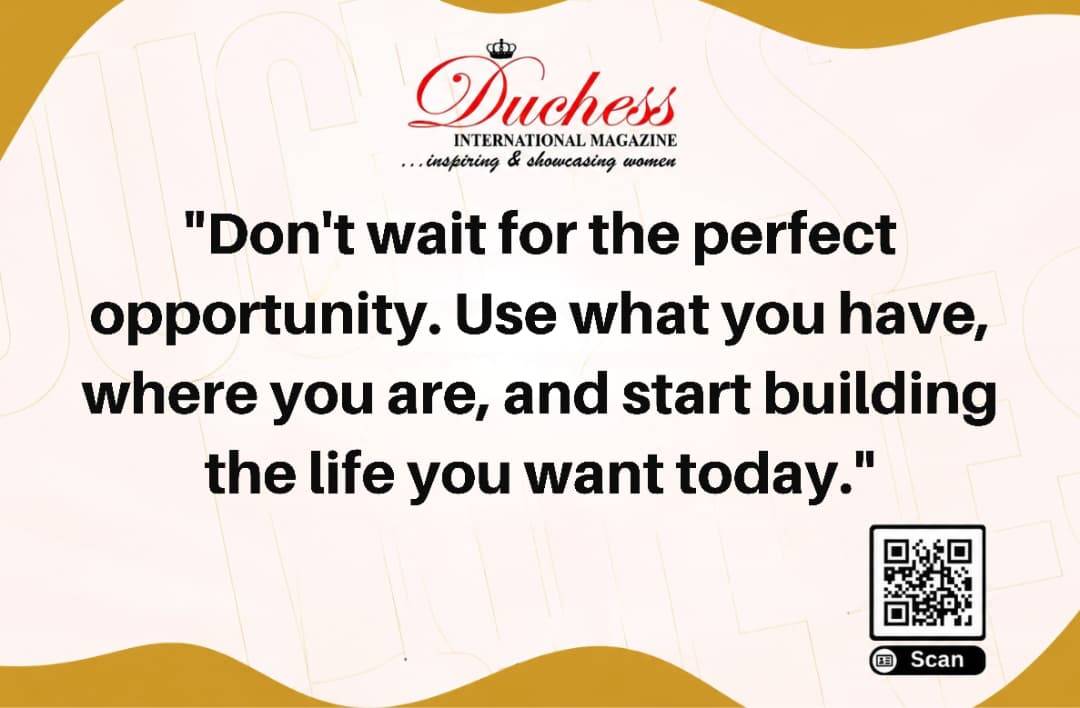
The life you want may not begin with a major breakthrough, a perfect plan or an invitation from someone who believes in your potential. Sometimes, it begins with the resources already within your reach and the decision to make something of them.
There is a particular kind of waiting that looks like preparation. You tell yourself that you will start the business when you have enough capital, apply for the position when you have acquired one more qualification, share your ideas when you feel more confident or pursue a long-held ambition when life becomes less complicated. Each decision appears reasonable on its own. After all, preparation matters, and some opportunities require resources, experience and careful planning. But when the conditions for starting keep moving further away, preparation can become a comfortable place to hide from the uncertainty of taking the first step. The problem is not that people want to be ready; it is that they can spend so much time preparing for the beginning that they never give themselves the chance to begin.
The idea of waiting for the perfect opportunity is particularly familiar in professional life. A talented employee may have ideas that could improve a company’s operations but remain silent because they are waiting for a more senior position. An aspiring entrepreneur may spend months studying successful businesses, refining a business plan and imagining how everything will look when the venture finally launches. A creative professional may have valuable work to share but keep postponing publication until the portfolio, equipment or presentation feels impressive enough. In each case, the desire to do things well is understandable. Yet there is a difference between preparing responsibly and believing that every uncertainty must disappear before progress becomes possible. The people who develop professionally are not necessarily those who begin with the greatest resources or the most confidence. Often, they are the ones who find a practical way to use what they know, test what they can do and learn from the results.
Starting with what you have does not mean pretending that limitations do not exist. Financial constraints are real, access to opportunities is unequal, and responsibilities can leave people with very little time or energy to pursue personal ambitions. It would be unfair to suggest that determination alone can overcome every barrier. However, acknowledging a limitation is different from assuming that it makes every form of progress impossible. Someone who cannot yet afford to open a physical shop may be able to test demand for a product through a smaller operation. A professional who cannot immediately leave an unsatisfying job may begin building relevant skills, documenting achievements or developing relationships that could support a future move. A person who wants to write may start with one article instead of waiting until an entire book is ready. The immediate step may be modest, but it can create information, experience and options that were not available before.
There is also a valuable lesson here about confidence. People often imagine that confidence must come before action, as though they need to feel completely capable before attempting something unfamiliar. In reality, confidence can grow through the experience of doing difficult things, making mistakes and discovering that a setback does not have to be the end of the story. The first presentation may be uncomfortable, the first business proposal may be rejected, and the first attempt at a new skill may reveal just how much remains to be learned. None of these experiences is particularly glamorous, but they provide something that endless planning cannot: direct evidence of what works, what needs improvement and what the next step should be. Waiting until you feel fearless may keep you waiting indefinitely. Learning to act while some uncertainty remains is a more practical way to develop the confidence that progress demands.
For women building careers, businesses and lives on their own terms, this distinction can be especially important. Professional environments do not always offer equal access to mentorship, funding, visibility or decision-making opportunities. Some women have to demonstrate their competence repeatedly before their ideas receive the attention others enjoy more readily. In such circumstances, being told simply to work harder or believe in oneself is not enough. Institutions must create fairer opportunities, and individuals deserve access to the support that allows their abilities to develop. Still, there can be value in recognising the forms of agency available within a difficult situation. This might mean speaking up in a meeting, requesting feedback, applying for a role that stretches one’s current experience or making professional work more visible. None of these actions guarantees immediate success, but each can help move a person from waiting to participating in the opportunities they hope to access.
Entrepreneurship offers another clear example of why beginning matters. Many successful businesses do not emerge fully formed. Their founders have to test assumptions, understand customers, adjust prices, improve products and discover which parts of the original plan are actually workable. A business idea that looks excellent on paper may struggle when it meets the realities of the market. Equally, a small experiment can reveal an opportunity that months of speculation would never have uncovered. Starting modestly can therefore be a strategic decision rather than evidence of a lack of ambition. It allows entrepreneurs to gather feedback before committing more money, time or resources than they can comfortably afford to lose. The aim is not to rush into every idea, but to create a manageable way to find out whether an idea deserves further investment. In this sense, action is not the opposite of careful planning; it is one of the ways better planning becomes possible.
Of course, not every opportunity should be pursued simply because it is available. Some require financial commitments that would put essential needs at risk, while others demand qualifications, preparation or safeguards that should not be ignored. There are also moments when waiting is wise because the timing is genuinely unsuitable or the potential consequences have not been properly considered. The distinction lies in understanding what must be in place before taking a step and what can be developed along the way. A person does not need every detail of a long-term ambition settled before making progress, but they do need enough information to make a responsible decision. The goal is not to romanticise struggle or turn every delay into a personal failure. It is to question whether the reason for waiting is a real constraint that requires a solution or an expectation of perfection that no realistic beginning could satisfy.
One practical way to make that distinction is to bring a distant ambition closer. Instead of asking when the perfect time to start will arrive, ask what can reasonably be done with the time, knowledge and resources currently available. Instead of deciding that an entire career must change at once, identify one skill to develop or one conversation worth having. Instead of waiting until a business is ready to operate at full scale, determine whether there is a safe, affordable way to test the idea. These smaller steps are not substitutes for a larger vision; they are how a larger vision can become more concrete. They also make progress easier to evaluate. Once something has been attempted, there is a result to examine, a problem to solve or a new direction to consider. The ambition stops existing only in the imagination and begins to take shape in the world.
The reminder from Duchess International Magazine is simple: do not let the search for perfect conditions prevent you from making meaningful use of the conditions you have. The resources available today may not be everything you need for the future, and the first step may not look impressive to anyone watching from the outside. That does not make it insignificant. A career can develop through one well-considered application, a business can grow from a small and carefully tested idea, and a personal ambition can move forward through consistent work that nobody else sees. Progress is not always dramatic, and beginning does not guarantee that everything will work out as planned. What it does offer is the possibility of learning, adjusting and moving closer to the life you hope to build. You may not be able to choose every circumstance surrounding your beginning, but where a meaningful and responsible first step is available, you do not have to wait for perfection to take it.

